Wikipedia Issues and Sathya Sai Baba
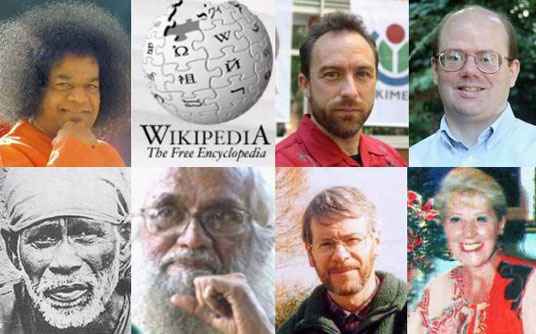
Top row: Sathya Sai Baba, Wikipedia logo, Jimmy Wales, Larry Sanger
Bottom row: Shirdi Sai Baba, Basava Premanand, Kevin R. D. Shepherd, Dr. Marianne Warren
Author's note: the image of myself was included in the cluster above in 2007, because I had recently been zero-rated by sectarian activities on Wikipedia for lacking a web presence. See Kevin R. D. Shepherd Bibliography
CONTENTS KEY
4. A Wikipedia Self-Publishing Issue
5. The Other Side of the Argument
6. The Findings document and Dr. Marianne Warren
7. Pro-Sai Activist Gerald Joe Moreno (Equalizer)
8. Web Tactics of Pro-Sai Activism
9. Anomalies and Testimonies of Sexual Abuse
10. Duke of Edinburgh Award Scheme
11. Aftermath
Kevin R. D. Shepherd in response to Gerald Joe Moreno
PRELIMINARY STATEMENT
I have never been a contributor to Wikipedia, and remain sceptical of the editorial process in that online encyclopaedia. The public relations policy of Wikipedia is deficient. That project, comprised of largely pseudonymous editors, is noted for changing article contents. The administration take no due responsibility for problems that frequently arise. Wikipedia has contributed to widespread confusions, including those generated by sectarian interests detectable amongst Wikipedia editors. In my own case, a pro-sectarian Wikipedia User page gained prominence on Google in 2006, furthering a strategy of stigma created by an American spokesman for the Sathya Sai Baba sect. That afflicting Wikipedia page was influential for over five years before being deleted by Jimmy (Jimbo) Wales, the leader of Wikipedia.
I have never been a devotee of Sathya Sai Baba, and never had any connection with the Sathya Sai Organisation. I remain unconvinced by the hagiology of that movement, instead being a critic of Sathya Sai Baba (d.2011), who is the subject of strong allegations about sexual abuse. Other drawbacks are also well known in this instance, including contested miracle lore.
I became one of the victims of an aggressive apologism occurring in the American branch of the Sathya Sai sect. This phenomenon is referred to below as Pro-Sai activism, demonstrated by SSS108 (alias Equalizer, real name Gerald Joe Moreno). In other directions, I have found much of relevant interest in the ex-devotee accounts. However, I do not agree with all the extraneous beliefs, idioms, and activities of ex-devotees, e.g., "new age" beliefs. In short, I am an independent analyst.
Jimmy Wales is a prominent internet figure diversely celebrated and criticised. A member of the Wikimedia Foundation Board of Trustees, his overall position has substantially exceeded that capacity. He has compared his own role on Wikipedia to that of a monarchy. If a difficulty arises, "I have the power to go in and resolve it, but usually just suggest a vote." He made a resolving action in my favour, personally deleting an influential User page (of activist editor SSS108). The offending page was created in 2006 against my publishing output, comprising annotated books.
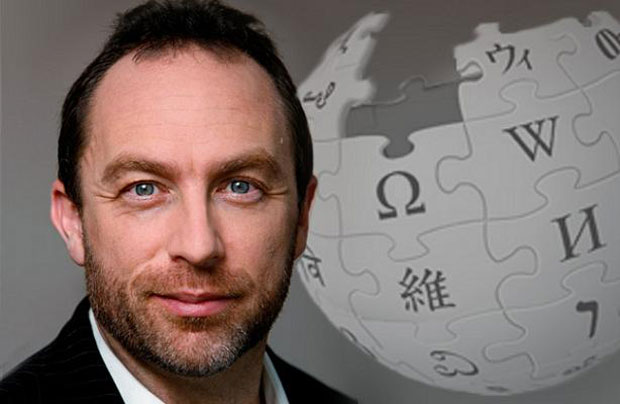 Jimmy Wales deleted the SSS108 User page |
There are some aspects of the Wikipedia process that invite critique (including the sectarian activist issue in which Jimmy Wales intervened). Wales himself has stated that the average age of contributors on Wikipedia is 26, a fact arousing objection in some sectors. More specifically, the pseudonymous nature of editing has produced strong reactions. In known instances of a sectarian activity on Wikipedia, the criticism can become very pointed.
There are some real name editors on Wikipedia. Two of these came out in my favour at the time of an attack originating from pseudonymous sectarian editors in 2012. In particular, the academic philosopher Simon Kidd strongly supported my output against suspect forms of dismissal, himself having read my books. Even while Kidd was making his articulate defence, and while Jimmy Wales was deleting the SSS108 User page, certain editors were noticeably belligerent and confusing. These attackers sustained attitudes from an earlier phase, in which American editor Dazedbythebell (Christopher Ott) employed SSS108 attack blogs against my profile on Wikipedia. American devotees of Meher Baba (d.1969) were here the basic problem, duplicating the hostility of SSS108, an aggressive supporter of Sathya Sai Baba who gained the dire reputation of a full time cyberstalker.
The existence of such sectarian presences on Wikipedia, employing libels, slurs, and other forms of aggression, is a very suspect dimension of internet activity. My argument is that the harassment does not belong in an encyclopaedia.
The SSS108 (Equalizer) attack blogs included a sectarian dismissal of two academic editors on Wikipedia. My references to these entities were depicted as comical citations, a description convenient to the sectarian stance in denying any validity to support for my books. One of these academics (Dr. M. E. Dean) encountered problems with a sectarian attitude, afterwards disclosing his real name on Citizendium. This was six months before SSS108 (Gerald Joe Moreno) chose to deny this academic any tangible identity. The sectarian apologist even duplicated his misleading version of events on a notorious attack cycle at blogspot.com.
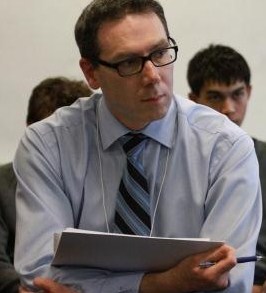 Simon Kidd, real name Wikipedia editor |
The second academic was denied all relevance by SSS108 in the claim to an Australian university milieu. Simon Kidd (of Australia) subsequently disproved the aspersions of SSS108 by revealing his bona fide academic background at the University of Western Australia. Yet the attacker continued to display on the web his misleading blog caricatures, evidently hoping that readers would believe his erroneous suggestions (Moreno is reported to have died in 2010).
My misgivings about Wikipedia, created by years of affliction, were not diminished when the administrator Smartse commenced a Noticeboard attack against me in early 2012. This hostility, following on from the aggression expressed by two Meher Baba supporters, resorted to a deceitful ploy suggesting that I was a New Age writer/publisher. This contrived stigma is not confirmed by either my books or my websites. The present website alone is proof to the contrary, featuring as this does an abundance of entries in clear opposition to New Age commercial strategies of the Findhorn Foundation, the Stanislav Grof psychedelic/holotropic doctrines, and other suspicious trends, including the Wikipedia platform conducive to sectarian strategy. That disposition of mine is obvious to fair assessors removed from the Smartse agenda.
What follows below is a description of some features involved in the SSS108 drawback, and arguments extending from the deficiency. For readers who find long articles difficult, a brief version of a related web contribution is available at Wikipedia Misinformation. Concerning the longer versions, close assessors of the material have concluded that warnings are pressing for the real name population, whether academic or citizen, in the avoidance of injury from pseudonymous misrepresentation.
University academics have been very critical of Wikipedia articles. Those entries are best viewed as starting points for research rather than the final word on the subject discussed. Authorship of Wikipedia articles is clouded by the anonymity enveloping the vast majority of contributors. The accompanying talk (or discussion) pages are noted for squabbles; the "edit wars" early became notorious. Edited by whom? Contradicted by whom? The reader does not usually know the answers to such pertinent questions, only in terms of pseudonyms.
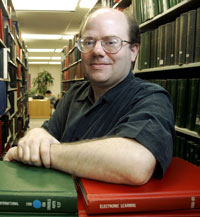 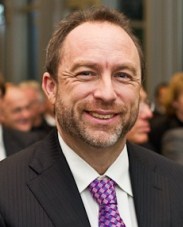 A big divide: Larry Sanger, Jimmy Wales |
The Wikipedia project was launched in 2001. However, the two American co-founders soon disagreed over particulars. Larry Sanger left Wikipedia after the first year. He is on record as saying that by the summer of 2001, the new online encyclopaedia was being overrun by "trolls" and "anarchist types." Sanger proposed a stronger role for proficient real name editors; his outlook is now associated with academic primacy. Whereas his rival Jimmy Wales (the continuing Wikipedia leader) represents the open-handed "anyone can edit" stance.
Sanger developed the rival project known as Citizendium, in an attempt to eliminate controversial problems. He has complained that his own involvement in Wikipedia disappeared on the Wikimedia Foundation records in 2004, when Wales began to be presented as the sole founder of Wikipedia. See "Wikipedia stand-off in the search for online truth," Financial Times Magazine, November 11/12, 2006, pp. 24-28.
The official Wikipedia policies have come under strong criticism. See also Wikipedia Flaws. In 2008, the article entitled Criticisms of Wikipedia aroused much interest. That compilation included such headings as:
Wikipedia contains incorrect, misleading, and biased information.
Wikipedia over-emphasises popular culture and under-emphasises scholarly disciplines.
Wikipedia disrespects and disregards scholars, experts, scientists, and others with special knowledge.
Wikipedia's culture of anonymous editing and administration results in a lack of responsible authorship and management.
In this compilation (from Wikipedia Review), there were such accompanying statements as: "Many of Wikipedia's articles are unsuitable for scholarly use. Because of poor standards of sourcing and citation, it is often difficult to determine the origin of statements made on Wikipedia in order to determine their correctness."
Another due complaint is made: "Wikipedia implements no controls that distinguish mature and educated editors from immature and uneducated ones." Not surprisingly perhaps, "this has driven most expert editors away from editing Wikipedia in their fields." Yet even more alarmingly, "Wikipedia's 'anyone can edit' culture has allowed baseless defamation of various individuals to spread widely through the internet."
One contention relates to the many Wikipedia articles tending to glorify "cult" figures, or to describe these without adequate critical paraphernalia. An attendant reservation is that any objector could too easily find himself (or herself) arguing with the anonymous representative of a dogmatic sect or underground organisation of "cult" tendency. There are also other forms of suspect organisation resisting critical appraisal.
Extreme difficulties are inherent in correcting Wikipedia processes of misinformation. This problem is described by such analysts as Anthony Judge, a computer expert and researcher who was critical of consequences visible in "the emergent values of an 'open society' model." See Abusive Wikipedia Biographical Editorial Process. The article is dated 14/03/2007, conveying how Judge was unable to correct erroneous information appearing on Wikipedia in March 2007. There were other complications arising which offset any element of technical skill. Judge observes that, for instance, "there was no obvious complaints procedure - no ombudsman-type service, no help service." One conclusion is: "Wikipedia is building up a reservoir of incorrect articles."
Anthony Judge ends with the information: "At the time of writing, 'scandals' relating to the Wikipedia editorial and arbitration process - notably with respect to biographical entries - were being widely reported in the media." One protester was only able to get his bio entry corrected through his personal connection to the Wikipedia founder Jimmy Wales.
|
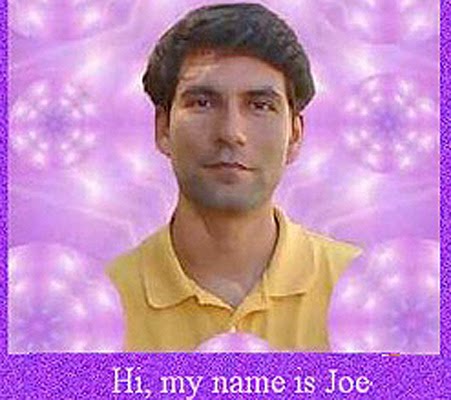
SSS108, alias Gerald Joe Moreno (blog name Equalizer), only known image |
The present article includes my complaint at editorial processes resulting in a Wikipedia User page being mounted against my books and publishing project by a zealous sectarian using the pseudonym of SSS108. That User page, dated October 2006, appeared on Google Search to my disadvantage. SSS108 was evidently campaigning against me, although I had never mentioned him. I had never even heard of him, and did not at first know who he was. However, his role was clear enough as an editor attached to the Wikipedia article on Sathya Sai Baba.
I had no connection with Wikipedia. In 2007, I managed to contact another Wikipedia entity about the offensive SSS108 User page showing on Google. The superficial response came that the User page represented problems in deletion or replacement, not being a Wikipedia article. This despite the fact that SSS108 was indefinitely banned from Wikipedia in March 2007. The stigmatising User page continued to show on Google for several years, not being deleted until February 2012, when Jimmy Wales intervened.
This very unsatisfactory situation was attended by other drawbacks, including the appearance of closely related attack blogs composed by the same sectarian writer. Those hostile blogs were supported on Wikipedia by an affiliate of the Meher Baba movement, calling himself Dazedbythebell. This devotee (real name Christopher Ott) wished to delete a Wikipedia article about myself. He and others were successful in this attempt. The misleading and libellous blogs were also influential amongst other Wikipedia editors who failed to learn background context. The semi-literacy on Wikipedia can be stunning, facilitating troll activity.
The real name of SSS108 was Gerald Joe Moreno. This American had not written any books. He instead composed blog and website materials identified by legal experts as libellous. Moreno (of New Mexico) presented himself as the opponent of "Anti-Sai Activists," thus defining his role as a defender of Sathya Sai Baba against critics and testifiers to abuse. An applicable description of his career amounts to Pro-Sai activism (sections 7 and 8 below). See further Wikipedia Anomalies and Wikipedia Anomalies Sequel.
Sathya Sai Baba (b.1926 or later) was an Indian guru with considerable influence in his own country. His ashram at Puttaparthi, in Andhra Pradesh, attracted funds for sixty years or so. The endowments reflected a prodigious wealth, acquired from the large number of devotees in India and the West.
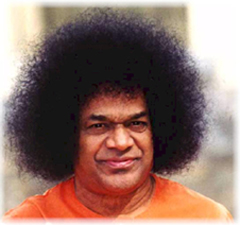 Sathya Sai Baba |
The fame of Sathya Sai was assisted by his claim to be the reincarnation of Sai Baba of Shirdi (d. 1918). That claim remains controversial, being disputed by followers of the earlier saint. The predecessor is frequently referred to as Shirdi Sai, to distinguish him from the namesake.
The Wikipedia article on Sathya Sai Baba (see Links below) has undergone marked vicissitudes and changing format. In 2006, and via this article, the pro-Sai entity SSS108 (Gerald Joe Moreno) attempted to create a cordon on Wikipedia against critics of Sathya Sai. After Moreno was banned, the article remained unsatisfactory to informed critics, often minimising adverse reports of the guru. That variable entry has described Sathya Sai Baba as "a controversial South Indian guru" surrounded by "allegations of sexual abuse, deceit, murder and financial offences" (accessed 27/03/2009). Despite a number of relevant details, the Sathya Sai Baba (SSB) article is still considered by critics to be strongly influenced by devotee beliefs.
Sathya Sai early resorted to the display of so-called miracles. These proved popular in Andhra, being regarded by devotees as proof of his divinity. In contrast, critics of these performances say that the "miracles" were sleight-of-hand tricks known and practised by magicians. Sathya Sai developed a constant habit of "materialising" sacred ash and jewellery from apparent thin air. Videos exist in which he can be seen concealing a pill of compressed ash between his fingers prior to the act of "materialisation." This guru also favoured the more elaborate practice of "materialising" from his mouth larger objects known as lingams. These displays are similarly repudiated by critics as contrivances designed to impress the gullible. The parapsychologist Erlendur Haraldsson made a controversial coverage of the "miracles." The flaws in this approach are evident.
The guru of Puttaparthi claimed to be a divine incarnation. An elaborate hagiology developed. His discourses (translated from Telegu) are celebrated in a multi-volume presentation entitled Sathya Sai Speaks. However, critics point to many inaccuracies in statements made by the guru. A well informed critic is Brian Steel, an ex-devotee who produced a major internet source on Sathya Sai Baba. See Steel, Annotated Bibliography for Research.
Devotees emphasise the charitable works of Sathya Sai, in the form of colleges and gifts to the poor. Ex-devotees are very sceptical, saying that extensive incoming funds easily allowed for such charities, mediated via the work of devotees.
Sathya Sai Baba became additionally controversial because of strong allegations made against him of homosexual abuse. Those allegations contributed to the disillusionment in Western countries, where many supporters left the movement from 2000 onwards. This drawback was spotlighted in the BBC documentary of 2004 entitled The Secret Swami. Devotees adamantly denied the allegations, following the example of Dr. Michael Goldstein, the American leader of the International Sathya Sai Organisation.
Sathya Sai Baba died in April 2011, in circumstances giving rise to further controversies. The title of an article in The Telegraph is revealing: Sathya Sai Baba's death triggers fight for his £5.5 billion empire. The precise total of his assets has differed in various reports. Wikipedia refers to the estimate of 9 billion US dollars. However, "estimates as high as 1.4 trillion rupees (about 31.5 billion US dollars) have also been made." There is the staggering fact that in June 2011, the guru's sealed private residence was opened by officials, who found gold and silver ornaments, plus the equivalent of 2.6 million dollars in cash. Concerning this personal extra, "the total value is believed to exceed 7.8 million US dollars" (quote from Wikipedia SSB article, accessed 25/06/2012).
During the guru's lifetime, the raising of funds by the Sathya Sai Organisation became an issue. This organisation claimed that funds were raised for charity. Wikipedia formerly relayed the report of an Indian news agency, announcing in 2000 that the Sathya Sai Central Trust was annually "bloated with donations worth approximately Rs (rupees) 65 crore." All donations were granted tax exemptions. In 2001, The Times reported an Indian Rationalist testimony of disbelief that the large amounts of money raised in this manner were being spent on hospitals and charitable works. The disbeliever was Joseph Edamaruku (1934-2006), the father of Sanal, another well known Rationalist.
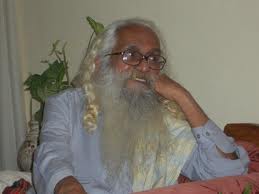 Basava Premanand |
The major Indian critic of Sathya Sai was Basava Premanand (1930-2009), who appeared in two well known British television documentaries (Guru Busters and The Secret Swami). He was in strong opposition for over thirty years, via such means as his journal The Indian Skeptic. Premanand was an amateur magician, possessing close knowledge of devices used to impress the credulous. He employed this knowledge, via his campaign, to expose the deceits involved in proclaimed miracles, principally those of Sathya Sai Baba.
In 1986, Premanand led a protest march to the guru's Puttaparthi ashram, accompanied by 500 volunteers. He was arrested by the police, the guru having very strong support in Andhra. That same year, Premanand sued Sathya Sai Baba for violation of the Gold Control Act in the purported materialisation of gold objects. The case was dismissed by the Andhra High Court, where the presiding legalist was a devotee of the guru who upheld the miracle lore. Premanand appealed on grounds that "spiritual power" is not a defence recognised in law. He was not able to break the cordon maintained by influential devotees.
Premanand subsequently founded the Federation of Indian Rationalist Associations, which toured Indian villages in a notable project of educating the public by exposing fraudulent gurus and holy men. Described by the BBC as India's leading guru buster, Premanand was honoured by the Indian government with the "highest award for the promotion of scientific values among the public" (Wikipedia quote). His book Murders in Sai Baba's Bedroom (2001) is a critical investigation of controversial events occurring in 1993. In 2009, the Wikipedia article on Sathya Sai Baba was still informing: "To date Basava Premanand has sustained injuries for severe beatings, survived four murder attempts, and has had his house burgled three times."
Other notorious details relate to deaths and murders. The June 1993 incident, known as the Sathya Sai Baba bedroom murders, became a strong topic. Very briefly, four young intruding residents at the ashram were killed, also two attendants of the guru. Sathya Sai was present in the fatal scenario. The details have been diversely portrayed. When heavily armed police arrived, they are said to have shot dead the four resisting devotees (or alienated victims of abuse). The official police report was subsequently revealed (by several sources) to contain inconsistencies. The guru was discernibly complicit in the murder of victims who wished to eliminate him. An American, namely Eileeen Weed, was present nearby. Her report is now well known on a You Tube video (Murders in Sai Baba's Mandir, Puttaparthi 1993, uploaded 2017).
There was an earlier case of alleged murder, dating to 1987, when "the body of a student at a college run by the Sathya Sai Trust was found in a semi-charred state." The Wikipedia coverage informed that this instance was officially dismissed as suicide. However, the Rationalist Narendra Nayak observed how "circumstantial evidence did not support suicide being a plausible cause of death." The police enquiry was interpreted as a farce by this critical investigator.
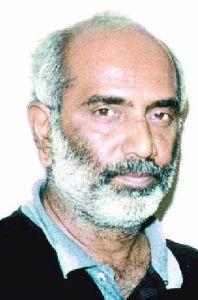 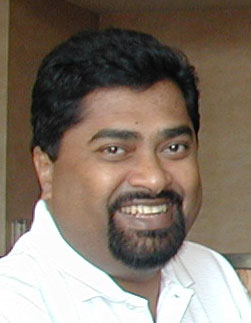 l to r: Narendra Nayak, Sanal Edamaruku |
Professor Narendra Nayak is a major Indian Rationalist from Karnataka, succeeding Basava Premanand as leader of the Federation of Indian Rationalist Associations (FIRA). Another prominent Rationalist critic is Sanal Edamaruku, who was reported by Wikipedia as saying: "The Indian media is scared of [Sathya] Sai Baba's political influence, emphasising that critics of the movement are often attacked by devotees."
Such emerging details were not in favour with devotees, though elsewhere considered of grave significance. Edamaruku represents the Indian Rationalist Association (founded in 1949 at Madras), a body gaining a large membership with branches in different parts of India. Like FIRA, this organisation has been involved in a media struggle against superstition.
In 2005, Edamaruku wrote a letter to President Abdul Kalam, demanding criminal investigation against the guru of Puttaparthi. The letter was not answered by the politician, a partisan of Sathya Sai. Indian critics say that the Puttaparthi "empire" was based on money laundering. A Rationalist complaint refers to Sathya Sai in terms of "his crimes and the damage he has done to the Indian society" (India would have been a better place without Sathya Sai Baba). See section 11 below.
An American defender of Sathya Sai Baba mounted an aggressive campaign against ex-devotees and critics. Gerald Joe Moreno, alias User SSS108, attempted to create a cordon on Wikipedia against opponents of Sathya Sai Baba. However, Moreno himself was decisively banned by Wikipedia arbitrators, as the consequence of a vote occurring in March 2007.
Moreno became notorious for attempting (in 2006) to remove the article on Robert C. Priddy from Wikipedia files. This entry was subsequently updated. Years after the Moreno episode, the Priddy article was deleted in 2012 by a new editor who showed no awareness of background context. In this way, the history and significance of online events is eliminated by the Wikipedia flux of irresponsible actions. Robert Priddy is notable as a major critic of Sathya Sai Baba, formerly a devotee for nearly two decades, based in Norway.
Moreno made accusations against Priddy such as “vanity publishing,” lack of notability, and lack of references. This attack was designed to render invalid the substantial web data supplied by Priddy. The Moreno accusations were not at all convincing in view of Robert Priddy’s academic background, his former long-term salience in the Sathya Sai Organisation (Norway branch), also his industrious use of relevant information pooled from numerous sources. Moreno had no academic background whatever, and no career as an author; he was a pseudonymous blogger and obscure Wikipedia editor.
The Wikipedia article on Robert Priddy was twice subjected to arbitration because of the Moreno stigma. Some uninformed onlookers were led to believe that Priddy's contribution was irrelevant. However, certain Wikipedia editors concluded that the situation was one of partisan zealotry attempting to suppress a leading dissident who had created several web sources promoting a critical view of Sathya Sai Baba. The contested article on Priddy became a subject of exasperation. The situation was eventually resolved in favour of Priddy by Wikipedia administrators. The disputed article was now supplemented with documented references.
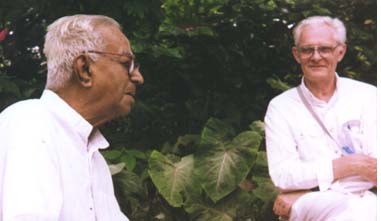
l to r: V. K. Narasimhan, Robert Priddy in 1998
The credentials of Robert Priddy (b.1936) were firm. Of British nationality, he researched and taught philosophy and sociology at the University of Oslo during the years 1968–85. His various scientific writings were published by that University. All the academic writings of Priddy (formerly listed on Wikipedia) were recognised as publications by the University of Oslo (Oslo Institute for Social Research) at either the Institute of Philosophy or the Committee for Examen Philosophicum. His major contribution was Communication and Understanding: textbook in semantical and logical analysis and the philosophy of science (Oslo University 1982; new edns 1983, 1985). This work was used by Priddy to set exams for his students.
In the early 1980s, he and his wife became leaders of the Sathya Sai Organisation in Norway. Like many other devotees, Priddy was misled by the copious propaganda encouraged at the Puttaparthi ashram in Andhra Pradesh. The benign teaching of "Love All Serve All" transpired to be deceptive. The Sathya Sai colleges and distributions to the poor at first seemed very impressive. Under such influences, Priddy lost track of scientific objectivity, as he subsequently admitted. He wrote many articles in Sanathana Sarathi, the official magazine of the Sathya Sai Organisation. In subsequent years, he did not consider those contributions to be appropriate.
In the fervour of devotionalism, Priddy also wrote the well known partisan work Source of the Dream: My Way to Sathya Sai Baba (1994). This book was first published at Bangalore as The Source of Dream. The Puttaparthi ashram was keen to sell this contribution from a Western academic. That book was cannily taken over by Weiser in 1998 under the new title Source of the Dream. Meanwhile, Priddy's friendship with the prominent devotee V. K. Narasimhan was the source of disquieting doubts. Narasimhan (d.2000) was an ex-journalist resident at the ashram; he was the close servitor of Sathya Sai, also former editor of the guru's monthly journal. Narasimhan was also subject to moods of deep reflective honesty, in which he made revealing disclosures about various events relating to the guru. Priddy recorded his conversations with Narasimhan in notebooks, which he published on the web (formerly online at www.saibaba-x.org.uk/16/index.html).
The cues from Narasimhan (who remained a devotee) caused Priddy to question the role of Sathya Sai. Internet contributions from David Bailey, and other ex-devotees, confirmed the underlying problem. In 2000-2001, Priddy resigned his official role in the Sathya Sai Organisation. He afterwards commenced to negate his partisan writings with internet warnings and disclosures, notably World-Wide Exposure of Sexual Abuse and Sathya Sai Baba (formerly online at saibaba-x.org.uk/6/saisex1). Those warnings were the major subject of appendix three in my book Investigating the Sai Baba Movement (2005). The material was proscribed by Wikipedia editor SSS108 on a notorious User page.
Ex-devotee Priddy was subject to death threats from Sathya Sai devotees. A relevant You Tube video is entitled Robert Priddy interviewed on how he became disaffected, 2017). He maintained several critical websites about Sathya Sai. He also contributed the lengthy dissident work End of the Dream: The Sathya Sai Baba Enigma. Collected Articles of Robert Priddy (2004). This book is a very informative collection of internet articles relating to Sathya Sai Baba, published in India by Basava Premanand at the latter’s special request. Premanand (d.2009) was the major Indian critic of Sathya Sai Baba (section 2 above), a leader of the growing contingent known as Indian Rationalists.
The tag of vanity publishing was a sectarian resort deployed by Gerald Joe Moreno as a desperate foil to the strong wave of critics who resisted cyberstalker intimidation and simplistic devotee emphases. Priddy here became a "vanity publisher," a tag that was transferred to me by association when I published data supplied by Priddy and Premanand. To Moreno, Premanand and the Indian Rationalists were "Anti-Sai" heathens. Moreno hated the industrious Priddy more than anyone else.
When Moreno attempted to suppress Priddy on Wikipedia, influential American devotees were in evident fear of the increasing "exposé" websites (and blogs) of Priddy and other ex-devotees. Moreno adopted the counter-strategy of "exposing" all critics of Sathya Sai, a move which aroused strong scepticism.
Moreno opted to deny all validity to the Priddy-Narasimhan interchanges, depicting these as mere hearsay. Moreno unconvincingly argued that because Narasimhan was a staunch devotee, Priddy must be wrong in reporting the reservations of the former. This is a dogmatic standpoint. Narasimhan's former role as a prominent journalist had left him with a cynical disposition, in addition to his more recent devotional attitude. The oppositions could live side by side, as in other known psychological instances that are not dissimilar. Indeed for a time, Priddy himself seems to have been subject to the same form of dual outlook before extricating himself from the movement. Priddy contributed the detailed article Narasimhan and faith-shaking events (formerly online at saibaba-x.org/16/VKN_faith_shaking_events). Also relevant is Sathya Sai Baba Bedroom Murders (saibaba-x.org.uk/8/Sathya_Sai_Baba_bedroom_murders). See also The Case of V. K. Narasimhan.
An extremist resort of Moreno was to depict Priddy as a drug advocate. This amounted to a typical diversion and an insidious libel. The vehement form of accusation was based solely upon former writings of Priddy appearing on the web in the 1980s. The accusation was initially countered by the Wikipedia editor (and ex-devotee) Martin Alan Kazlev in Moreno slander against Robert Priddy (2006, formerly online). This article was also entitled Gerald "Joe" Moreno on Wikipedia, and refutation of his allegations against Robert Priddy. Kazlev explains that this issue arose because of links made to the Wikipedia article on Priddy, including a link deviously added by Moreno which led to one of his own agitating webpages.
Kazlev adds that Moreno "objected to my pointing out [that] his page attacking Robert Priddy was ad hominem." The same commentator also emphasises: "Notice the bitter, angry, and insulting tone in Moreno's writing." This tone was pervasive in the Moreno web corpus. Kazlev remarks that the problem "is typical of many abusive devotees of cult figures everywhere." The response of Moreno to the criticism of Kazlev was to hound the latter also.
The Kazlev article described the attempt of Moreno to depict Priddy unfavourably, on the basis of his taking LSD in 1963 as a university student volunteer in an official investigation project. Robert Priddy stated on the web that his dose of LSD-25 was provided by the Norwegian Minister of Health for experimental purposes. Priddy subsequently composed three documents describing his LSD experiences, which he placed online in the 1980s. These writings remained on the web while he was a devotee of Sathya Sai; he deleted them at the end of his devotee phase.
As a critic of LSD, I questioned the relevance of these writings. Priddy told me in 2007 that he had long outgrown the eulogies, to which he had added cautions. In The Psychedelic Experience, Priddy says that he did not become addicted. Moreover, his disillusionment with LSD led to his conclusion that "all psycho-chemicals of this nature should be avoided." He stresses instead the "gradual evolution of the psyche by controlled moral and mental discipline."
I do not myself agree with promotions of psychedelic experimentation. In fact, I can present strong arguments against that option. However, in cases where there is clear denial of the "spiritual enlightenment" syndrome, extenuating factors should be acknowledged by critics. Retrospective accounts of this nature are deemed relevant by some academic analysts, in that these accounts serve to offset the exuberant and misleading conclusions found elsewhere. Priddy was not a believer in "LSD spirituality," unlike many other writers on the subject of psychedelic experience. The intensity of LSD experiences is not denied by critical analysts. It is the psychoactive context of these experiences that is disputed.
Moreno argued that the warnings expressed by Priddy are trifling by comparison with the length of the documents he composed on LSD experimentation, documents which he (Moreno) reproduced on a blog without permission, in a manner designed to prove that Priddy was aberrant. The Pro-Sai tactic can prove something quite different, meaning a sectarian motivation. In 2008, Moreno was obliged to remove the appropriated documents from his blog, having infringed copyright rules.
One should respect the warning of Priddy in the same document abovecited that:
The use of biochemicals like LSD-25 to alter consciousness is like reaching for 'plastic grapes.' They do not allay one's hunger. They can also create an illusion of knowledge and power, and that can be harmful.
The Priddy version of LSD is thus very different to that of Stanislav Grof and other psychedelic enthusiasts, who interpret the "illusion of knowledge and power" in terms of an LSD "therapy" amounting to a "spiritual path" of neoshamanism. Those enthusiasts include MAPS (Multidisciplinary Assn for Psychedelic Studies), a controversial American organisation influenced by Grof (see Grof Therapy and MAPS).
LSD and cannabis (marijuana) were influences upon the late 1960s/early 1970s conversion of the "hippy generation" to Eastern religions and "new age" beliefs in various Western countries. The tendency of the Beatles to marijuana in the 1960s, under the influence of Bob Dylan, effectively set the seal upon precipitating forms of indulgence. Many of those who took up Transcendental Meditation were oriented to that controversial exercise by psychedelic experiences. LSD became a craze, so too did "Eastern mysticism." The confusions resulting in various directions are still frequently obscured.
The Sathya Sai Organisation is no exception to the need for clarity. Large numbers of neo-hippies were visiting the Puttaparthi ashram during the 1970s (and after). The major rival was the ashram of Bhagwan Shree Rajneesh in Poona, where MDMA was a favoured ingredient of the alternative diet. However, stronger drugs like LSD were a discernible factor in the creation of guru movements in the West. The prominent Sathya Sai devotee Isaac Tigrett is noted for a career of heavy drug (and alcohol) use by the time he became a supporter of the Sathya Sai Organisation in 1973. This American multi-millionaire businessman originated from a hippy background.
There are scientific implications that prolonged usage of LSD can encourage the sense of identity with "spiritual states" and paranormal phenomena strongly associated with some Hindu doctrines and sects. Even the peripheral LSD user Robert Priddy may have been influenced to that effect (however partially) by his psychoactive experience. The difference being that Priddy was later able to break the train of associations acting upon the brain.
The postscript to The Psychedelic Experience reflected some widespread 1960s beliefs that cannabis was less dangerous than alcohol or tobacco. Priddy duly added: "I am in principle against any form of drug use myself now, being convinced that no lasting good can come of it."
The older form of cannabis (marijuana) was mild by comparison with recent derivatives. However, I do not agree that the earlier form was less dangerous than other addictive substances. Priddy smoked cannabis in the 1960s along with many others of his generation. That fashionable trend is considered by some scientists to have comprised an unwise indulgence, resulting from ignorance of the potential effects which can prove detrimental to health.
The recent creation of skunk cannabis is more dangerous to many consumers, being a much stronger drug. Such complexities were neglected by the Advisory Council on the Misuse of Drugs, a prestigious British panel who erroneously declined to promote an upgrading of the cannabis risk on the grounds that the potency of this drug had altered little over the past thirty years. See also section 8 of my Response to Moreno which appears below. See further Wikipedia, Gerald Joe Moreno, and Google. See also Opposing Drug Use.
The drug aspersions against Priddy were a distraction created by Moreno. The real issue is the cogency of allegations against Sathya Sai Baba. Turning to other aspects of the Moreno-Priddy conflict, after being for years the recipient of numerous web attacks, the ex-devotee posted a series of disclosures about his opponent, commencing in 2009. For instance, there is the statement:
Moreno's daily method is to slur, vilify, and to try to scare into submission. Internet libel, in the mostly uncontrolled environment of the worldwide web, is a constant speciality of his. It is the sort of destructive mentality that the ethical teachings of religious and other paths, including [Sathya] Sai Baba's, would most certainly contradict. (Sai Baba Hatchet Man, March 2009)
The preferred anonymity of Gerald Joe Moreno should be emphasised. According to Priddy, Moreno "posted his website via an Indian third party web service to make locating his server undiscoverable to non-technical internet users; this was nonetheless traced to U.S. server lunarpages.com, where libellous websites by him are still hosted."
Priddy further complained that Moreno posted a copyright photo of him and his son Kai, refusing to remove the image when asked. Moreno used "absurd excuses" while "viciously attacking my son (who is totally uninvolved with any Sai criticism) in webpages trawling every possible association he could trace, though my son had no part in the things he [Moreno] managed to find remotely related." This episode dates to 2005, apparently the first instance of Moreno harassing an outsider to the sect.
The additional complaint was lodged against Moreno that he adopted a persistent tactic of suppressing his own web image (only one of which is known). Meanwhile, Moreno manipulated the Priddy image "in cartoon fashion." Eventually, Priddy posted the sole available image of Moreno, which the cyberstalker had deleted from his earliest website. In both this and another instance (my own), Moreno threatened copyright infringement, ignoring what he himself had done earlier with his victims (Moreno dares not show his face).
More ominous was the Priddy accusation that Moreno was a "full-time character assassinator." The two major ex-devotee targets of Moreno were Priddy and Barry Pittard (of Australia), both of whom maintained successful blogs in criticism of Sathya Sai. Moreno was contradicted in his extremist argument that these two critics could have no support from those they defend (meaning the sexually abused who provided testimonies). Priddy strongly contested such remarks, listing the Rahm family, Conny Larsson, and Ullrich Zimmermann amongst the supporters who had suffered abuse. Furthermore:
We do not release the countless emails and letters, or phone calls [from the abused], because we have most often been asked for and have guaranteed confidentiality. This is partly because many can put themselves at risk of serious consequences, i.e., those who live in or have to visit 'India').... Moreno has exerted himself stupendously to libel, spread gossip, and contradict without any evidence, more than 30 alleging victims, in his webpages, blogs, and postings on [bulletin] boards, portals, and defamatory comments galore to articles all over the internet... a despicable attempt to harm people we know to be genuine and truthful after years of contact with many of them. (Priddy, sathyasaibaba specious claims and self-defeating arguments, April 2009)
The prolific and aggressive blog output of Gerald Joe Moreno included the absurd accusation that Priddy and Pittard were "cult leaders." This can be interpreted as a superficial tit for tat response to the cult associations of Sathya Sai Baba expressed by critics. A similar excessive ingenuity was evident in the bland argument of Moreno that Priddy and Pittard had no case against the guru because they had not witnessed any abuse by him, nor been present in any such event of abuse. Priddy responded:
Acts of which people are guilty are convicted [in courts of law] by persons who were not witnesses, often only on forensic or circumstantial evidence. Sathya Sai Baba has been charged in the Supreme Court [of India], but he is protected by the Government and judiciary, and cannot be brought to book within India. Moreno seems to promote the almost pathological 'solipsistic' idea that not witnessing an event personally disqualifies one from evaluating it through the evidence and testimony, [and] following this up through contacts and questioning and reporting about the results. (Ibid)
Another pointed comment from Priddy is: "We (himself and Pittard) have been defending the weak and defenceless subjects of the sexual abuses (they have informed us about) against vicious attacks on them in [Moreno] webpages and by a massive email campaign to many of their contacts, friends and families, by Moreno himself" (ibid). Gerald Joe Moreno operated as a blog and email industry of afflicting proportions.
Priddy and Pittard also emphasised discrepancies in the situation of enormous wealth acquired by the ashram at Puttaparthi. They criticised the guru's preference for elaborate ostentation, as in the use of a gold chariot and ornate temple decorations. They cited discrepant statements of the guru in Sathya Sai Speaks such as: "Do not waste money on pomp and show." Priddy observed that Sathya Sai unveiled a life-size bronze statue of himself in the Kulwant temple complex at his ashram, this complex being a multi-million dollar development (Sai Baba Salutes his Own Statue, formerly online at saibaba-x.org.uk/1/Sai_golden_idol).
The same commentator refers to the Puttaparthi scenario of "silver motorised chariots, golden thrones, huge light displays, pomp-filled birthday and many other celebrations." In discrepant discourses, Sathya Sai criticised expensive aspects of ceremonies such as the ostentatious golden chariot of the Paduka celebrations, even asking for this to be sold. "But he continued to mount it [the golden chariot] yearly even after this disavowal." The opulent complexion of Puttaparthi ashram was reflected in the fact that by 2000, the price for a one-room flat, with minimal furnishing for up to one month, had reached 7,000 (US) dollars plus daily rental costs (Priddy, Wasteful and Extravagant Showpieces, formerly online at saibaba-x.org.uk/13/Wasteful_extravagance).
.jpg) Sathya Sai Baba |
In contrast, Moreno defended the guru against all adverse reflections. Despite this loyalist campaign, the sectarian attacker maintained a contradictory emphasis:
Joe Moreno claims he is not a follower and does not believe Sathya Sai Baba is an omniscient avatar etc. He long believed that [Sathya] Sai Baba is a sexual abuser.... He is in deep psychological denial, as his thousands of webpages/blogs/comments, and constant disruptive stalking activities of most Sai critics by him, prove to the hilt. (Priddy, sathyasaibaba specious claims, April 2009)
Moreno anonymity extended to a noticeable strategy on his major blog, entitled sathyasaibaba, at wordpress.com:
He even allows the public to think he is a substitute for sathyasaibaba, having chosen that blog title, no doubt realising that alerts and tags would appear (to the unprepared and curious public) as being from Sathya Sai Baba himself! (Priddy, sathyasaibaba scales up hate attacks on critics, March 2009)
The Priddy counter here observes that the blog sub-title Life, Love and Spirituality is at variance with the substantial entries amounting to "libel and character assassination." If this is love, then hate could be unfathomable.
The role of Gerald Joe Moreno, as a vehement defender of the Sathya Sai Organisation (SSO), led to surmisals about the context. However, Robert Priddy reflected that "whether or not Moreno is a self-appointed, unofficial deputy, or a hired undercover agent, makes little difference; his massive libel campaign passes without correction or comment from the entire [Sathya] Sai Organisation, despite their being challenged on this by prominent ex-followers" (ibid).
A more complex area of the dispute relates to the Californian lawsuit of ex-devotee Alaya Rahm in 2006.The defendant was here Dr. Michael Goldstein, head of the Sathya Sai Society of America (and also leader of the SSO). Rahm was a testifier to sexual abuse. The opposition foiled his legal action in a rather superficial manner, stating that the Sathya Sai Society were only a bookstore and not an organisation liable for prosecution. Alaya Rahm then self-dismissed the case upon the advice of his attorney, who knew that delays were in the offing.
On the web, Moreno subsequently emphasised materials in the name of Lewis Kreydick (an American devotee), allegedly supporting the Goldstein opposition. Priddy here complains that ex-devotees who visited the court in Orange County were unable to obtain the Kreydick materials, these not being available to the public. "Kreydick's submission was filed, but it was not presented in court nor was it made a public document" (ibid). Priddy claims that the supposed proofs of origin were "sheer deception" (ibid). The BBC had already investigated the instance of Alaya Rahm. Their 2004 documentary The Secret Swami was in support of the Rahm family, which included two other American ex-devotees (the parents Al and Marisa).
Priddy contends that Moreno was obliged to remove the disputed Kreydick materials from the Wikipedia article on Sathya Sai Baba. Moreno had posted those additions, but "was unable to show any receipt or any proof that the documents were ever available at Orange County Court," from which source he claimed to have obtained them, i.e., "from the court which he claimed had sent to him against payment" (ibid) Priddy also says that he challenged Moreno on Wikipedia with the conclusion: "There is no independently sourced information about the Lewis Kreydick deposition" (ibid).
Moreno employed "thousands of words and a plethora of entries in the Wikipedia discussion pages trying to defend the posting of Kreydick materials." The sectarian was afterwards banned indefinitely from Wikipedia (in March 2007), although "he tried at the time to claim he had withdrawn of his own free will" (ibid).
According to Priddy, Moreno acted as a proxy for the Goldstein party in publicising Lewis Kreydick's very dubious and simplistic claims. Moreno was originally informed of the Alaya Rahm legal case by Sathya Sai officials; no specific information about this case was available, except to attorneys and participants, until after Moreno had publicised. Priddy states: "Moreno received printed and video materials from the defending [Goldstein] party" (ibid). The implication is that either Goldstein, or the legal advisor to the Sathya Sai Society (Robert Baskin, described as a devotee), was the intermediary. The court drama, occurring in April 2006, afforded additional context to the subsequent appearance and agenda of Moreno on Wikipedia (section 4 below). The overall implication is that Gerald Joe Moreno emerged on Wikipedia as a polemical agent for the American branch of the Sathya Sai Organisation.
With regard to other legal complexities, Robert Priddy strongly contested the statements of Gerald Joe Moreno about events in India. I will here quote excerpts from an informative entry:
Moreno denies that there have been any legal grievances filed in India. Even that is false. By specifying India - where grievances of this kind could not get a hearing - he would distract all attention from the countless documented grievances, including [those] in letters sent to leaders of the Sathya Sai Organisation. He can never throw journalists or researchers off the scent in this simplistic way. It is the same tactic many [Sathya] Sai Organisation leaders have used! He [Moreno] knows that Hari Sampath petitioned the Supreme Court of India, and that it [the petition] was thrown out on a trumped-up legal technicality by judges who are Sathya Sai followers.... Moreno also knows full well that there have been many grievances with a legal basis against Sathya Sai Baba, as is fully documented in the Indian Skeptic through the years, not least court petitions by Basava Premanand....
Moreno always deviously overlooks everything which is documented but is against his agenda of denial of everything against Sathya Sai Baba.... He performs mental double backward somersaults to settle on most of his standpoints. Intimidation and bribery by [Sathya] Sai officials have so far worked to quash almost every grievance concerning sexual abuses, financial scams, and to terrorise the parents of murdered sons (in Sai Baba's bedroom). Such [intimidation] was done against Dr. Naresh Bhatia, as reported by the Daily Telegraph, and also tried against Basava Premanand and Hari Sampath, who have both survived assassination attempts. Officials even removed some court registers from the records (as in the case of the document removed by the Supreme Court of India, though a copy was kept by the petitioner, Hari Sampath). (Priddy, Sathya Sai Organisation defended by proxy, April 2009)
These reflections are pointed enough. The counter of Robert Priddy to Gerald Joe Moreno is distinctive. Priddy endured several years of ridicule before responding in the sustained manner he eventually demonstrated. For instance, he proved wrong the hostile assertion appearing on a Wikipedia talk page (in 2006) that he was dying of AIDS (a statement mediated via a colleague of Moreno). The Priddy assessment of his zealous opponent further states:
Moreno is incapable of replying to any criticism in measured terms, and now that I am at last exposing his agenda of untruthfulness, deception, spin and disinformation, he is provoked into angry carelessness and excesses. He has long since lost his grip on decent rational thinking.... He fills pages and pages with overblown trivialities and vituperative rants, and thus avoids all the genuine issues and never replies to the cogent rebuttals of his slurs and attacks. (Priddy, G. J. Moreno's 'senile dementia' slurs, avoidances and irrationality, April 2009)
Another strong repudiation of the Moreno tactic is expressed in terms of:
Gerald Moreno's constant character assassination attempts on all critics of Sathya Sai Baba, parodying them in irrelevant and adolescent ways, and relentlessly webstalking them and any family members, associates, and any of their friends whose names he can discover - is a cultist hate campaign of massive dimensions virtually without parallel on the internet today. (Priddy, The Gerald Joe Moreno Dossier Part 1, August 2009)
See also Robert Priddy Not Exposed.
4. A Wikipedia Self-Publishing Issue
The former Wikipedia article on Robert Priddy included reference to a book of mine, namely Investigating the Sai Baba Movement (2005). The title of my book does not refer to Sathya Sai Baba, but to the disputed phrase "Sai Baba Movement," employed by some academics as a blanket term encompassing different gurus and saints.
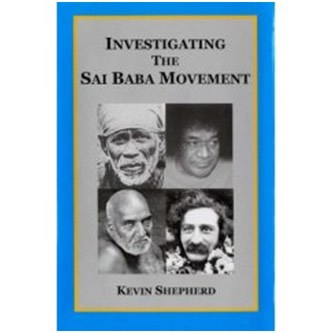 |
The book under discussion focuses upon three deceased saints of Maharashtra, including Sai Baba of Shirdi (d.1918). Some critical ex-devotee sources on Sathya Sai Baba of Andhra Pradesh are employed in the form of three appendices. The book features 480 annotations to the main text, some of these being lengthy. Further annotations apply to the appendices, making an overall total of 587 annotations. This feature has been considered distinctive in the category of self-published works, well removed from the sphere of commercial works.
My book was listed as a supporting source in the Wikipedia article on Robert Priddy, being added in June 2006 by the editor Andries (an ex-devotee). This inclusion was resented by Wikipedia editor SSS108 (Gerald Joe Moreno), who was not concerned to read the book, only to contest the secondary association with Priddy. Appendix 3 covered some materials of Robert Priddy, the major opponent and target of Moreno. This approval of Priddy meant that Kevin R. D. Shepherd also had to be eliminated from Wikipedia reference.
Moreno had evidently never read any of my books. He was only concerned with the cordoning, and attempted exclusion from Wikipedia, of his major exegetical rival in the West (namely Priddy, the Eastern equivalent being Basava Premanand, whom Moreno also detested). All critics are "Anti-Sai" deviants in this constricting worldview. The stigmatising phrase Anti-Sai was pervasive in Moreno web compositions. The Pro-Sai advocate had never written any books. His attack site saisathyasai.com was obsessed with denying relevance to all critical reports of Sathya Sai.
In October 2006, Moreno produced a Wikipedia User page attacking my publishing output, a page which became known as a sectarian attempt to eliminate relevant documentation. The stigmatising page was entitled User:SSS108/Kevin Shepherd. This document comprised a discussion between Moreno and three other contributors to the Sathya Sai Baba article (and talk page). All except one of these (four) contributors expressed biases in favour of the guru. The device used to eliminate the unwanted data was a Wikipedia quote, one which merely included reference to myself in association with Priddy. There was no attempt at due analysis of Investigating the Sai Baba Movement. Instead, Moreno opted to dismiss the entire corpus of my works as being of no consequence. Wikipedia neutrality can be a very suspect phenomenon.
The Wikipedia "quote in dispute," commencing the hostile User page, read as follows:
According to Kevin Shepherd, the former national leader of the Sathya Sai movement in Norway, Robert Priddy, expressed the opinion that Sathya Sai Baba was an accomplice to the 1993 murders, among others based on information given to him by his friend V. K. Narasimhan.
No author identity for this quote was given. Andries Krugers Dagneaux was one of the four contributors to the discussion, and the only one to express support of the quote (which apparently originated with him). Another contributor was Jossi Fresco, a prominent Wikipedia administrator who had gained notoriety amongst critics for his partiality towards sectarian/cult movements and manifestations. These entities were named as Andries and Jossi, while Moreno was identified as SSS108. The stigmatising User page was perpetuated on Wikipedia (and Google) for over five years, being inseparable from the attempt to discredit me as an "Anti-Sai" sympathiser.
The laboured discussion was weighted by Moreno in favour of finding the quote to be utterly superfluous to Wikipedia. The data contributed by Priddy was strongly implied as being too unreliable to merit inclusion, therefore any reference to this data could easily be dismissed. Furthermore, my own author validity was stigmatised by Moreno in terms of a self-publishing category amounting to "unsourced or poorly sourced controversial material." Accordingly, "this reference to Shepherd should be removed" (further details in Wikipedia, Gerald Joe Moreno, and Google).
At first I had no idea who SSS108 actually was. Then some academic friends of mine discovered his online identity as Gerald Joe Moreno (or Joe Moreno). I had received two letters from Priddy several months earlier; however, he had not mentioned Moreno or Wikipedia. Robert Priddy's first letter to me, dated 21/05/2006, contained the statement: "Thank you very much for contacting me, and not least for summarising many of my most important contentions regarding Sathya Sai Baba so succinctly and accurately in your book." He was here referring to the third appendice abovementioned. It is often important to gain confirmation that one is reproducing the views of a source informant correctly.
I did not get a further letter from Priddy until January 2007. He then apologised for his lapse, as he had been very busy and also on holiday. Priddy now mentioned Moreno, obviously being very familiar with the latter's web output. "Moreno is a person without any qualifications other than a tremendous energy and IT ability.... He [Moreno] studies every phrase [of opponents] with a toothcomb, twisting meanings and taking them out of context" (letter dated 05/01/2007).
Priddy also referred to some less obvious activities of the American blogger, describing one or two instances of harassment. I was shocked to learn that Moreno had telephoned the workplace of one victim and told "cleverly constructed lies about him being a porno site owner." What was one to make of such startling disclosures? Yet Priddy was adamant in the allegation. "That is the kind of stalking he does, by telephone (or email) worldwide to people's friends, relatives, and other contacts." Priddy identified Moreno as a webstalker (i.e., cyberstalker), a term which at that time I did not fully understand, not being a computer user in those days. Priddy credited Moreno with a computering skill, misused in the attacker's campaign against critics of the guru.
Meanwhile, the suppression of Priddy on Wikipedia was being attempted. The objective of Gerald Joe Moreno, alias SSS108, was to produce a partisan Wikipedia article on Sathya Sai Baba devoid of any complicating factor. His evident sectarian (or Pro-Sai) motivation was attended by an ex-devotee surmisal that Moreno had gained support from Michael Goldstein, the international leader of the Sathya Sai Organisation.
The repudiation, on the User page, of the "quote in dispute" mirrored two basic preoccupations of Gerald Joe Moreno. Firstly, a cardinal sin was implication of the guru as an accomplice to the disconcerting "bedroom murders" of 1993. Secondly, the prominent devotee V. K. Narasimhan was presented by Moreno, on his blogs, as one who never entertained doubts or critical perspectives that could be passed on to Robert Priddy. The diaries of the latter convey a very different picture.
Furthermore, the disjointed and quibbling discussion, on the User page of SSS108, even raised a query that Priddy was the former "national leader" of the sectarian movement in Norway. There were no quotations from my book in the proscribing User page. That book actually states: "He (Priddy) and his wife were the leaders of the Sathya Sai Organisation in Norway for some eighteen years" (Investigating the Sai Baba Movement, p. 293, lines 2-4). That particular statement is confirmed by Priddy's own report and by other ex-devotee accounts. Moreover, an extant programme brochure of the Sathya Sai Organisation in Europe, dating to 1994, describes Priddy as "national coordinator," his Oslo group being defined as the only SSO group in Norway since commencing in 1983. A link to that brochure was found in the Wikipedia article on Priddy, which Moreno attempted to eliminate.
The stigmatising User page featured Moreno's email contact with booktrust.org.uk, who could not get the details correct about an imprint (New Media Books), for which I had gained distribution rights. That was a small publishing imprint, whereas booktrust.org credited New Media as a limited company. The contemporary descent into semi-literacy is widespread, extending to the book trade. From then on, Moreno persistently repeated the error of New Media Books Ltd, also stating that I was the publisher. In fact I was only the distributor at one time. His further attribution of vanity publishing, in this context, was an excess demonstrating his acute lack of perspective.
More illiteracy was demonstrated by the University of Sheffield, the only other contact investigated by Moreno in his sectarian email strategy. He very briefly stated, on his User page, that an obscure Mrs. Barringer said she had never heard of Citizen Initiative (CI), and could find no trace of it. All she had to do was look up Nielsen Bookdata, with whom I was a paying subscriber in the early years of Citizen Initiative. Nielsen was the major publications information source in Britain. However, sectarian email ploy failed to state this basic fact on the Wikipedia User page. Amazon were also quite aware of Citizen Initiative, a fact demonstrated in July 2006, when Amazon enthusiastically but erroneously described a forthcoming publication of mine as being already in print.
Such well known and highly visible sources were complemented by the plus factor that CI was represented in both the paper and online versions of the annual Directory of UK and Irish Book Publishers. This media again related to the giant enterprise of Nielsen Bookdata (plus The Booksellers Association). That form of representation was quite sufficient for many small publishers not claiming giant status.
The inadequate email sleuthing of Gerald Joe Moreno was the basis for dismissing Citizen Initiative as being off the map. The cyberstalker was obviously motivated by suppressive agendas, whether or not being in close liaison with the notoriously evasive Michael Goldstein of California, whom the BBC had to track with a secret camera in the absence of a civilised response to pressing questions.
The Wikipedia editorial process can be strongly queried when sectarian interests are bent upon disqualifying and eliminating alternative data. That is what happened on the SSS108 User page in October 2006. Here Moreno gave the reason for dismissal (of the Wikipedia quote) in terms of data employed by me that was not published elsewhere. His terse justification was expressed as follows:
This is indicative of poorly sourced material and it will be removed for this reason, and for the reason that the section in his [Shepherd's] book that deals with Sathya Sai Baba is wholly critical with no other viewpoints.
SSS108 here failed to qualify that the section in my book dealing with Sathya Sai is in the form of appendices, following a convention in academic works that controversial material should be covered in such extensions. The Pro-Sai argument is lop-sided, amounting to exclusion of unfavoured and non-canonical sources (ex-devotee, BBC, and Indian Rationalist). In contrast, academics know (or should do) that new materials on any given subject can transpire to be relevant (or even crucial) to study of the subject.
Moreno grafted on to his loaded argument a glaring hole in the threadbare Wikipedia criteria relating to verifiability and self-published sources. Everything revolves around the key issue of "neutral point of view," supposedly maintained by Wikipedia editors and administrators.
Questionable sources were defined by Wikipedia as "those with a poor reputation for fact-checking; such sources include websites and publications expressing views that are widely acknowledged as extremist, or promotional in nature, or which heavily rely on rumours and personal opinions."
Self-published sources were granted a separate listing, in terms of both "online and paper." That means most of the websites and blogs that any reader is likely to encounter. Self-published media are defined as "books, newsletters, personal websites, open wikis, blogs, Internet forum postings, etc." These media were stated to be "largely not acceptable" for Wikipedia entries. Exceptions were evidently envisaged and endorsed, though subject to skeletal deliberations that can too easily miss the point in slipshod usage and sectarian ploys. "If the information in question is really worth reporting, someone else is likely to have done so." That guideline is very misleading, because some self-published books are known to have contained substantial relevant material not found elsewhere. For instance, my own book Investigating the Sai Baba Movement included material relating to Meher Baba that was not formerly available in book form, material which overspilled into the treatment of both Shirdi Sai Baba and Upasani Maharaj.
There is the further intricacy of supporting works by the same author. Gurus Rediscovered (1986) was a self-published work in disagreement with the Hinduising view that eclipsed the unorthodox Muslim background of Shirdi Sai Baba.There were no specialist scholars in the West working in this field at the time. The two who did subsequently emerge in the 1990s both acknowledged the relevance of my early book. Dr. Antonio Rigopoulos conceded that Gurus was "a ground-breaking work, " while Dr. Marianne Warren was obliged to acknowledge that "Shepherd was the first author to question this Hindu bias.... most of his arguments concerning [Shirdi] Sai Baba's Sufi connections are strong."
I had also self-published a separate annotated book on Meher Baba that has become notable for a non-sectarian interpretation, without casting any offensive aspersion upon the subject (who was an unusual Irani Zoroastrian). Meher Baba, an Iranian Liberal (1988) provided an annotated bibliography not found elsewhere, a factor recognised by diverse connoisseurs.
The proscribing Wikipedia editor SSS108 failed to acknowledge the two supporting works abovementioned, and also the academic references involved. The only possible excuse for his editorial pogrom is that the Wikipedia guidelines are to date pronouncedly deficient in relation to self-published works.
There is also the matter of supporting interconnected works by the same author. For instance, A Sufi Matriarch: Hazrat Babajan (1986) is strongly related in content to the "Sai Baba movement" theme elsewhere treated. The subject was a Muslim living in Maharashtra. My annotated coverage was the first book to appear on Hazrat Babajan, who had formerly been mentioned only in cameo portrayals. The basic source was an article published in India nearly half a century earlier, difficult of access for most researchers. See also Shepherd, Hazrat Babajan: A Pathan Sufi of Poona (New Delhi: Sterling, 2014).
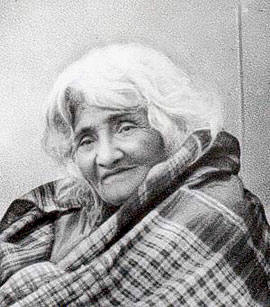 Hazrat Babajan |
Hazrat Babajan (d.1931) was a Pathan Muslim, an unorthodox Sufi who lived a very simple existence under a tree in Poona (Pune). She did not establish any ashram. There still does not appear to be any Babajan sect or movement, though her tomb (dargah) at Poona does have adherents. The other sects converging in the putative "Sai Baba movement" exhibit degrees of assertion about the priority of their respective figureheads, though rarely resembling the verbal aggression occurring in the American branch of the Sathya Sai Organisation.
New data is a known x factor. Episodes are known of resistance lasting for many years to worthwhile reporting. New interpretations of a subject have also proved vital to detailed studies, whatever the publishing category involved. There is also the very relevant matter of books which convey due information found only in specialist sources, rare journals, or other relatively inaccessible documents and channels. The Wikipedia guidelines do not give information about annotatory content and the use of specialist sources in self-published books. The majority of self-published books do not feature annotations.
In the Wikipedia 2006 User page of SSS108, I was dismissed for having cited dissident and rationalist sources in preference to the hagiological literature of the canon favoured by the Sathya Sai Organisation. The SSS108 accusation of being "wholly critical with no other viewpoints" (cited above) reflects the choice between realistic reporting and the hagiological gloss insisted upon by devotees and related polemicists. Wikipedia was here a vehicle for hagiology, with no protection against sectarian monopoly.
Annotations and appendices in self-published works require more detailed elucidation in the Wikipedia guidelines, which have too often instated dubious sectarian sources promoting miracle lore and other drawbacks. Many Wikipedia bibliographies of the Moreno decade could not demonstrate elementary criteria of rational reporting. University academics still generally frown upon Wikipedia articles, regarding these as uncitable, especially in view of the aggregate pseudonymous authorship. See also Wikipedia Anomalies: Sequel.
5. The Other Side of the Argument
The refrain of banned Wikipedia editor Gerald Joe Moreno (alias SSS108), that rival exegetes were vanity publishers, is viewed elsewhere as a rhetorical contrivance. Robert Priddy and the Indian Rationalists are likely to gain higher placings than sectarian defamation. In relation to myself, I will here mention a few matters alien to the lack of due neutrality in the Wikipedia sphere.
I managed to compose a thousand page work using specialist sources of multi-lingual Iranist scholars, also Indological experts in Sanskrit and Indian vernacular languages. The first two copies sold by the leading academic bookshop in Cambridge went to a prominent Iranist scholar in Italy (Gherardo Gnoli) and to an important university library in Tehran. The study tempo in such environments is somewhat more intensive than the blog-oriented reference points operative in American cultism. Minds and Sociocultures Vol. One (1995) did at least represent a degree of familiarity with learned journals and other academic heavy reading which sectarians show no sign of having assimilated. My aim was to employ scholarly and professorial data instead of popular writer output, the latter being more at risk of error in pronouncements and theories.
A Wikipedia editor (The Communicator, real name Simon Kidd) graciously defended my corpus on a Wikipedia discussion page relating to alternative therapy, whose supporters were adversely influenced by the Wikipedia User page of Gerald Joe Moreno against myself. The advocates of Grof therapy were misled by the Moreno page, being completely unfamiliar with my writings. However, they subsequently relinquished their attitude on this point, grasping that discrepancies were involved. The Wikipedia article on Holotropic Breathwork (HB) read like a therapy advert until countered by a critical extension. HB is the commercial trademark therapy of Stanislav Grof (b.1931), an exercise known to have created negative symptoms in some clients.
Another Wikipedia editor stated to the Grof therapy supporters:
You misrepresent Kevin Shepherd, as he appears to have consistently been involved in self-publishing, for reasons clearly stated in his books, not vanity publishing. His titles are easily available from Amazon.co.uk and Blackwells online.… Instead of worrying about the ‘reputability’ of Kevin Shepherd, you need to consider the objectivity and connections of aggressive attempts to prevent access to any and all historically grounded, well articulated scholarly criticism of highly controversial subjects, such as Sathya Sai Baba.… It is clear that Kevin Shepherd’s work is in good repute with academic researchers in comparative religion. (Jedermann, Nov. 26th and Nov. 22nd edits, 2006, appearing at the discussion page of the Holotropic Breathwork article)
Jedermann (his pseudonym) was a British academic, also one of those discontented with Wikipedia bungling and illiteracies, to the extent indeed that he migrated to Citizendium. A very literate man, he sent me an extract from his bona fide doctoral dissertation, exhibiting annotations of daunting expertise. He soon grasped that Gerald Joe Moreno has not written any books, being instead a composer of scurrilous attack blogs in the cause of Sathya Sai Baba. The anonymity of this sectarian contributed to the uninformed belief of Grof therapy exponents that User SSS108 was some kind of academic expert employing an official numberplate of unimpeachable authority.
Jedermann sent me a letter expressing vexation at having to deal with the extremist attitudes of Grof therapy; he had been requested by another academic to help oversee this problem on the Wikipedia files. The HB team entertained the bizarre idea that they were effectively immune to criticism because their auspices were Dr. Grof, whom they believed to provide the ultimate answers for therapy and spirituality. Jedermann then began to talk about leaving Wikipedia, stressing that Citizendium favoured editorial expertise and identifiable contributors. This was in February 2007.
The mood amongst some literati had deduced by now that Wikipedia was a pseudo-official platform for too many anarchists, cultists, entrepreneurs, and fictionalisers. American Wikipedia was ambitiously becoming a huge international enterprise giving much attention to cinema and novelism, while frequently lacking due scholarship in more traditional fields. The popular imagination was besotted with junk and trivia, being effectively disabled in telling the difference between novelism and history, between myth and reality.
Jedermann assisted the academic (from Australia) who confronted the HB team. He soon concluded that the effort was doomed to failure in view of the HB conceptualism promoted. Nevertheless, the persistent Communicator eventually evoked some reluctant concessions, facilitated by prospects of the Wikipedia arbitration procedure.
Meanwhile, Moreno had proved hostile to the lengthy book written by Basava Premanand entitled Murders in Sai Baba’s Bedroom (2001). This detailed work probes and presses the data and allegations concerning the 1993 murders which sent a shock wave through the Sathya Sai movement. In India these and other allegations were squashed by the large number of influential devotees of Sathya Sai Baba, some of whom occupied prominent political and administrative positions. Why were four devotees killed by the Indian police at the guru’s ashram? The official version is deemed too convenient by critics. In addition, details of sexual abuse surfaced in the BBC documentary (available as a video) entitled The Secret Swami (2004), which profiled allegations and denials in a striking manner, serving to impress outsiders that something very dubious was at issue.
The canonical works on Sathya Sai Baba are misleading. The well known multi-volume biography by Kasturi is considered a hagiography. The partisan literature includes some books on the guru that were written by devotees who subsequently defected, when discovering repugnant details about the sexually molesting Sathya Sai. Certain of those books continued to be sold by unscrupulous commercial publishers causing public confusion.
Moreno improvised a stigma on his Wikipedia User page headed “Information about Kevin R. D. Shepherd.” This granted two and a half lines, containing the accusation that there were no online references and no media articles about me. I have always considered such promotions to be indulgent, and declined to be the subject of a video interview with Nielsen Bookdata in 2005. Writers who wish to make a philosophical point are not obliged to register as commercial celebrities.
The overbearing sectarian, of New Mexico, also stated on his Wikipedia User page that there were no university references to myself. When he belatedly discovered that I was associated with Cambridge University Library (CUL), Gerald Joe Moreno expressed an amusing attempt to downgrade that factor. His abusive entry at saisathyasai.com gained extension on a blog dated October 2008, which asserted that Cambridge University Library is "not to be confused with Cambridge University itself." The facile blog was mistitled Introduction to Kevin RD Shepherd.
The library downgraded by Pro-Sai tactic happens to be the highest University building in Cambridge, with a pedigree of holdings going back for several centuries to the earliest days of Cambridge University. The very recent sectarian calculations in New Mexico are quite insufficient to nullify the status of CUL, though elite librarians might reflect that the context of eminent institutions could be under threat from the cult blog mentality.
Moreno fleetingly mentioned my first book, but without supplying the title. That book was Psychology in Science (1983), with one sub-title declaring The relevance of new models in the interdisciplinary study of psychology. That book sold almost exclusively to academic readers and libraries in different countries. On the basis of that book, an enthusiastic Professor (a physicist and ecologist of distinction) wished to enrol me in the academic profession. I was appreciative of his goodwill, but nevertheless declined. A specialised academic career would have curtailed my range of interests, which were pronouncedly interdisciplinary and free-ranging.
Professor Glen Schaefer read Psychology in Science in 1984, while I was engaged in private research at Cambridge University Library (CUL). From January 1981, I spent over a decade on that research, accumulating many notebooks (I left Cambridge for Scotland in 1989, but kept returning to CUL until 1993). The Professor was concerned that I had no official funding in this activity, and no salary like himself and other academics.
The same concern was expressed by the benevolent senior academic who assisted my entry to CUL in 1981. Dr. Robert H. Thouless (1894-1984) was a well known psychologist and eminent Fellow of Corpus Christi College. For many years he had taught Educational Psychology at Cambridge, having gained his Ph.D in 1922. He had authored the reputed book Straight and Crooked Thinking (1930; revised edn, 1953). His interests extended to parapsychology and Eastern religion, though in a critical mode. Dr. Thouless composed a letter of recommendation on my behalf to the Admissions Office at CUL. The customary second sponsorship often required was waived in this instance, because of my link with prestige seniority at Corpus Christi.
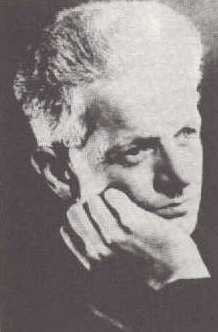 Robert Thouless |
I think that the reason why such prominent academics became interested in my obscure career was the disposition for interdisciplinary studies, forsaking all else. Some professionals really wanted to be interdisciplinary themselves; they were prevented by their official roles from being too adventurous.They seemed surprised at what I was doing. My approach to study was in some respects encyclopaedic, a cardinal incentive being to cross boundaries between the sciences, philosophy, and religion. In 1984 this approach arrived at the conception of what I then called "polymathic anthropography." I subsequently deleted the first word in that rather cumbersome phrase. The basic theme found expression in an early manuscript (of 1984), later published as Meaning in Anthropos: anthropography as an interdisciplinary science of culture (1991).
Shortly after writing Meaning, I declined Professor Schaefer's generous offer of assistance with elevation to a Ph.D credential. He was quite serious, and puzzled when I cordially refused. He warned me about economic problems that could ensue for an unsalaried career committed to a form of "study and philosophy idealism." Of course, he was right, the commitment being too strong to permit deviation.
The fact is that I preferred an unfettered exploration of the many open shelves at CUL, plus the Rare Books Room (also the vaults, though the contents of those had to be sought on request forms per book). Notebooks and unfinished manuscripts littered my desk at home. CUL had unrivalled facilities for shelf access, outstripping the Bodleian in Oxford. Of course, I did not need to go to the Bod, as it was affectionately called. All I needed to do was walk two miles from my home in Cambridge to CUL, which dominated the skyline in the vicinity of West Road. I would stay there all day, often being one of the last to leave in the early evening, shortly before seven p.m. There were many floors, and literally millions of books, in different languages. A major attraction was the learned journals, existing in copious quantities, for which a separate index existed.
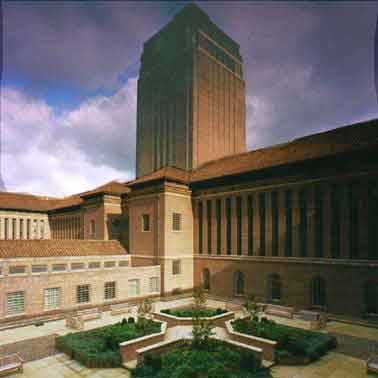 Cambridge University Library |
The long-term history of CUL goes back some six centuries; the present building dates to 1931-34, after the original library outgrew location. A decade ago, a statement from this institution read: "Every year brings two miles of new accessions, a ceaseless process despite prophecies of the death of the book." The electronic screen cannot suffice for all learning purposes; some features of the web detract from learning. Even Wikipedia has to elevate published books and journals above web sources.
I remember CUL with much affection. The librarians and staff were unfailingly courteous and considerate. During the most intensive phase of my study programme there, I spent the full five and half days of opening time within the precincts. Saturday afternoons were devoted to the local bookshops, principally Heffers, which had expanded during the late 1970s into a very large establishment, catering primarily for an academic clientele. Sundays were devoted to my notebooks, and yet further reading.
CUL was (and is) a paradise for bibliophiles. The Cambridge dons said that CUL was internationally exceptional for the large holdings. Specialised books could be found in the various college libraries in Cambridge. CUL was nevertheless a monument to research collateral. Undergrads rarely appreciated how much was on offer. I saw many postgrads who became more attentive. There were also numerous visiting Professors from other countries. An academic friend told me that CUL was easier to negotiate than the Bodleian (in terms of shelf access), and that only Heidelberg University could seriously match these two. I was closely informed that no academic library in America had such resources or amenities. I did not query the authorised version. I was quite certain that I could never read all the books and journals I saw on the interminable shelves. My notebooks just filled up, the need for an intelligible index becoming paramount.
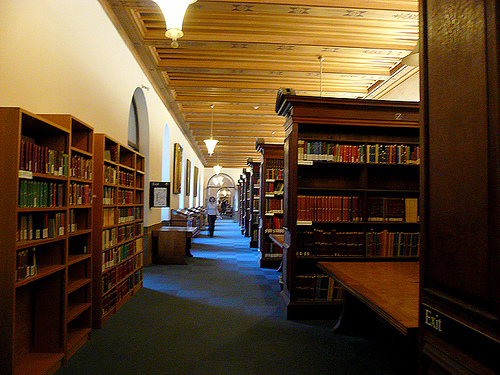 Cambridge University Library |
I have since discovered that many academics are aware of the "justifying reasons for self-publishing" in the case of serious books appearing in the face of commercial publishing constraints. Some academics have themselves resorted to self-publishing. The Wikipedia guidelines are not sufficiently distinct or comprehensive in this area. The book dismissed on a hostile Wikipedia User page (of SSS108) has 480 annotations spanning over a hundred pages. In fact, those annotations comprise one third of Investigating the Sai Baba Movement (including index). That is the proportion found in the more exacting scholarly works produced by university press, a practice strongly associated with the influential traditions of Cambridge and Oxford.
I am not here claiming that my books are in any way important, merely pointing out that some self-published works can exhibit features distinguishing them from the commercial output, features likewise not found in many works of the self-publishing category. Numerous books produced by giant commercial publishers have no academic interest. From a different angle, even some books produced by university presses are deemed disappointing by academic assessors.
A more generous Wikipedia editor than Gerald Joe Moreno was magnanimous in his appraisal. He mentioned his academic degree in philosophy and his former experience in high profile bookselling firms. Because that democratic assessment appeared on Wikipedia, I am obliged to quote here:
Shepherd’s case is unusual. He is an atypical writer, a non-academic who has researched in Cambridge University Library and published a number of scholarly books. His Minds and Sociocultures Vol. One is over 1000 pages long, has maps, appendices, notes and an index. There are 461 notes to the main text [with a further 280 notes to the introduction], and the index alone is 43 pages long. His other books are similar with respect to the quality of scholarly apparatus. It is unlikely in the extreme that any publisher would have taken on such a book, especially from a non-academic. Shepherd is realistic about his abilities, and prefers to be regarded as a scholarly amateur. He is scrupulous in his use of (citations of) specialist scholars, though he is occasionally critical of academics (and academic publishers) when they endorse what he regards as dubious persons and practices. By self-publishing, he maintains his authorial independence, although he suffers from the lack of resources provided by commercial and academic publishing houses. His books have high production values (I speak here as a professional bookseller) and are presumably expensive to produce. He does not seem to gain financially from their sale, nor in any other way as far as I can see. He does not promote any organisation or religious persuasion. (The Communicator, Jan. 2007 edit, Wikipedia, Holotropic Breathwork discussion page)
For the record here, The Communicator was Simon Kidd. To fill in other details, Minds and Sociocultures Vol.One was produced by a freelance publisher, not by me. Being in close liaison with the publisher, I was able to stipulate my wishes for format, which is not the case for most authors in the publishing contract. I was not the easiest client, objecting to the deadline imposed by advertising considerations, a factor which the publisher had not anticipated.
There are various misconceptions about self-publishing. The more diligent works are not in the "vanity" category, which are frequently one-off creations that are soon forgotten. A separate branch of the publishing industry has catered for "vanity" works, easily recognisable at a glance.
The more exceptional forms of self-publishing have attested a strong survival value, going back to such authors as John Milton (1608-74) in the seventeenth century. His Areopagitica (1644) was very controversial in his day, defending the individual right to publish and condemning censorship. Milton was a Protestant civil servant (and poet) who argued "for the liberty of unlicensed printing." Wikipedia has described this distinctive tract as being "among history's most influential and impassioned philosophical defences of the principle of a right to freedom of speech and expression, which was written in opposition to licensing and censorship" (accessed 10/02/2013).
6. The Findings document and Dr. Marianne Warren
The issue of hagiology versus realism is pressing in the instance of Sathya Sai Baba. The lore of miracles is particularly strong in this direction, abetted by acts of what critics define as exhibitionism. The reaction of dissidents to that form of promotion has been pronounced. Video clips provide testimony to the deceptions emphasised.
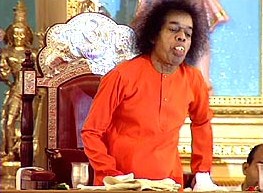 Sathya Sai Baba "materialising" a lingam in his mouth, 2002. |
An early sceptic of the "miracles," celebrated at Puttaparthi ashram, was the Australian devotee Terry Gallagher. He was initially influenced by a popular devotee book entitled Sai Baba: Man of Miracles (1971), authored by Howard Murphet, another Australian enthusiast. Gallagher visited the ashram in 1983, there gaining an interview with the guru. He made a substantial donation, returning on subsequent occasions with his family in 1985 and again in 1986, when they stayed for seven months. Gallagher records how he then "began to observe things that made me question what I had experienced on previous visits."
In particular, the new observations related to a daily "materialisation" by the guru of holy ash (vibhuti). This feat transpired to be deceptive manipulations of ash pellets concealed in the hand. Gallagher reports:
In the months that followed, I observed how he [Sathya Sai] transferred these vibhuti pellets from one hand to the other, using the letters he collects from devotees to disguise his movements. In the many interviews that followed, I also observed more than thirty instances of rings, 'diamonds,' japamalas, vibhuti containers, etc., all being produced by sleight of hand and deception.... It was the observations and information that followed from these initial findings that concerned me the most, especially those relating to students being sexually interfered with in grotesque ways by [Sathya] Sai Baba. (Terry Gallagher's Testimony at www.exbaba.com search tab)
A retired academic in Norway is Robert Priddy (section 3 above), an ex-devotee noted for his criticisms of Sathya Sai. In letters to myself dating to 2006-7, Priddy mentioned a controversial and shocking topic:
The amount of evidence that has surfaced on the internet since 2000 from the sexually abused (by Sathya Sai Baba) is the tip of the iceberg. Nearly all who contact us want to remain completely anonymous.… because the persons involved have to consider their family, friends, employers, etc.… I have pieced together the facts and am convinced from all my contacts (mostly confidential, many scared to be known about) that Sathya Sai Baba has molested many boys throughout many years.
This appalling situation was made even worse by affiliated details about homosexual pupils of the guru, who are said to have become addicted to sexual contact with hapless boys in the Sathya Sai Baba colleges. The “vice ring” theme exercised a shock impact. Reports given by victims implied a ring of homosexual molesters. Sathya Sai Baba was allegedly the cause of this aberration, himself being a strongly alleged molester of different age groups.
However, the Sathya Sai Baba Organisation cultivated the alternative image of the “miracle” guru and the public benefactor. That image was disputed. The establishment of colleges and distributions to the poor were viewed by ex-devotees as a superficial facade, especially in view of the lavish fundings obtained from supporters. The interlinking reports of Robert Priddy, David Bailey, and other ex-devotees can be described as a landmark in the history of sectarian problems. Apologists vehemently denied those reports, which were castigated by an American polemicist (Gerald Joe Moreno) as Anti-Sai inventions.
Appendix One of my book Investigating the Sai Baba Movement (2005) covers details mentioned in The Findings, a pivotal exposé composed by the British ex-devotees David and Faye Bailey. This document produced a surge of shock reactions when promoted on the internet in 2000. Earlier accounts of discrepancies had appeared on the web. However, The Findings was the flame arising from the sparks. Some devotees recognised the validity of this reporting and themselves became objectors, whereas others refused to acknowledge the increasing allegations. David Bailey made clear that the supposed "materialisations" of sacred ash and jewellery were visibly contradicted by close observation. His wife at first strongly resisted this factor. She eventually grasped the truth when she stopped gazing adoringly at the guru's face and paid more attention to his hands.
The Findings document also dwelt upon claims of sexual abuse, while strongly querying other discrepancies such as economic gains at the expense of devotees. This document had additional impact because of the former evangelistic role of David Bailey, who now felt acutely compromised by the emerging data that placed Sathya Sai in a bad light.
A tragedy is that David Bailey went into oblivion after suffering various attacks and put-downs by apologists for Sathya Sai Baba. According to Robert Priddy, Bailey was “attacked so horribly” that he had decided to withdraw from the scene of argument. Bailey did not withdraw because he had lost certainty in his findings, but because he now believed that the opposition was beyond correction, being dangerous and totally irrational.
According to Priddy also, I was the only enquirer able to coax a brief reply from Bailey (via Priddy) after his years of isolation from the Sathya Sai controversy. The reply in 2006 confirmed his wish to remain aloof in the face of extremism. Bailey had retreated into obscurity somewhere on the Continent. I had discovered that his former post box address was no longer functioning. I never did find out exactly where he was living.
The Findings have been much discussed. Included are quotes from David Bailey such as the following:
On my last visit to Puttaparthi, a male student came and asked me for help, on behalf of some of his fellow students, because they were desperately in need of someone to stop Swami [Sathya Sai] sexually abusing them. I was told how [Sathya] Sai Baba had for years been demanding that these particular boys have oral sex, and group sex for his pleasure. Their details matched what I had already been told so many times around the world. I asked him [the student] if this was an acceptable practice in India, and his look of horror as he denied it, spoke volumes. Then he asked me a question I could not answer. 'Sir, why do you think ex-students tried to kill him in '93? (The Findings)
The reference to 1993 denotes the infamous "bedroom murders." Bailey became a devotee at that period, while teaching music to students at the Sathya Sai College. He gained more than a hundred interviews with the guru over four years, by which time he was deeply disillusioned. There is no denying the authenticity of the lengthy Bailey report, ignored by devotees. The Baileys had previously authored three books glorifying the guru, which they were subsequently concerned to remove from circulation.
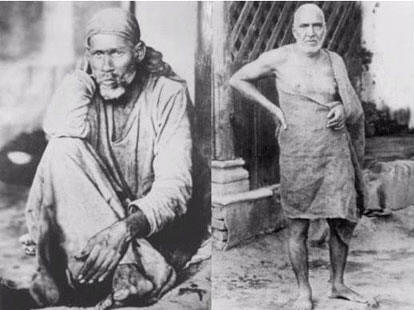 l to r: Shirdi Sai Baba, Upasani Maharaj |
My book Investigating the Sai Baba Movement describes Shirdi Sai Baba (d.1918) rather than Sathya Sai. A dogma of the Sathya Sai Organisation is that Sathya Sai was the reincarnation of Shirdi Sai. The conflation of the two has been resisted elsewhere. Their lifestyles and personal habits were very different.
The same book describes two other figures in juxtaposition with Shirdi Sai. Upasani Maharaj (d.1941) was the Hindu disciple of Shirdi Sai, a vigorous and forthright entity who wore spartan sackcloth instead of the customary ochre robe of Hindu renunciates. Upasani was not typical of the guru milieu by any means, and nor was his Irani Zoroastrian disciple Meher Baba (d.1969), concerning whom an extensive literature now exists. See further Shirdi Sai Baba and the Sai Baba Movement. The blanket term of "movement" here covers different movements or sects. I remain independent of popular affiliations, for example, the Meher Baba movement. Nevertheless, I was witness to events antedating the problem represented by the Meher Baba Oceanic situation associated with Pete Townshend.
The triple configuration of guru figures in Maharashtra is significant in twentieth century Indian religious and social history. The Andhra phenomenon of Sathya Sai Baba has quite different characteristics. Devotional lore can too easily obscure basic events in all four cases. Of the four figures mentioned, two are of Hindu background, one a Muslim, and the other a Zoroastrian. This involves a more complex approach than is generally the rule in surveys of Hinduism, the religious category to which Sathya Sai belongs. For instance, the father of Meher Baba was Sheriar Mundegar Irani.
My earlier book Gurus Rediscovered (1986) was acknowledged by Dr. Antonio Rigopoulos, a Sathya Sai Baba supporter, as "a ground-breaking work." This was because of my emphasis that Shirdi Sai was an unorthodox Muslim Sufi and not a Hindu. That emphasis was more extensively vindicated by Dr. Marianne Warren (d. 2004), a scholar of Indian religion at the University of Toronto. Dr. Warren was for many years a follower of Sathya Sai Baba, having visited his ashram at Puttaparthi. In the sequel Investigating, I included data from the first edition of her book Unravelling the Enigma: Shirdi Sai Baba in the Light of Sufism (1999). My version included a pointed response to some of her interpretations.
A subsequent revised edition (2004) of Dr. Warren’s book evidenced that her orientation had changed. She had since come to understand that she and others had been deceived by Sathya Sai Baba. Warren sent to Robert Priddy the memo entitled Sathya Sai Baba – Godman or Con-man (formerly online at saibaba-x.org.uk/7/W/Index). This document included the following statement:
Devastating news came in the form of revelations made available on the internet. In April 2000 these revelations were published under the innocuous title of The Findings. These were a collection of stories, affidavits, letters etc, compiled by David and Faye Bailey from ex-devotees, and revealed various hitherto unknown or hidden aspects of Sathya Sai’s behaviour and practices that were fraudulent and sexually explicit. There were strong allegations of homosexual paedophilia. These revelations brought an instant response from myself and my husband, as well as many others around the world, to distance ourselves as soon as possible from the Swami (Sathya Sai Baba). We had been volunteers in various aspects of the (Sathya Sai) Organisation, but dropped these activities immediately.
Few could credit that Swami (Sathya Sai Baba), who had repeatedly declared his divinity, could be involved in these dreadful acts, but evidence soon mounted. The content of The Findings and subsequent revelations is the subject of this present book. This book therefore is not the work I originally intended to write. As a result of all the investigations, research, allegations and revelations, I present this document as objectively as possible, as a warning to those who may discover the literature of Sathya Sai Baba and all the extraordinary claims, and are tempted to believe it.
Dr. Warren’s original plan had been to write a second book on the theme of what Sathya Sai Baba had said about Shirdi Sai. She subsequently understood that this theme was a major red herring for the gullible. She states in her memo that she would not include the statements of Sathya Sai Baba about the Shirdi saint, as these “are not independently verifiable.”
The memo of Dr. Warren above-cited was a draft introduction to her proposed second book, which did not materialise because of her death in 2004. Some additional details can be found in correspondence between Warren and Robert Priddy dated Feb. 2003 (formerly online at saibaba-x.org.uk/7/W/Warren2). Dr. Warren wrote:
In my [published] book on Shirdi Sai Baba, I felt I could not use much of what Sathya Sai Baba had said because none of it was verifiable (although I was a devotee at the time). But it is amazing how much of what he has said has become an integral part of the accepted hagiography [of Shirdi Sai]. Even Rigopoulos was not discriminating enough in his book on Shirdi Sai, accepting Sathya Sai’s pronouncements as gospel.… I have quite a lot of material other than the Shirdi material, for an anti-Sathya Sai Baba book, as I was involved in Toronto Sathya Sai Baba Centres in Canada for 20 years, and the Sathya Sai Baba Book and Information Centre for 10 years. There were many things that occurred during those years that made one entertain doubts.…
When we went back [to the ashram] in the late 1990s, a Bank was established in the ashram grounds and I was rudely asked by a sevadal [ashram assistant] which line I was in. Amazed, I asked what the lines were for – and found out that one was to withdraw money or change traveller’s cheques and one was to donate to Sathya Sai Baba. The Sathya Sai Baba donation line was very long !
For two years after The Findings, my husband and I were devastated. We got rid of all the [Sathya Sai Baba] pictures and altar and we decided to retire early to Mexico. It’s the best decision we ever made, and now we have largely cut ourselves off from the Sathya Sai Baba community in Toronto. There are many Sri Lankans who have emigrated there, and there are huge Sri Lankan and Indian Sathya Sai Baba Centres there supporting a [Sathya] Sai School. Western [i.e. non-Indian or non-Ceylonese] Canadians were relatively few. After two years of getting ourselves established on Lake Chapala in Mexico, I began to look again at the ex-Baba [i.e. ex-Sathya Sai Baba devotee] material on the internet and was horrified at all the revelations [i.e. exposures which were multiplying]. These I feel need to be widely publicised.
7. Pro-Sai Activist Gerald Joe Moreno (Equalizer)
In March 2007, Gerald Joe Moreno (alias SSS108) was banned indefinitely from Wikipedia, after transgressing against one of the administrators who had warned him. The basic charge was activist editing. The official report relates that he was voted against unanimously by the six arbitrators in the case. The vote meant that he was banned from editing the Sathya Sai Baba entry and related articles. Two of his colleagues (named elsewhere as Lisa de Witt and Simon Brace) were also banned in this manner.
Moreno is described in the Wikipedia report as running several attack websites and blogs against critics of Sathya Sai, claiming to debunk negative stories about the guru. Also banned was a fourth editor, namely Andries Krugers Dagneaux, described as being proprietor of an attack website, namely Ex-Baba.com, representing the ex-devotees. However, Dagneaux (alias Andries) was still permitted to edit on the talk pages of the Sathya Sai entry and related articles. This concession was gained because his edits to the Sathya Sai Baba article "are generally responsible, requesting verification rather than aggressively deleting or reverting."
The arbitration reservation about Dagneaux (alias Andries) seems to have occurred because of his sympathy for the Wikipedia article on Robert Priddy. In that context, he "has editwarred extensively and repeatedly inserted links to an attack site maintained by Robert Priddy." However, further details are relevant here. The edit war was with Gerald Joe Moreno, Dagneaux arguing that the disputed link "was important to Priddy's notability as a Sathya Sai Baba critic." Moreno was denying any notability to Priddy.
The arbitration decision emphasised the incompatibility of a neutral point of view with an activist agenda. An earlier arbitration issue had seen Moreno in the ascendant position. This preliminary episode was closed on 05/09/2006. The official report is brief by comparison with the sequel, revolving around the conflict between Moreno and the ex-devotee Dagneaux (Andries) in relation to the Sathya Sai Baba article. Moreno sought the intervention of an arbitration committee, attacking Dagneaux on grounds of holding a biased point of view against the guru. Dagneaux strongly countered by accusing Moreno of quoting his own opinions, and also repeatedly removing from the article a relevant statement concerning the sexual abuse of boys by Sathya Sai Baba.
These two contending editors were officially "forgiven any offences they have committed by introducing unreliable information into the [Sathya Sai Baba] article." However, Moreno successfully influenced the arbitration decision that "negative information in an article or on a talk page regarding Sathya Sai Baba or organisations affiliated with him which is poorly sourced may be removed without discussion." This concession transpired to be a risk.
The same arbitration precedent had nevertheless stressed the principle: "Wikipedia is not a soapbox." This principle decoded to: "Wikipedia is not an appropriate vehicle for propaganda or advocacy of any kind." There is furthermore the sober emphasis in the earlier report: "The writing style [of Wikipedia articles] should be neutral, factual, and understated, avoiding both a sympathetic point of view and an advocacy journalism point of view."
There is a pronounced difference between this ideal and the contents of Moreno Pro-Sai attack blogs. Critics preserved other disparaging comments of Moreno appearing on a Yahoo bulletin board at the period of his Wikipedia editorship. Rather forceful language and accusation here entered into the friction between some devotees and ex-devotees. Online bulletin boards are regarded as web jungle by academics, who normally refuse to read them.
The major attack website of Gerald Joe Moreno gained a reputation for extremist dismissal of all critical coverages and allegations casting doubt upon the guru of Puttaparthi. The accusation of "lies" constantly appeared, Moreno viewed all critics as liars. Sathya Sai Baba here represented unassailable truth.
The same Moreno attack site exhibited the recurring refrain of “Exposing Critic’s Smear-Campaigns Against Bhagavan Sri Sathya Sai Baba.” Moreno referred to ex-devotees and others as Anti-Sai Activists. In his FAQ, he stated that his purpose was to “expose the lies, deceit, misrepresentations, conflations, exaggerations and contradictory allegations” which he attributed to his opponents. He accused the "Anti-Sai Activists"of an "agenda of hate and propaganda at any cost." However, Moreno was accused of an extensive hate campaign manifesting in numerous libels transmitted via his network of sites and blogs.
Gerald Joe Moreno made the unconvincing statement that he was not a devotee after the age of twenty-five. I quoted his FAQ as saying: "I am an open-minded (but not gullible) agnostic." This assertion related to his declaration of having "basic philosophical differences of opinion" with the guru's teaching. He also stated in his FAQ: "I do not try to suppress other viewpoints."
Maintaining this contradictory non-devotee stance, Moreno evidently regarded himself as a Pro-Sai Activist in direct opposition to the detested Anti-Sai persuasions. His compositions were clearly of a sectarian nature, with aggressive features negating the "Love All Serve All" catchphrase associated with the movement he defended. Moreno continually mocked and taunted. The general tone of his Pro-Sai activism tended strongly to defamation of his opponents and critics.
The Pro-Sai Activist stated that he gave the benefit of the doubt to alleged sexual abuse victims until May 2006, prior to which date he believed that Sathya Sai did abuse male devotees. This switch in attitude facilitated strong denial tendencies. Moreno was evidently influenced by events attendant upon the self-dismissed lawsuit in April 2006 of Alaya Rahm, an ex-devotee testifier to abuse. Moreno subsequently promoted the contested Kreydick testimony on Wikipedia, a tactic countered by ex-devotee Robert Priddy (section three above).
The Rahm lawsuit occurred in California, encountering problems of evasion from the defendants, who were leading American Sathya Sai devotees, notably Michael Goldstein (Alaya Rahm's Lawsuit vs Sathya Sai Society, ex-baba.com search tab). An improvised technicality of the defence (i.e., that they were merely a bookstore) was clearly designed to make their cause remain unaccountable. In this way, the allegations were foiled. Critical observers deemed the defending tactic to be an entirely unconvincing ploy. An ex-devotee argument implied that the influence of apologist Goldstein was paramount in the new decision of Moreno to deny sexual abuse.
Moreno denial of paedophilia maintained that there were no testimonies from boys or their parents in this direction, and that the youngest male (Jed Geyerhahn) who testified to sexual abuse was sixteen years old. This argument ignored complexities, including anonymous Indian boys who were scared to give their identity because of indoctrinated devotee parents. Instead, Moreno stated on his FAQ that Anti-Sai Activists “are a mob of angry, vindictive and hateful individuals who place their own agenda of deceit and dishonesty above all else.”
Very little is known about the background of Gerald Joe Moreno, save that he became a devotee in his late teens, when he visited the Puttaparthi ashram, gaining an interview with Sathya Sai circa 1988. His date of birth is obscure. Residing in Las Cruces, New Mexico, he appeared online in 2003, his first website being vishwarupa.com. He demonstrated a strong disposition for blog and bulletin board projections of Sathya Sai, developing abusive idioms in his apologist tactic. His method was categorical repudiation of all "exposé" materials commenced by David Bailey and other ex-devotees. The latter had exposed Sathya Sai Baba, so Moreno tried to expose the exposers. That is the basic logic involved in Pro-Sai Activism.
The Moreno attack strategy targeted “critics, sceptics and ex-devotees.” References to Christian fundamentalists and “white supremacists” here occurred. Moreno stated in his FAQ that he received a racist email denigrating Sathya Sai. Ex-devotees like Robert Priddy (section 3 above) were not racists or fundamentalists. Some ex-devotees were emotionally wounded people. Fatalities of suicide are reported to have occurred in the ranks of sexually abused victims.
Moreno further complained in his FAQ: “Since Sathya Sai Baba claims to be a reincarnation of Shirdi Sai Baba, there are some Shirdi Sai Baba devotees who deride him as a fake and an imposter.” The Shirdi Sai contingent have more justification than Christian fundamentalists. The reincarnation claim is a strong issue evocative of opportunism. Critics are not an angry Anti-Sai mob because they do not believe in such claims.
The Pro-Sai activist strongly resisted his image being represented on the web. To be more specific, there is only one publicly known photograph of him, salvaged by ex-devotees when he deleted this from his early website. The "bust portrait" is now well known.
Moreno sent me an email (September 2007) threatening to report me to my web server if I did not remove his image from my website. That objection was invalid under the circumstances; web image identity is respected in the UK, if not in America. The activist afterwards threatened me (on his website) with "hefty [legal] damages" if I dared to publish his image in any book. There was no such intention on my part. I merely wished to identify the suppressing (and banned) agent SSS108, who furnished the proscribing Wikipedia User page (showing on Google) against my publishing venture.
I subsequently deleted his sole known image from my websites in 2010, in view of his continual complaints at being given such a tangible identity. Moreno failed to reciprocate, refusing to delete the images of myself that he presented in a hostile manner on his attack site and blogs.
Gerald Joe Moreno expected to conduct a libellous campaign against all critics without being identified in conventional format. Furthermore, he demonstrated a habit of using web pseudonyms outside Wikipedia, such as joe108, vishvarupa108, and Equalizer. His activity encompassed the tag identity of sathyasaibaba (visible on Google Search), arising from his blog of the same name.
There are some critics of Wikipedia who say that all contributors should be identified with a photograph, along with clear and specific details of personal identity, rather than the irritating web pseudonyms favoured in America.
A contributor who appeared on Wikipedia under his real name is Martin Alan Kazlev. This Australian editor supplied a testimony dated December 2006 in the Requests for arbitration file, linked above. Kazlev here says that, as a devotee of Sathya Sai for more than two decades, he was originally sympathetic to the arguments of SSS108 (Moreno). However, after corresponding with Moreno on the one side and several ex-devotees on the other, Kazlev concluded that the allegations against the Puttaparthi guru were realistic. He added:
I have observed that SSS108 uses tactics of slander, libel, and smear against ex-devotees in order to discredit their reports of sexual abuse.... Once I was considered to be no longer a naive devotee of Sathya Sai Baba, SSS108 decided to try to attack me.
Kazlev found that he was the victim of an attack blog from Moreno, an expression of Pro-Sai disdain also aimed at other ex-devotees and one outsider. This series of attack blogs bore the designation of "exposed" as a suffix, meaning that the disapproval of Gerald Joe Moreno had been aroused. The outsider here was myself, being in receipt of hostility after complaining about the proscribing Wikipedia User page of SSS108 (section 4 above), then objecting to the defamatory sequel at saisathyasai.com (see the Response to Moreno below), and further pointing out the lack of due response from Moreno (see Wikipedia, Gerald Joe Moreno, and Google).
Earlier, SSS108 (Gerald Joe Moreno) had become notorious amongst Wikipedia editors for personal attacks. Another editor (Ekantik) stated in the Wikipedia report entitled Requests for arbitration (see link above):
We must remind ourselves that SSS108 is a single purpose account who has a problem with anyone and everyone who disagrees with him, even going as far as to construct attack blogs against them.... With all of his general uncivility, resistance to good advice, and disruptive editing, several editors have despaired of him despite numerous attempts to help him correct his ways.
Coming to the crux of the Wikipedia issue, the attack on Robert Priddy by Moreno became noticeable on talk pages. The edit war with Dagneaux, over the Wikipedia article on Priddy, involved Moreno's aversion to a link made to a Priddy website. SSS108 castigated that site as an unreliable source. This problem, on the talk page to the Priddy article, was in force from July 2006 to January of 2007. Not only did Moreno diminish the Priddy article by his edits, he also nominated that article for deletion in November 2006. SSS108 argued that the article he detested was not notable, instead being a "vanity article" serving ends of self-promotion. Moreno stated that Priddy had created his own article to push a personal agenda against his former guru. In December, and on the same talk page, Moreno asserted: "These Anti-Sai websites contain defamatory and potentially libellous information."
By that time, several Wikipedia editors had strong reservations about SSS108. One of them was accused by the activist of making duplicitous edits on the Priddy talk page, the relentless target of Moreno. The article on Priddy was short, merely listing works of the subject and briefly referring to his website material on Sathya Sai Baba.The obsessive angle of Moreno insisted that the entry was unreliable, the contents unreferenced in any reliable source. Ironically, Moreno was accused of inserting unreliable materials into the Sathya Sai Baba article.
Another editor, Mel Etitis, stated that the agitator "is simply removing large sections of the article [on Priddy] on pretty thin grounds." This complaint appears in the Requests for arbitration file (linked in the top paragraph above). That report also includes the memo of Etitis informing: "SSS108 continues to be aggressive, abusive, and confrontational" (22/01/2007). In a subsequent communication, Etitis further complained:
I've now had to block him (SSS108) for harassment and incivility; his response was to make obscure and unfounded accusations against my being involved in a conflict of interest on an article that I've hardly touched (15/02/2007).
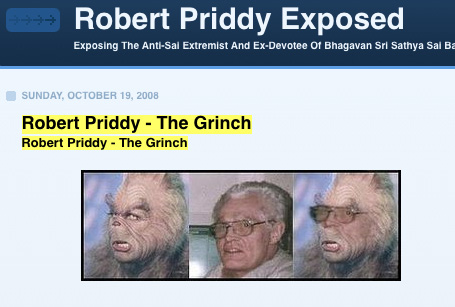 Moreno blog tactic caricaturing Robert Priddy, 2008 |
Turning to other internet sources, ex-devotees had much to say about Gerald Joe Moreno of New Mexico, largely because of his blatantly distorted portrayals of the critics of Sathya Sai Baba. See Moreno and ex-devotees. His strongly accented attack on Robert Priddy was countered in an article by the Wikipedia editor Martin Alan Kazlev, entitled Moreno slander against Robert Priddy (2006, formerly online). Moreno frequently called Priddy a liar, referring to him contemptuously. Kazlev details both sides of this situation. The following quote represents some of Priddy's responses:
If he had an ounce of decency in him, Moreno would remove all my nicknames, along with much copyrighted material of mine he has posted, and also the illegally used copyright photo of me and my son [an outsider to the movement], who has asked him to do so several times in a polite way. But no! He attacks my son there [on his website] in very unpleasant and irrelevant replies, and only because he [the son] helps his father with computer knowledge....
For Moreno, a liar is virtually anyone who questions Sathya Sai Baba, describes him or his words with a critical eye, or makes any statement Joe finds fault with, often because they will not entrust him with sensitive information. Any question which might be cleared up in an atmosphere of trust and maturity is ruled out by Moreno's crusading zealotry. He soon calls all of the dozens of alleging victims of [Sathya] Sai Baba's homosexual molestation 'liars', without any proof, without regard for what they credibly claim to have undergone.
Kazlev was formerly one of those influenced by the output of Moreno. A follower of Sathya Sai, he at first accepted without question the sprawling Moreno website saisathyasai.com, apparently so detailed. Kazlev subsequently found that this site was extremely inaccurate. This was after he contacted ex-devotees and probed their side of the argument. Kazlev contributed the critical article Gerald Joe Moreno (formerly online) that same year of 2006.
Kazlev referred to putatively "exposing" blogs by Moreno, “full of bitter ranting and adolescent mockery.” Moreno depicted dissidents as purveyors of pornography, as paedophiles, as fundamentalist Christians, as racists, and so forth. These accusations are patently transparent as misconceptions and distortions. Kazlev observed that Moreno “has so far shown himself incapable of accepting even a single fact that goes against his guru, however well-documented it is, and systematically avoids dealing with any of the criticisms of his [Sathya Sai’s] teachings, known public behaviour, untruthfulness, and so on.”
Yet paradoxically, Moreno claimed that he was no longer a devotee. He conveyed the impression that he was a devotee between the ages of eighteen and twenty-five, not thereafter. The format was suspect. Kazlev concluded that Moreno was still very much a follower, one with an obsessive belief that anybody accusing Sathya Sai of abuse is a liar. “Very often his defamatory attacks take the form of infantile behaviour, such as creating images meant to mock or humiliate.” Kazlev commented that the claims of ex-devotees about sexual abuse and betrayal of trust are too numerous to overlook. “There is just too much evidence, from too many sources, to ignore.”
The same writer described how Moreno tried to have his “slander page against Robert Priddy” linked in Wikipedia. That very hostile link was removed in accordance with Wikipedia rulings. Kazlev also observes how one of Moreno’s colleagues [likewise a Wikipedia editor before the ban] had claimed that ex-devotees were in part manipulated by the CIA, an error apparently based upon the detail that the father of Tal Brooke (an early testifier to abuse) was employed by the CIA. The facile accusation of "conspiracy theory" proved ineffective against pressing testimonies to sexual abuse, documented on ex-devotee websites. Sathya Sai Baba emerges strongly in the testimonies as a homosexual molester. The extent of personal suffering, experienced by various ex-devotees, adds to the gravity of the issue at stake.
Rather more boldly, Kazlev ventured a psychological analysis of Moreno, referring to the latter's "strongly puritanical personality." The problem of "Sathya Sai fundamentalism" was substantial. Moreno even tried to implicate myself and others as being compromised by two former cyberpunk stories composed by Kazlev, which Moreno accusingly posted on a blog. The extremist argument here was that if others supported comments of Kazlev against Sathya Sai and Moreno, they were guilty of a cyberpunk profile. For the record here, I regard the cyberpunk idiom as part of the contemporary nadir in decadent literature; however, that malady can be no worse than sectarian libels and hate campaign.
One of the most bizarre aspects of Moreno web output was the zeal for implying that critics of his guru should not on moral grounds be citing the testimonies of varied ex-devotees. This superficial argument featured in the very laboured insinuation of Moreno that I was supporting the "new age" workshop role of Swedish ex-devotee Conny Larsson by citing the latter's talk (at a reputable FECRIS conference in 2006) about Sathya Sai anomalies and abuses. In reality, I regard new age "workshop" roles as being misguided; however, such roles do not negate testimonies concerning other events. There was no "workshop" at the FECRIS conference in Brussels.
The FECRIS address of Larsson stated that over 50 million dollars per annum were being acquired from devotees worldwide by the Central Sathya Sai Baba Trust. Larsson further alleged a payroll of that Trust going to eminent supporters in India like Government Ministers, Supreme Court Judges, and bureaucrats. The Indian Rationalists also knew of these economic developments. According to Moreno, I must not mention what Larsson said, because that is hypocrisy according to sectarian standards. Moreno imposed his prohibition/stigma in a blog of 2008, not mentioning what Larsson said. The cult blogger here assumes a role of "exposing" me for inappropriate citation; his own position was very precarious, being regarded by lawyers as extremist and libellous. The blog in question bears the name of Equalizer, referring to Moreno in the third person, a device further compromising the doubtful contentions.
The accompanying book by informed Conny Larsson is significant. He divulges here that the four young male devotees shot dead at the Puttaparthi ashram, in 1993, were victims of sexual abuse. The information would make sense of the notorious "bedroom murders" event, explaining why the victims had the apparent intent to accost or even to eliminate the guru. A pretext was devised by Gerald Joe Moreno to cover this extremity: Larsson is a new age guru, who should not be cited by any non-subscriber to the new age. For the FECRIS address, see my Allegations of Sexual Abuse, which is the source that Moreno was misinterpeting.
The same Pro-Sai activist reasoning was demonstrated by Moreno in his contention about the "New Age" beliefs of Kazlev, interpreted to mean that Kazlev could not be cited by me against Moreno, as I do not subscribe to those beliefs. Therefore, in citing Kazlev, I am supposedly being contradictory. In citing Moreno, I am wasting time, except that others have to be warned where such eccentric arguments can lead.
The relevance of some materials by Kazlev is underlined by his clearly named role as a Wikipedia editor during the "Priddy crisis," also his transition from being a devotee to a critic. To cite Kazlev is not equivalent to supporting all his views or attitudes. I made the obvious point that academics and legalists do not disqualify reports or testimonies on the basis of some associated elements which they do not happen to believe in. Such a prospect would mean acute retrogression in many departments of civilised life, a benefit which is under threat from sectarian tactics and idiosyncratic web presentation. Religious beliefs or secular ideologies do not annul primary or secondary evidence, as lawyers are well aware.
Arousing strong reactions was the extremist attempt of Moreno in 2006 to libel Barry Pittard, another ex-devotee and strong critic of Sathya Sai Baba. See Serious Defamation Attempt by Gerald Moreno Defeated. To quote an excerpt here:
Moreno was evidently so determined to defame Barry Pittard that he maliciously misrepresented the internet page by Pittard's former partner, which Moreno claimed was 'proof' that Pittard fathered a child with a 15-year old girl. To add insult to injury, Moreno extended himself yet further by claiming that Sai devotee informants who knew Pittard confirmed to him that Pittard was known to have done this, without him [Moreno] presenting a shred of testimony from the alleged and anonymous sources. He continued to post his defamation on his website and bulletin boards over several weeks, and still purposely distorts and avoids central facts of the matter.
Eventually Barry Pittard posted a decisive fact-based rebuttal of Moreno's false claim. Moreno then had to retract his false allegation, though his reaction was most grudging and manipulative in its wording - a single line buried among a mass of self-justification.
Moreno gained the repute of being a “pet stooge” of the Sathya Sai Organisation (SSO). He was described as being privately condoned by the SSO, despite his unscrupulous methods and extremist excesses. A web statement (dating to 2006), associated with Robert Priddy, states that Moreno “is clearly in league with Goldstein and other leading US Sai Organisation members and supporters; pretending to be an ‘independent researcher,’ the Sai Organisation’s pet stooge does their street-fighting for them, with which they cannot afford to dirty their reputation further (since Sathya Sai Baba has ordered them not to answer any allegations whatever).”
A related accusation, from the earlier period, is: "He [Moreno] posts photos of critics of Sathya Sai Baba with distorted faces and added bodies of a pornographic kind." Moreno denied such charges in his webpage against me dated Sept. 2007. There is evidence amounting to serious contradiction of his denial. Two surviving Moreno web images of his opponents (from the early period in the conflict) reveal the distortions described by the accusation. One image exhibits an oversized nose, while the other features the addition of female breasts to a male ex-devotee. See my description at Undeclared Distorted Images of Opponents (2008).
The distorted images of Van Der Sandt and Sanjay Dadlani can be accessed at Gerald Moreno and 'copyright blathering'. This feature also reproduces Moreno's juxtaposition of a Priddy image with that of an ape-like creature, a gesture clearly intended as one of contempt and ridicule. The demeaning gesture, appearing on a Moreno attack blog dating to 2008, is reproduced above.
A detailed letter from Robert Priddy to myself (dated 05/01/07) included the following:
The writings of Moreno are a hodge-podge of ad hominem attacks, defamations, faulty arguments, contrived diversions, and not least outright lies. Goldstein and the Organisation have to follow the orders of Sathya Sai Baba, which are not to engage with critics in any way, though the second-in-command, Dr. G. Venkataraman (after six years of silence from all Sathya Sai Baba officials) did write a long article to refute the allegations last summer (and we have refuted Venkataraman most thoroughly on ExBaba.com). So Moreno is evidently their stooge, as has also been pointed out on various websites. Moreno uses dirty tricks, like posting names of his opponents on porno sites, then publicising it. Someone has posted my website URL on a porno site (at some expense).
The porno site issue caused shock (a prominent anti-cult organisation expressed incredulity when informed, saying they had never heard of this particular aberration before). In 2007, Moreno denied the accusation of Priddy, attributing the problem to Priddy’s own wish to advertise his "Anti-Sai" website on a porno site. Many onlookers did not believe this counter-allegation. Some critics allowed that one of Moreno’s close associates may have accomplished the porno site procedure, in which case Moreno would have known about this at the time. Ex-devotees continued to hold Gerald Joe Moreno in strong suspicion, on the grounds that nobody else would have had any motivation to harass Priddy in this manner.
Some ex-devotees suggested that Moreno was financed by the American branch of the sect to libel critics as a full-time career. The fact that in my case, he censured an outsider to the sect, was viewed as an ominous sign for the general population.
Gerald Joe Moreno caricatured my objections to his proscribing Wikipedia role as "whining and snivelling." My protests were also dismissed as "spineless critiques." Moreno responded to those complaints with a defamatory entry on his primary website dating to September 2007. My subsequent objections to that entry were ignored. Those counters were expressed in the Response to Moreno reproduced below. Moreno continued to ignore the complaints, instead maintaining his unaltered entry at saisathyasai.com. Furthermore, when I composed a further qualifying webpage in 2008, he again ignored the onus for correction. Instead of due recognitions, he mounted a libellous blog against me which duplicated the content of his earlier website entry. That pseudonymous blog contrivance bore the name of Equalizer. This tactic demonstrated the nature of his role more clearly than anything else could probably have done (see New Age Sceptic and Not Academic).
The Pro-Sai activist (Gerald Joe Moreno, alias Equalizer et al) became notorious for not revising his web compositions. Instead he maintained libels which international lawyers described in negative terms. His blog campaign to discredit all critics was interpreted as evidence of sectarian perversity, whether or not directly supported by Michael Goldstein (leader of the Sathya Sai Organisation). Many of his web compositions did not carry his own name.
His campaign of harassment on Google Search included in my direction such erroneous accusations as: "Kevin R. D. Shepherd is a vanity self-publisher and author whose writings mostly revolve around (or include numerous references to) the Findhorn Foundation." Though a self-publisher, I am not in the vanity category, being known in more literate circles as a producer of serious works. The Pro-Sai libeller revealed his extensive unfamiliarity with my writings, only a small part of which relate to the Findhorn Foundation.
The web output of Moreno amounted to internet terrorism, bombarding Google Search name lists of opponents and victims with numerous disparaging references. Over ten of these Moreno hostilities were visible on my Google listing at the same time. As a consequence of complaints, Moreno eventually acknowledged pseudonyms like Equalizer as being his own.
 Sathya Sai Baba |
The runner-up on Google ratings for Gerald Joe Moreno was a blog at wordpress.com entitled sathyasaibaba. The sub-title being Life, Love, and Spirituality. This blog glorified the guru, with the underlying imprint of Sathya Sai devotionalism, which generally advocates themes in the idiom of "love all serve all" and "speak sweetly." However, the Moreno (alias Equalizer) blog differed from other partisan celebrations by the inclusion of aggressive commentaries on ex-devotees and critics.
In July 2007, the item Kevin Shepherd and Robert Priddy was posted on the same wordpress blog by Moreno. This was clearly intended to consolidate the Pro-Sai Activist dismissal of my publishing venture because of my association with Priddy via a book appendice (an association formerly attacked on the Wikipedia User page of SSS108). The adamant blog item affirmed that "his (Shepherd's) reference to Robert Priddy's Anti-Sai propaganda is highly suspect, non-credible and obviously poorly researched."
Moreno assumed the name of Equalizer in many of his blogs. He was also represented at wordpress with the tag phrase of "sathyasaibaba wrote," giving the impression to some Google surfers that the guru was the author. Critics say that the tendency to conflation is potentially significant, indicating a desire to be seen as authority. To give an example of the pseudonymous problem as found on Google Search in a wordpress.com/tag of December 2008:
sathyasaibaba wrote 4 weeks ago: author Kevin Shepherd endorses psychic trance medium.
This is a totally inaccurate reference to my relevant citation of ex-devotee Conny Larsson at a FECRIS conference occurring at Brussels in 2006. That event did not involve any psychic trance, a phenomenon I have never endorsed. Larsson's "Vedic workshop" role, occurring elsewhere, has been considered a pursuit of psychological reassurance after his acute and searing disillusionment with Sathya Sai Baba. See further New Age Confusions.
The sathyasaibaba blog stated that some of the guru's detractors have strange beliefs. This may indeed be true (e.g., UFOs, aliens, devas, earth spirits). New Age beliefs are rife in America, Europe, and Australia; these beliefs interacted with guru movements since the 1960s. They are on a par with the strange beliefs about gurus like Sathya Sai, who has been "channelled" in New Age mode. Sathya Sai Baba is also presented as a divine incarnation of love, a discrepant pretext for Moreno's obnoxious series of attack blogs, plus the myriad of hostilities reflected at his saisathyasai.com (no longer online).
Moreno gained a strong reputation amongst ex-devotees for cyberstalking. His email activities are notorious. In my outsider case, he sent me three brief unsolicited emails, the first being threatening (about the use of his sole known image), and the sequels being of a derisive nature. I did not reply to any of these, in accordance with the best advice. Moreno is reported to have been unduly intrusive via email in the case of certain ex-devotees and their contacts, attempting to influence other people against the victim. Cyberstalking can involve various methods of attack. The phenomenon has become an issue in America, which spawned the problem. In Britain, cyberstalking was classified as a criminal offence in 1998. The trolls are now widely detested, with many aggrieved victims.
A Wikipedia article on Cyberstalking carried such relevant statements as: "Many cyberstalkers try to damage the reputation of their victim and turn other people against them; they post false information about them [the victims] on websites." The extent to which such predators will go can shock uninformed persons. "In some cases, they [cyberstalkers] have been known to create false blogs in the name of the victim containing defamatory or pornographic content" (accessed Aug. 2009).
See also Internet Terrorist Gerald Joe Moreno (2009), precipitated by the duplication of hostile features at blogspot.com. An updating occurred at Hate Campaign Blogs of Gerald Joe Moreno (2010). See also Analysis of a Cultist Defamation.
8. Web Tactics of Pro-Sai Activism
The emphatic form of sectarian polemic, favoured by Gerald Joe Moreno, assumed from the outset that all his opponents were invariably wrong and deserving only of ridicule. His heavily accented emphasis, upon the "Anti-Sai" contingent, reflected a dualistic connotation strongly evidencing total opposition on his part to any critic of Sathya Sai Baba.
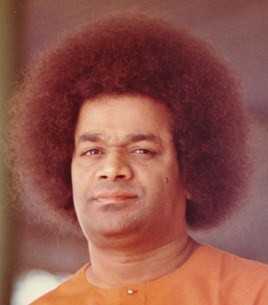 Sathya Sai Baba |
In my own case, the Moreno version of superiority continued with an extremely misleading (and libellous) personal attack in the webpage reserved for me at his vengeful website saisathyasai.com. This webpage dates to late September 2007, afterwards duplicated on a contrived blog bearing the name of Equalizer (alias Gerald Joe Moreno).
Pro-Sai activism here grossly misrepresented my publishing venture, attributing to me extraneous publishing imprints that I have merely distributed, not published. The logo of one such imprint was erroneously reproduced with a superfluous word denoting company status. Such basic errors accompanied the abusive strategy of depicting me as a vanity publisher and author of no relevance. Moreno also asserted: "He (Shepherd) is a thoroughly biased conspiracy theorist incapable of formulating a sober argument."
Sectarians often resort to depicting critics as conspiracy theorists. That accusation has no effective weight in the majority of cases. Very often, sectarians are revealed to be conspirators, for example, the Rajneeshi terrorists active in Oregon during the 1980s. Pro-Sai activism claimed to be formulating sober arguments lacking the element of bias; only support of the guru and his miracles was sober.
Moreno maintained his earlier dismissal of my books as per his Wikipedia User page of Oct. 2006. His website sequel of Sept. 2007 elaborately veered away from the details of my complaint. The activist did not mention the Wikipedia issue until over halfway through his justification, instead commencing with personal abuse, also peripheral matters such as an indirect reference I had made to the US State Department warning (against Sathya Sai) via a British newspaper (The Guardian). Nor did he mention the relevant contents of The Guardian newspaper article, which he dismissed. He distracted attention from this article by arguing that ex-devotees had been involved in trying to inform the journalist concerned, therfore the article was wrong.
His renewed attack was heavily coloured by Pro-Sai idiom, including the parting shot description of myself in terms of "just another foaming-at-the-mouth Anti-Sai ruffian." These ruffians were further said to "come a dime a dozen in the Anti-Sai Movement."
I was not a member of any Movement relating to the castigated category in Pro-Sai activism. The exaggerations in the rhetoric are evident enough. My complaint or counter-argument (posted on this site in August 2007) was described by Moreno as "browbeating and Anti-Sai propagandizing." It was actually neither, instead being a response to the overbearing action of a blatantly sectarian Wikipedia editor who had attempted a cordon against non-sectarian factors (section 4 above). Some analysts have commented that the Pro-Sai web maneouvre of Sept. 2007(at saisathyasai.com) is memorable as an instance of what can afflict outsiders who complain at Wikipedia problems.
The abusive tactic continued from the libellous preamble by ignoring most of what I had said in the original of the current page, and by deriding quotes from that page. For instance, Moreno cited two sentences of mine without stating that these were in reference to a newspaper article (in The Guardian). He attributed a cited passage from the journalist Paul Lewis to my negligence. Moreno stated: “He (Shepherd) purposely left out the pivotal word ‘unconfirmed’ in his quote.” Moreno attributed the quote to the US State Department, whereas I was quoting Paul Lewis in reference to that American source. Lewis did not have the word "unconfirmed." The reference was "inappropriate sexual behaviour by a prominent local religious leader" (Lewis, "The Indian living god, the paedophilia claims and the Duke of Edinburgh awards," The Guardian, November 4th, 2006, p. 3 col. one, lines 44-46). The Lewis article was a basic source in the original Part Four of this webpage. See also Paul Lewis and The Guardian Article (2008).
Moreno employed his error as supposed proof that I am “wholly unconcerned with giving full and accurate citations.” In reality, my quote from Paul Lewis was verbatim, as the journalist did not include the word “unconfirmed.” Both the journalist and myself used the word allegations to cover testimonies of inappropriate sexual behaviour on the part of Sathya Sai Baba (section 10 below). The Moreno version of citation is not legitimate. He was yet again suggesting that the allegations of sexual abuse were unconfirmed and unfounded.
Moreno only referred to Paul Lewis in a different section of his attack, where he was concerned to stigmatise The Guardian article as an “Anti-Sai Baba hack job.” There was no reference to the content of that article, instead a distracting obsession with Moreno’s blog adversary Sanjay Dadlani, who was not mentioned either by Paul Lewis or myself. The violation of due terms of argument was acute, as in many other Moreno blogs. Dadlani was an erratic ex-devotee blogger who boasted that he knew in advance about the newspaper article. The Lewis article was not written in a blog idiom, the basic mode favoured by Moreno. This despite Moreno's assertion that the Lewis item was "a poorly written article."
Gerald Joe Moreno is noted for his dismissal of critical newspaper reports as tabloid lies, in respect of Sathya Sai Baba. He attributed tabloid tendencies to other critics as well, merely because they were sceptical of the guru. Nevertheless, some journalists do accomplish their job well enough. Paul Lewis did not rely upon ex-devotee reports, instead relaying comments from FAIR, the MP Michael Gove, the Duke of Edinburgh Award Scheme, and Sai Youth UK (section 10 below).
The Pro-Sai activist version of international events in this issue was also misleading. I had very briefly indicated, in an update (July 2007), that official protocol was in question over the cessation of public warnings concerning Sathya Sai. Both UNESCO and the US State Department were well known for having provided such warnings against homosexual molestation. UNESCO had become the subject of a controversy (via the BBC); they were reputedly influenced by political considerations engineered by prominent Indian supporters of the guru. In contrast, the American agency had maintained vigil for much longer. Some analysts suggested that the US State Department eventually relaxed on this matter because Sathya Sai Baba was confined to a wheelchair from 2005.
Moreno turned this aside into a major distorting issue near the top of his webpage, implying that the official relaxations were proof of the guru's complete innocence. Further, he claimed that my brief references to these matters were "highly indicative of a conspiracy theorist." I was merely alluding to a fraction of the controversy about such matters, being more intent upon describing my own tangible harassment on Wikipedia. Pro-Sai activism is notorious for attempting to conceal complaints by the invention of superficial arguments and detours designed to confuse the uninformed, who are legion amongst web surfers.
The Pro-Sai blog tactic moved on to denounce my reference to articles of Wikipedia editor M. Alan Kazlev. Those citations were deemed a crime because Moreno was the subject of critique. The cyberstalker attempted to offset the critique by deriding new age beliefs of Kazlev, which included reincarnation (a widespread belief of Indian gurus, incidentally). This meant that I could not justifiably cite Kazlev, as I do not hold the same views (though I am neutral to reincarnation, which exists in very different versions). This unfamiliar angle was part of the bizarre worldview of Moreno, in which anybody who does not hold certain beliefs cannot legitimately reference someone holding those beliefs. That perspective is ludicrous, adopted for obvious purposes of convenience, and symptomatic of an acute poverty of argument (any non-believer in reincarnation could not criticise Sathya Sai according to this eccentric interpretation).
Discrepantly enough, I was also berated for not mentioning the more severe criticisms of Kazlev against Moreno. That abstention was good manners on my part, an attitude lost upon G.J. Moreno, who maintained a sense of acute personal vendetta against “Anti-Sai” rivals. A crime against the purge is: "Kevin Shepherd referenced M. Alan Kazlev against Joe Moreno." This was one of the disapproving headings to the Moreno webpage of Sept. 2007 that is under discussion here.
There followed a castigation of ex-devotee Ullrich Zimmermann, whom the Pro-Sai activist failed to describe in due context. I had stated: “One of the most arresting testimonies has only recently been duly evaluated.” I was here referring to the Robert Priddy commentary on Zimmermann, which I cited. Moreno totally ignored the context, instead distorting my brief reference to mean that “Kevin Shepherd endorsed, believed and described” the peculiar beliefs which Zimmermann had inherited from the miracle milieu at Puttaparthi. Priddy had tackled this problem in his commentary, unlike Moreno. I did not describe those beliefs, far less endorse them or believe them. See further the qualifying description in section nine below.
The Pro-Sai exegesis continued with an accusation that I referenced the BBC documentary, The Secret Swami (2004). The well known BBC screen feature was a pet dislike of Moreno, who continually accused the BBC of deviancy for presenting alternative views on the guru. “The BBC itself accepted and promoted the views of, and were sympathetic with, Anti-Sai Activists.” This heinous crime is presented as reflecting adversely upon my ignorance of it. Anyone who sees the video, or the transcript, of the BBC documentary, will easily discern that the BBC profiled both sides of the argument. However, in Pro-Sai activist lore, the BBC are indicted as Anti-Sai supporters. Furthermore, “the only people who evade and continually screen out all the contrary evidence are Anti-Sai Activists.” Dr. Michael Goldstein’s evasionism is now very well known. The Pro-Sai reasoning of Moreno eliminated clear documentation while claiming contrary evidence in sectarian belief.
To give another example of the polemical tactic: “Fortunately, readers can assess Kevin Shepherd’s conspiracy mentality and extremist views when he alleged without proof that Sathya Sai Baba is a ‘strongly alleged paedophile guru who is closely associated with terrorism.’ ”
In actual fact, there is no conspiracy mentality involved in citing sources which do strongly allege sexual abuse and paedophilia (section 9 below), also some sources which do invoke close associations with terrorism. Moreno explicitly denies the relevance of Basava Premanand and the Indian Rationalists, comprising another sector of his pet hates. Sathya Sai was implicated, however indirectly, in numerous murders and other severe problems occurring on his doorstep. Formulaic Pro-Sai denial is no guarantee that the truth is represented by sectarian preference.
Moreno here lumps together all the numerous dissident reports as being “assumption, blind belief and conjecture.” The verdict of Pro-Sai judgment was here stipulated. An outsider (myself) reporting dissident texts “clearly has an agenda to push and readily attempts to deceive readers with Anti-Sai propaganda.” Outsiders take note. Only Pro-Sai polemic is legitimate, with all that this implies.
Further, the Pro-Sai dogmatist accused me (more than once) of never contacting him to find out the truth. This is interpretable as a superficial ruse, calculated to make me appear unreasonable in comparison to the sectarian exegete. The reason for not contacting him is legitimate enough when the context is known. I was complaining about Moreno’s adamant stigmatisation of my books on a Wikipedia User page, also his dismissive item Kevin Shepherd and Robert Priddy recently appearing on a wordpress.com blog in July 2007 (meaning the sathyasaibaba blog). Moreno deviously refrained from mentioning these acute deterrents. Furthermore, I knew that Moreno was notorious for parading on his website communications sent to him, depicting these in an unfavourable light. I had concluded that contacting him, in any contingency, was strictly not advisable.
Moreover, ex-devotees warned outsiders that Gerald Joe Moreno was a cyberstalker, continually seeking to gain the IP identity of new victims. Ex-devotees possessed information about what Moreno had done in email campaigns against victims. In his own mind, the informants said, any measure was justified in support of the guru.
Moreno's disdain for ex-devotee Robert Priddy was acute. Moreno accused me of being willing to compromise my anti-drug views by defending Priddy’s early pro-drug articles. There was no such compromise, as more impartial readers can plainly see. I pointed out that Priddy was not an advocate of LSD-induced hallucinations, to use a Moreno phrase.
The 1960s encounter of Priddy with drugs did influence his thinking for some length of time, possibly even facilitating the subsequent ideological hold of Sathya Sai Baba. Priddy's conversion to the guru, during the early 1980s, was attended by his placing online three articles about his psychedelic experience. Priddy deleted those articles many years later (belatedly in my view). Moreno unlawfully acquired them, reproducing them on a blog, while alleging that the victim had deceptively removed the articles in order to conceal his former descriptions of experimental LSD experience. Priddy added to his psychedelic articles some explicit disavowals of commitment to LSD, so I awarded these due recognition (section 3 above).
In a devotional book of 1994, Robert Priddy explicitly referred to his LSD experience as a preliminary inspiration to his pursuit of “spiritual development” under Sathya Sai Baba (Source of the Dream, chapter 2). He there admits that the drug experience had created in him “a certain spiritual pride.” The preliminary had been superseded in his mind, though he was subsequently to grasp that he was still in error, as a victim of guru deception. Priddy wrote in his devotee book: "The [LSD] experience probably did not improve me much outwardly, if at all, but inwardly it altered my life in various quite crucial ways." The big issue relating to such experiences is where they actually lead. Robert Priddy had to laboriously extricate himself from his well entrenched role of nearly twenty years subscription to the guru he later repudiated so strongly.
Many Westerners who experienced LSD hallucinations afterwards became attached to various Hindu and Buddhist celebrities. This trend occurred over decades. The confusion created by hallucination can be extensive. Some LSD users became "spiritual teachers," such as Richard Alpert, alias Baba Ram Dass. Others found that their chosen guru had serious defects.
The Pro-Sai inquisition next alighted upon the subject of the late V. K. Narasimhan (d.2000), the devotee at Puttaparthi who was a friend of Priddy. Moreno elevates his own article on Narasimhan as an uncontestable source sufficient to repudiate anything Priddy wrote about his close friend. However, it is not possible to believe in the Pro-Sai claim that Narasimhan never expressed cynical doubts. The more lengthy accounts by Priddy, retrieved from his diaries, are more convincing as a guide to the Indian ex-journalist. The Pro-Sai contraction alleges that my very brief outsider reference to Narasimhan amounts to “fanatic viewpoints.” I merely credited that ex-journalist devotee as possessing an analytical streak, a factor supported by diaries. On the basis of Priddy sources, I fleetingly commented that Narasimhan was “known to have entertained extensive doubts, his habitual cynicism tempered by his dependence upon ashram amenities.”
The dogmatism of the Pro-Sai position has been considered more pronounced than numerous other sectarian strategies currently visible in diverse media. Moreno asserted that “Kevin Shepherd’s position about V. K. Narasimhan undermines his self-professed integrity and highlights his bias and fanatic viewpoints.” That extreme verdict has elsewhere been assessed in the light of a cyberstalking tactic originating on Wikipedia.
The attack then moved into the Moreno version of Wikipedia events about which I had complained. We are told that “Kevin Shepherd repeatedly whined and snivelled” (on the Citizen Initiative webpage uploaded in August 2007) about the Pro-Sai stigma contrived against me on the Wikipedia User page of SSS108 (alias Joe Moreno), dating to October 2006. See section 4 above. Moreno also misattributed the Wikipedia quote he disputed to the book of mine he dismissed, further indication that he had not read what he was proscribing. The self-justifying stance of the Wikipedia stigmatiser was attested in the comment: “Don’t expect Kevin Shepherd to accurately relate these facts without his typical spin, paranoia and ‘cult’ accusations.” Uninformed readers might here be led to think that there was nothing sectarian about Gerald Joe Moreno, though he relied for his readership upon blinkered devotees. His Pro-Sai Activist disposition was evident in virtually every paragraph of his copious website and blog attacks on the despised “Anti-Sai” critics.
Moreno then mentions with relish how he (temporarily) foiled the ex-devotee Andries Krugers Dagneaux via a Wikipedia arbitration committee case in 2006. Diverse Wikipedia editors subsequently grasped the acute difficulty in reasoning with Moreno, as the official Wikipedia report attests (section 7 above). Various crises occurred, as a consequence of which Moreno was banned indefinitely from Wikipedia in March 2007. Yet in mentioning the decisive ban, I was here censured by the pro-guru blogger with the misleading remark: “Don’t expect Kevin Shepherd to mention any of these pertinent facts.” I did not need to mention the arbitration case, only the stigma applied to my publishing effort and the overall outcome of the Wikipedia administration activity. These were the most pertinent facts in my case, not the continual friction between Moreno and Dagneaux that amazed and annoyed other Wikipedia editors.
The Pro-Sai Activist is emphatic about his temporary victory on Wikipedia in 2006, a celebration considered superfluous elsewhere. In his attack on myself, he says: “This was a huge blow to Andries and Anti-Sai Activists (and they whined and hissed about it on their own Anti-Sai websites).” The diction is self-explanatory. Some academics have expressed incredulity that such sectarian activity and temperament was allowed to flourish on Wikipedia for nearly a year. The protracted episode has been considered one of the most telling instances of the unguarded and unmonitored editorial/administrative malfunction on Wikipedia that became notorious. Moreno was basically addressing American, European, and Indian devotees who were susceptible to his pervasive “Anti-Sai” stigma, no other party being in affinity with this provocative ideological idiom.
The penchant for defamation was subsequently extended to two Wikipedia editors who expressed approving assessments of my books on a discussion page. Because they endorsed me, Moreno denied their validity (after he had been banned from Wikipedia). This issue is charged with an unusual edge, because the two maligned editors were academics with solid credentials. I am referring to Jedermann and The Communicator. See further Joe Moreno Insults Academics on Wikipedia. Jedermann (Dr. M. E. Dean) declared his real name on Citizendium six months before Moreno depicted him as a meaningless and nameless subject of my "comical citation." The issue basically boiled down to: how dare such pro-Shepherd editors contradict the Pro-Sai evangelist Gerald Joe Moreno (alias Equalizer alias vishvarupa108), who represents the perfect guru, and who is therefore infallible. Moreno never admitted to any error, as ex-devotees never tired of emphasising.
The confusion created amongst semi-literate Wikipedia editors is attested by the instance of Dazedbythebell (Meher Baba devotee Christopher Ott), who was still identifying me with two other persons in 2012, including The Communicator. See Triple Incarnation Theory. In 2009, The Communicator declared his real name, which is Simon Kidd, an academic in Australia. Nevertheless, problems arising on Wikipedia were magnified over the years by careless editors, a drawback of which real name manager Jimmy Wales became aware in 2012 (section 1 above), the year he deleted the SSS108 User page.
Another semi-literate (and pseudonymous) editor, contributing to the Wikipedia Reliable Sources Noticeboard in 2012, even construed the present webpage in terms of an unmerited hostility to Wikipedia, insinuating that criticism of the faultless online encyclopaedia disqualified me for mention as a reliable source. Some analysts have concluded that, convergent with the sectarian issue, the Wikipedia editorial process is a serious hazard to outsiders (whether academic or citizen).
Pro-Sai Activism attempted to implicate me in pornographic subscription. This sidetrack from my complaint (about the Wikipedia cordon by Moreno in 2006) met with close attention from analysts able to comb every word. Their conclusions were not flattering to Moreno. I had quoted a letter from ex-devotee Robert Priddy, mentioning his grievance at having been entered on a porno site, a deed which he strongly attributed to Moreno or a close accomplice. Moreno denied the charge, suggesting that Priddy himself was responsible for his being listed on pornography webpages with a view “to obtain more exposure for his Anti-Sai website on a world-wide sex directory.” The retired academic Robert Priddy (over seventy years of age) was simply not the type to advertise in this manner. Some critical observers reminded that pornography taint is a tactic of cyberstalkers against their victims.
In a detour from the problem in evidence, Moreno brought up two more of his obsessions, meaning two opponents whom I had never mentioned, namely ex-devotee Sanjay Dadlani and critic Reinier Van Der Sandt. He cited both of them in a pornography context, attempting to draw me also into this association. “Mr. Shepherd, do you or do you not agree that viewing child pornography is wrong regardless of whether or not you are a customer?” This is cyberstalker tactic, deemed very dubious by some legal analysts. It is well known in literate circles that I oppose pornography, especially child pornography, as I have made clear in a published book, meaning Pointed Observations (2005). If I had the opportunity to do so, I would assist the implementation of laws against porno rings, porno sites, and cyberstalkers, laws that would eliminate these forms of social gangrene.
In the same web passage, Moreno denies the accusation of Priddy that he (Moreno) has, e.g., posted “photos of critics of Sathya Sai Baba with distorted faces and added bodies of a pornographic kind.” Unfortunately for the Pro-Sai argument, there exist two such Moreno-derived images answering to that description, one with a distorted nose, and one with the addition of female breasts to a male body. See Moreno and copyright. The two afflicted images are those of Van Der Sandt and Dadlani, who both ranked high on the hit list of Pro-Sai activism. See also Joe Moreno’s Undeclared Distorted Images of Opponents.
I can here state that, because of the virulent Moreno attack on myself, I made enquiries about Sanjay Dadlani. He was apparently a young Indian ex-devotee who sometimes dabbled in the fashionable contemporary diction emanating from America, a trend influencing the younger generation to their acute literary disadvantage. Ex-devotees said that Dadlani had engaged in a bulletin board and blog duel with Moreno. The Indian was severely harassed by the American, who had launched an intensive campaign against Dadlani. Further, the same harasser is alleged to have employed porno site devices against the victim. The details are shocking. I was told that Dadlani had retreated from the harassment into his academic career, not wishing to engage further.
Moreno websites and blogs were employed to attack over fifty ex-devotees (the number has been counted as high as a hundred). Sanjay Dadlani gained 49 separate and adverse Google rankings resulting from Moreno attack pages. Seventeen of these entries were described in terms of "Google listings where Moreno has arranged for Sanjay Dadlani's name to appear on numerous disgusting porn sites." Such details strongly indicate a penchant for cyberstalking activity, despite the denials of Moreno.
The Pro-Sai activist webpage (at saisathyasai.com, dating to 2007) against myself (a complete outsider) ended with three emphases that are also in dispute:
(1) Moreno asserts that I failed to cite his web articles, though he deviously avoids reference to the fact that I linked to his primary website (where those articles can be found) and quoted several times from his FAQ on that site. The FAQ of a web presence is generally considered to be the crucial indicator of attitude. For this consideration, I was derided as “a fanatic and intellectual imposter.” Academics have carefully noted the abusive standpoint of Pro-Sai Activism, which is considered an irresponsible blogging convenience in the sectarian cause. Further, the Moreno articles are so vehemently “Anti-Sai” that more impartial readers tend to have difficulty in maintaining patience. In addition, Moreno not only failed to mention my link to his website, but also neglected to link to my own site, providing only the URL.
(2) The abusive web presence threatened legal action for my “copyright infringement” in using his sole known image. There was no other image available to identify the American Wikipedia sectarian who proscribed and stigmatised the books of a British author, on the flimsy basis of citing the sectarian's major opponent Robert Priddy in a single appendice. This Wikipedia intrigue was assisted and endorsed by Jossi Fresco, a Wikipedia administrator who had gained a reputation for favouring controversial sects and cults. After being banned by more responsible administrators, Moreno threatened to sue me for “hefty damages” if I used his image in any published book. He evidently knew that it was unreasonable to sue for his sole known image being reproduced on the web. His preference for anonymity is notorious amongst ex-devotees, who provided a long list of his known web pseudonyms. I had no intention of using his image in any book. He responded to the reappearance of his suppressed single image by employing three images of myself and five of my mother, in a clear context of mockery. This tactic has received assessment elsewhere as being illustrative of an extremist temperament.
(3) The Pro-Sai exegete continued his former Wikipedia role of censoring agent. Moreno stated: “He [Shepherd] attempts to deceive readers with his self-published works,” though the accuser has given no indication of having actually read any of those books. Further, I am “a thoroughly biased Anti-Sai Activist.” This ultimate stigma is attended by a Pro-Sai judgment that “the facts speak for themselves,” meaning the presumed innocence of Sathya Sai Baba. Critics say that the facts need to be ascertained in a totally different manner to sectarian vituperation and insidious libel.
The supposed facts are listed in terms of the customary Moreno credo found in various of his web items. This formula asserts that Sathya Sai Baba has never been convicted of any crime, never been charged with any crime, and “never had even one single complaint lodged against him by any alleged victim, first-hand, in India.”
This Pro-Sai version of the Indian situation was contradicted by ex-devotees, who emphasised that constrained and silent victims have been terrified of harassment and even murder. Furthermore, Moreno omitted the fact that Andhra High Court, also the Supreme High Court of India, were dominated by Sathya Sai devotees, who declined to act in the proper legal manner. The complaints of such concerned objectors as Hari Sampath and Basava Premanand were suppressed and dismissed by the presiding legalists demonstrating a devotional Pro-Sai mentality. See section 9 below and section 3 above.
The law in other countries is less encumbered by sectarian interests. Concerning the web tactics of Pro-Sai activism, a Western legal expert has commented (January 2009) in relation to my own instance:
I think that Joe Moreno has been quite defamatory, and I would be very surprised if he has not taken the precaution of ensuring that no property of any value is in his own name, and thus not available to execute against action exerted to satisfy an award of Damages for Defamation.
The sectarian tactic of Gerald Joe Moreno had by that time reacted adversely to my further objections in 2008 (on my second website). He duplicated the content of his earlier website attack on a superficial blog bearing his pseudonym of Equalizer. This attack blog claimed to “expose” me. The sectarian aberration is elsewhere viewed as confirming a manic form of cyberstalking that could easily fasten upon more outsiders to the sect.
Moreno (Equalizer) applied a derogatory heading to his "Kevin Shepherd exposed" blog (at blogspot.com). That heading includes hostile descriptions of myself as "vanity self-publisher," "pseudo-intellectual," and also "New Age Promoter and Anti-Sai Extremist." The sectarian blogger committed excesses that are very obvious to many readers. I am known at large for NOT being in the vanity category of the book trade, and am well known for NOT promoting the New Age. My output on Sathya Sai Baba is relatively small, coming under the description of criticism as distinct from extremism.
The present article resulted from Moreno extremism and stigma on Wikipedia. That stigma was furthered when Gerald Joe Moreno (alias Equalizer) presented his libels and inaccuracies under such facile blog titles as Introduction to Kevin RD Shepherd. What he actually demonstrated is that sectarian thinking can easily become manipulative on Wikipedia, mushrooming into distorting blog epithet, hate campaign, and obsessive web harassment visible on Google.
One of the monotonous accents of the "Kevin Shepherd exposed" blog mistakenly identifies me as a "Findhorn Foundation Radical." I have never been in that category, having no affiliation with the Findhorn Foundation. I am a critic of the Foundation, which is not the same thing. I have never been a member of that organisation. The misconceptions created by apologist thinking are pronounced.
See below my initial objection to the September 2007 website attack of Pro-Sai activism in the document entitled Kevin R. D. Shepherd in response to Gerald Joe Moreno. The sectarian did not respond to that document, failing to mention my objections, also failing to make due revisions to his erroneous webpage. Instead, Moreno fastened upon part of the very brief Postscript, in an abortive attempt to imply that I could not distinguish myself from other persons bearing my name.
Gerald Joe Moreno inserted this bizarre justification of his position in an update of January 2008 to his notorious webpage at saisathyasai.com. See further The Joe Moreno Blog and Tag Harassment. Moreno was unsuccessfully attempting to disown responsibility for the juxtaposition of his blog title Kevin Shepherd and Robert Priddy on a composite wordpress.com tag prominent on Google Search. The situation of wordpress tags being employed to assist sectarian harassment (however indirectly or inadvertently on the part of wordpress management) is reprehensible, an affliction in this instance that was ultimately the consequence of Wikipedia activist editing.
See further my Wikipedia, Gerald Joe Moreno, and Google (2008). See also my subsequent web article Internet Terrorist (2009), a warning for victims of sectarian misrepresentation. Also relevant is Hate Campaign Blogs of Gerald Joe Moreno (2010), featuring in my account of some Wikipedia events dating to 2006-2012. I should add that Wikipedia editorship has been known to cite Moreno blogs against me, while ignoring my own websites. One conclusion is that some Wikipedia editors have a defective IQ, a deficit conceivably influenced by a reading diet largely restricted to blogs. Blog cancer is still generally unrecognised in contemporary society, where literary standards are falling sharply. I have been obliged to counter misconceptions with Analysis of a Cultist Defamation.
9. Anomalies and Testimonies of Sexual Abuse
Outsider observers (i.e. those who are neither devotees nor ex-devotees) have noted the idiosyncrasies of both partisans and dissidents in relation to Sathya Sai Baba. Devotees are too uncritical of this guru for outsiders to take seriously, especially when they are aggressive and condemnatory towards critics. Ex-devotees have also exhibited disconcerting tendencies in some cases, e.g., contemporary lewd speech, new age exhibitionism, new age beliefs. This reflects their background in compromised social milieux of the Western industrialised countries.
In addition, the ideological extremisms of the Sathya Sai sect left their mark on some ex-devotees, who continued to use expressions conditioned by their exposure to "miracles," which are not accepted as valid by critical observers. Other ex-devotees are quite lucid in their descriptions, resisting anything relating to the miracle lore. A premium is awarded to the more graphic and coherent accounts, especially anything bibliographic. In more general terms, the testimonies to abuse and distress are sufficiently substantial to merit a conclusion that these have to be taken seriously. The word "allegation" here amounts to a reductionist label.
The oft-changing Wikipedia article on Sathya Sai Baba has included reference to the Swedish ex-devotee Conny Larsson, one of the testifiers to sexual abuse, whose related book is entitled Behind the Mask of the Clown. After many years as a devotee, "he later broke away from the movement, outraged at witnessing the Baba's behaviour of a sexual nature with a young boy; once outside of the movement, Larsson expressed worry over being mistreated by current followers of the movement" (Wikipedia article, accessed 01/04/2009). That statement indicates more than one behavioural anomaly in the sect. The British ex-devotee David Bailey certainly did encounter extreme repudiation from vehement devotees after making known his discoveries in The Findings (section 6 above). The opposing mentality can be fanatical.
The Sathya Sai Organisation (SSO) was a medium for worship of Sathya Sai Baba as a divine being, as God. The members were not critical of anomalies, save in the instance of ex-devotees who seceded from the SSO. A Public Petition for investigation of Sathya Sai and his worldwide organisation was launched many years ago (exbaba.com search tab). The project was hindered by bureaucratic inertia. An internet document provides a lengthy list of prominent ex-devotees of Sathya Sai Baba, including former key leaders and long-time workers in the SSO. That document is Ex-Office Bearers (formerly online at saibaba-x.org.uk/10/EX-OFFICE BEARERS), ending with:
The main cause for most defections are the sexual molestations, including oiling of genitalia and even widely alleged homosexual seduction and even oral and other sex by Sathya Sai Baba, plus his uninvestigated involvement in the police executions of four of his devotees in 1993 (Murders in Sai Baba’s Bedroom), and not least his many documented fraudulent ‘materialisations,’ broken promises, and misuse of funds. The facts concerning these are documented in the 1 hour BBC documentary on Sathya Sai Baba – The Secret Swami – sent worldwide in 2004 and available on order from the BBC.
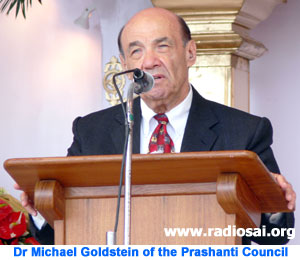 Michael Goldstein |
For many years, the Sathya Sai Organisation leader was Dr. Michael Goldstein. The dogmatic attitude of this official, in the BBC documentary of 2004, earned him the designation of “doctor from hell.” He was accused by ex-devotees of continually screening out all the contrary evidence to the glossed role of Sathya Sai Baba as a spiritual luminary. Goldstein is stated to have returned unopened the complaint mail from former representatives of the American branch of his sect. A tactic of evasion thus attends Goldstein’s acceptance of the guru’s contested claim to purity (Shepherd, Investigating the Sai Baba Movement, p. 298). Goldstein gained notoriety when, secretly filmed by the BBC, he adopted what seemed a threatening attitude towards an interviewer. See Michael Goldstein and The Secret Swami Documentary.
The American devotee Isaac Tigrett also appeared in the BBC documentary. His association with the guru dates from the 1970s. A multi-millionaire, Tigrett is noted for a substantial economic donation to the sect. Tigrett shocked many viewers by saying that if Sathya Sai Baba were to commit murder, this would make no difference to his (the devotee’s) perspective. The same devotee has credited that the allegations of sexual abuse are true (Investigating, p. 298), his standpoint thus constituting an unacceptable commitment elsewhere. Tigrett said explicitly: "I believe there is truth to the rumours."
  Isaac Tigrett, Tanya Datta |
The BBC interview featured a dialogue with the reporter Tanya Datta. See BBC Secret Swami for a transcript. The following excerpt is relevant here:
Datta: "Even if it was proven to you that [Sathya] Sai Baba was a paedophile and a serial sex abuser, you're saying it wouldn't change the fact that he is your guru."
Tigrett: "Absolutely not. He could go out and murder someone tomorrow, as I said, it's not going to change my evolution."
The milieu under discussion has therefore been considered dangerously permissive. The guru had such a hold over some devotees that nothing he could do was too unlawful for them. During his lifetime, the Sathya Sai Organisation in India became strongly associated with terrorist bullies deplored by the Indian Rationalists. One of the Rationalist leaders (Basava Premanand) survived four murder attempts believed to have been instigated by the “miracle” guru or his close associates. Such details have been mentioned by the BBC (Shepherd, Investigating, pp. 287, 291 note 24, 297). Unfortunately, other attempted murders were successful, according to internet reports. The notorious "bedroom murders" of 1993 were inadequately investigated, the lethargy of the Indian government being the prime cause. The government was influenced by devotional sentiments amongst the upper classes. The official police report of this violent episode has come under strong query.
An early testimony to the problems discussed here appeared in an Australian magazine dating to 1999. The ex-devotee editor stated:
A growing number of boys and young men are coming forward with allegations of sexual harassment, sexual abuse and rape.… one finds many more accounts of faked miracles, suspicious deaths, massive financial fraud, weapons and explosives being found in the ashram, an assassination attempt, and yet more cases of paedophilia and homosexual abuse.… I ended up speaking to many victims, parents of victims, former Sathya Sai Baba centre leaders, and some respected figureheads from the movement. All confirmed the same pattern of abuse and sexual misconduct.… The effects of this misconduct has caused unestimateable damage within many families, including suicides. I only investigated the allegations of sexual misconduct. I notice there are also many who claim the miracles (of Sathya Sai Baba) are faked, there are many allegations of financial fraud, and there are many dead people who were supposedly ‘healed’ by Sathya Sai Baba. (Report of Duncan M. Roads in Nexus Magazine, Aug–Sept. 1999; see also Duncan Roads and Sai Baba cyberterrorists and Attack on Nexus Editor Duncan Roads)
One of the ex-devotee accounts used by Roads was that of Terry Gallagher, a former official in the Australian branch of the Sathya Sai Organisation. In 1993, Gallagher visited the Puttaparthi ashram of Sathya Sai Baba, shortly after the notorious murder of four young devotees in the living quarters of the guru.
The purpose of this visit was to find the reason why former students of Sathya Sai’s college would want to kill him, particularly when they had been given a free education! The eyewitness accounts were horrific! After bursting into the mandir, four students [or devotees] found themselves trapped upstairs where Sathya Sai Baba was staying. Each was interrogated by the police, then one at a time they were executed. The stench of death was everywhere. I made further enquiries about Sathya Sai Baba having sexual relations with college boys and male students – some of these as young as seven years of age – and whether this was the reason for former students wanting to kill him. I was told, to my horror, that this (sexual molestation) was an acceptable Indian practice! I felt sick, and just wanted to take my family and leave the ashram and India as quickly as possible. Before we did, we were all called for an interview with Sathya Sai Baba, and we told him what we had experienced and been told. Sathya Sai Baba made no comment on our accusations and was only anxious to know who had told us these details.… Sathya Sai Baba was tense and agitated, and his body language told us all that what we had found out about him was the truth.
Gallagher had earlier gained confirmation of the sexual molestations from college students and long-term devotees living at the ashram. He had also detected the ruse of Sathya Sai Baba in “materialising” rings and other objects, which the defector described as “all being produced by sleight of hand and deception.” See Terry Gallagher's testimony (www.exbaba.com, search tab).
The episode of the June 1993 murders has gained frequent references in web sources. The official ashram version, endorsed by the police, is that four devotees were attempting assassination of the guru, and were shot dead by law officers. This has been strongly contradicted by some dissident and sceptical writers, who stress that official investigations were not adequately pursued. See, for instance, Basava Premanand, Who Murdered the Six in Sai Baba's Bedroom? This is an evocative extract from his lengthy book on the subject published in 2001 (www.exbaba.com, search tab).
The Rationalist leader Premanand is here very critical of events surrounding the Puttaparthi guru who claimed: "Nothing happens in this universe without my specific wish." In this atmosphere of unquestioned omnipotence, many young college students were sexually abused, while objectors who saw through the diverse ashram manipulations were murdered.
Premanand observes that the notorious 1993 bedroom murders only became known because the alleged four assailants activated the siren, causing hundreds of ashram residents to appear on the scene. The single bullet preserved was not from a police rifle. There were apparently more than 200 rifles kept at the residence of Sathya Sai.
Another disputant was Hari Sampath, a voluntary security man at Puttaparthi ashram during 1992-95, before becoming a disillusioned ex-devotee. He later composed a Formal Criminal Complaint against Sathya Sai Baba (www.exbaba.com, search tab). This document, dating to 2001, was submitted to Indian bureaucrats and legists who opted for a suppressive tactic.
One of the many episodes described in the Criminal Complaint was the June 1993 "bedroom murders." According to Hari Sampath, the four ill-fated devotees were not shot dead by police. Instead they were tied up and clubbed to death by a crowd of local ashram devotees armed with sticks and knives. The police were not even present on this dire occasion. Bullets were afterwards pumped into the bloodstained corpses by two police constables, who were following a contrived plan. There was no post mortem, a procedure which Sampath says would have easily revealed how the real cause of death was not bullet wounds.
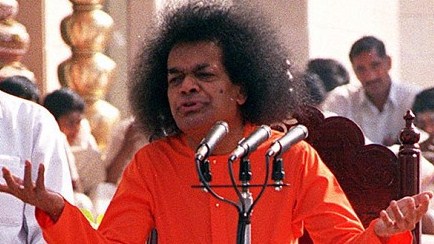 Sathya Sai Baba |
The testimony of Hari Sampath is very unflattering to the guru. For instance, he relates that Sathya Sai Baba has "on hundreds of occasions, asked his followers to abandon conventional medical treatment" for diseases like cancer, and instead rely upon his "materialised" holy ash. "Upon following [Sathya] Sai Baba's advice, the diseases had worsened considerably, never been cured, and had led to death in many instances." Failure of the promised cures had resulted in several suicides. The guru "has also been claiming for several years that he has the ability to resurrect dead people."
The same source informs that:
[Sathya] Sai Baba uses a very small portion of these assets [bequeathals to his international trusts] in building hospitals, school or colleges, both to enhance his image as well as to keep the donations coming in for 'good causes'.... Sai Baba uses most of the wealth acquired through unscrupulous means for personal aggrandisation as well as possession of luxury items like a fleet of imported cars etc. Sai Baba has two Mercedes limousines, two BMW cars, one Daimler, one Jaguar, and a lot more Indian automobiles just for personal use. He has the roof of his mandir lined with solid gold.
Sampath is also explicit about the issue of sexual molestation, including details of Indian victims:
Hundreds of incidents of [Sathya] Sai Baba forcibly molesting young men, and making them perform sexual acts, have been reported in the mainstream Indian media....Some of the molestation victims of Sai Baba are even 11 years of age or younger. The sexual abuse crimes of this individual has resulted in severe emotional and mental trauma for the victims and their families, leading even to suicides in some instances....
I have heard numerous instances of boys as young as 7 years old and usually 11-16 years old being slowly brainwashed into having sex with this godman [Sathya] Sai Baba until they almost believe it is good for them. This has been apparently happening as far back as the 1960s, and I know of people who had been similarly abused in 1968 and thereabouts.
Sampath left the movement in disgust, moving to America. He now learned of Westerners who had been abused by the guru, male victims from various countries such as America, Canada, Germany, Britain, Sweden, France, and Australia. They were less afraid to speak out than the Indian victims. A basic pattern of molestation emerged:
The molestations always progressively took on an explicit sexual pattern which included [Sathya] Sai Baba forcing the young men to perform oral sex. Psychologists dealing with these areas of crime call this 'grooming,' and it is considered [the] typical behavioural pattern of serial and habitual offenders who molest younger people. (Formal Criminal Complaint against Sathya Sai Baba)
The ex-devotee became concerned about the predicament of Indian victims, whose circumstances were often very different to those of Western abused. Commentator Michelle Goldberg, in Untouchable? (2001), reports Hari Sampath as saying:
I've spoken to 20 or 30 boys who have been abused, and that's just the tip of the iceberg. There are 14-year-old kids made to live in his [the guru's] room and made to think it's a blessing. In most cases, their parents have been followers for 20 years and are not going to believe them.
An early report of sexual molestation appeared during the 1970s, in the book Lord of the Air by the American ex-devotee Tal Brooke, who described sexual abuses by Sathya Sai Baba. That account was widely ignored by devotees, being banned. The rejected book was subsequently viewed as valid by other sectors.
The allegations of Tal Brooke have since been accompanied by many other international testimonies to sexual molestation on the part of Sathya Sai Baba. There are about thirty named testimonies in this respect, though many more of an anonymous nature, and an even larger number who are referred to by a wide range of informants. Many of the named testimonies have been written down by the abused. The data is impossible to ignore by any diligent analyst. See further The Testimonies of Sexual Abuse (2008). Apologists for the sect vehemently denied the "allegations."
A well known testimony is that of Conny Larsson from Sweden, who campaigned on television against Sathya Sai. Two of Larsson’s acquaintances committed suicide in the tragic train of events relating to the abuser. Two other salient testimonies come from Alaya Rahm and Mark Roche, both of them Americans featured in the BBC documentary The Secret Swami. A report by Dr. Naresh Bhatia on the anal rape of a young Indian boy caused strong reactions (including typical denials by partisans of the guru). The American David Juliano wrote that he was abused by Sathya Sai in 1974, further indication of the lengthy time span involved. Keith Ord was a British informant whose friend committed suicide like other victims.
The differing nationalities of the abused are striking. These vary from Hans de Kraker of Holland and Marc St-Andre of Canada to the Iranian Afshin Khorramshahgol and the Indian Meenakshi Srikanth (who testified that many Indian college students were sexually abused by Sathya Sai). Then there is John Purnell of Australia and Iqbal Raaid of Pakistan. A bold case of resisting intimidation was Jens Sethi of Germany, who fearlessly reported to the Hamburg police and published his account in a newspaper.
Despite a substantial number of reported victims amongst Western males, the major target was apparently Indian boys in the Sathya Sai colleges. These unfortunates are described as being generally terrified to speak out, not least because of the blind and dogmatic devotionalism exhibited by their parents. This devotionalism is the screening factor that blocked due charges being made against the abusing guru in India.
The well known Indian Rationalist commentator, Basava Premanand, received the names of various Indian college students abused by Sathya Sai. The British ex-devotee David Bailey reported that Indian college students had told him they were sexually molested. Hari Sampath became very concerned at the fate of Indian boys, as detailed above. Some students of the Sathya Sai Colleges posted about 150 names of victims in their ranks, using the Quick Topic website for this purpose. However, in general the victims were too scared to give their true names, a major reason stated to be the fear of being killed, in the wake of the "bedroom murders." See further Robert Priddy, Worldwide Exposure of Reported Sexual Abuses, especially section 13 entitled Sai Baba a threat to many of his students (formerly online at saibaba-ex.org.uk/6/saisex1).
Another testifier to abuse is Ullrich Zimmermann (a German living in America), noted for three lengthy online video interviews, describing in detail his relationship with Sathya Sai Baba. Zimmermann is now another ex-devotee. He narrates in rather explicit terms how Sathya Sai Baba imposed oral sex upon him in the guru’s interview room. The dissident website ExBaba.com described these interviews in terms of delivering “a major blow to any wishful doubts entertained by the faithful that Sathya Sai Baba practices sex on male devotees.” Ex-devotee Robert Priddy contributed an analysis in the web article Ullrich Zimmermann's Shocking Interview with Sathya Sai Baba (see www.exbaba.com, search tab). This commentary emphasised that Zimmermann found difficulty in extricating himself from devotee thinking, a predicament including miracle stories and fantastic beliefs about the guru as a divine being.
The lengthy statements of Zimmermann included extravagant descriptions deriving from his conditioning to the "miracle" mentality, so strongly encouraged at the Puttaparthi ashram. Zimmermann was twice induced by the guru to engage in oral sex; the victim was led to believe that this was for his spiritual benefit. His first interview with Sathya Sai occurred when he was 21 years old, in the 1980s. His later video statements, made in 2000, attest the strong influence of exotic concepts prevalent at Puttaparthi. He refers to occult powers, "white tantra," and even dual sexuality (which he interpreted in a miraculous vein). In that milieu, all actions of the guru were justified as divine blessings. Zimmermann still reflected this scenario in his thinking. He believed for many years that the oral sex was an "honour" awarded to him by the guru.
Two sexual contacts with the guru left the young devotee feeling confused, while tending to justify the situation in terms generally acceptable amongst devotees (though certainly not to medics and psychiatrists). On the second occasion of molestation, Zimmermann withdrew quickly, feeling awkward. He says that he then saw a flash of white light emanating from the sexual organ of the guru; this hallucination can be interpreted in terms of a psychological defence mechanism on his part. The basic trust he had cultivated in Sathya Sai, since the age of 14, was resistant to the shock of mundane encounter. Nobody was able to give him due information in such an uncritical devotional milieu. He wished to conform with adult expectations. Under such influences, Zimmermann became disposed to concepts of "channelling," popular amongst some Western devotees of Sathya Sai. He later transferred attention to the Ramtha cult.
Nearly two decades elapsed before the victim openly presented details of his sexual encounter with Sathya Sai Baba. Zimmermann needed yet further time to grasp that he had been extensively deceived. A similar delay of disclosure occurred in the case of Mark Roche, another devotee who eventually testified to oral sexual abuse in the BBC documentary of 2004. Priddy correctly observed in his commentary:
It is not unusual in all kinds of cases of sexual abuse for such a long delay in speaking out, as is well known and widely documented by abuse counsellors and psychologists.
Sathya Sai Baba had developed a ritual of "oiling," applying oil in the interview room to selected male devotees. The oil was applied by him to the stomach or genital area of the recipient. This ritual became notorious amongst ex-devotees as a significator of the guru's sexual interest, which could easily develop into molestation. Unconvincing explanations for this preliminary were proffered by the guru and by devotees. Kundalini arousal was a favoured theme.
Ullrich Zimmermann found that the oiling ritual led quickly into oral sex. The sordid details were supplied in the web sources. The victim afterwards talked to other people living at the Puttaparthi ashram, who confirmed that such events of a sexual nature regularly occurred. The BBC documentary, The Secret Swami, features Dr. Michael Goldstein denying that such events had ever happened. Goldstein was International Chairman of the Sathya Sai Organisation. His defensive attitude is contradicted by what Zimmermann and others have reported, meaning that the large scale homosexual activities of the guru were well known over the years to many ashram residents.
The commentary (on Zimmermann) by Robert Priddy is quite explicit in describing the suppression of details embarassing to the Sathya Sai Organisation:
There is full proof that these [sexual] abuses were known to Goldstein and many other top leaders, not least from Dr. Hislop, whose infamous circular letters to US [Sathya Sai] Organisation leaders tried to cover up the same kind of allegations in the early 1980s.... That [Sathya] Sai Baba escapes conviction is due to the impossibility of charging him formally elsewhere than in India, and there he has virtual control of the High Court of Andhra Pradesh and the Supreme Court of India through his devotees who preside over them.... His totally unaccountable Sathya Sai Organisation could not be sued in the US, not being registered as an organisation.
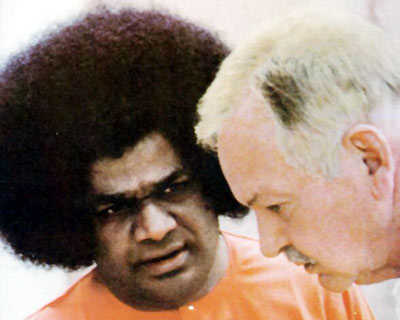 Sathya Sai Baba, John Hislop |
Dr. John (Jack) Hislop (d.1995) was documented by the major bibliographer amongst the ex-devotees, namely Brian Steel. The expansion of the sect to Western enthusiasts started in the late 1960s. Steel informs that the three major intermediaries were the Australian devotee Howard Murphet and the Americans Dr. Samuel Sandweiss and Hislop (between 1965 and 1995 in the instance of Hislop). Murphet authored the influential book Sai Baba: Man of Miracles (1971), which encouraged hagiology and associations with Shirdi Sai Baba.
The Sathya Sai Organisation (SSO) commenced in 1965. Thereafter, the explosion of Western interest in Indian gurus coincided with an adroit shift of emphasis on the part of Sathya Sai. His former promotion of Shirdi Sai Baba was now replaced in his discourses by a focus upon Jesus Christ. See Brian Steel, Sathya Sai Baba's credibility gap.
The American branch of the SSO was founded in 1975, with Hislop acting as Chairman. This development "was largely carried out by Christians, Jews and New 'Agers' rather than by Non-Resident Indians as was the case in some other countries, notably UK." Steel adds that the American branch became by far the largest and most influential of the overseas national versions of the movement.
Amongst the peculiarities in this scenario was the "Resurrection claim" dating to 1971. This claim concerned Hislop's acquaintance Walter Cowan, the lore being assiduously promoted by Hislop and many other devotees over decades. These enthusiasts "boldly promoted and advertised as absolute proof of the Divine Powers of Sathya Sai Baba the implausible stories of the Hislop Crucifix, the picture of the predicted Prema Sai Baba on Hislop's ring, and the completely unsupported claim of the 'resurrection' of Hislop's friend Walter Cowan.... The number of foreigners attracted to the Sathya Sai Baba fold since 1971 by this persuasive promotion is incalculable." See Brian Steel, Sathya Sai Baba, Elsie and Walter Cowan, and John Hislop.
The resurrection myth sensationally affirmed that Cowan (an American) had died at Madras in December 1971, afterwards being quickly resurrected by the intervention of Sathya Sai. However, medical proof of death was lacking. The myth was penetrated by Professor Erlendur Haraldsson, who investigated the alleged miraculous phenomena associated with Sathya Sai Baba. The well known coverage of Haraldsson was eventually published in 1987. Brian Steel comments:
Haraldsson's account clearly refutes the resurrection claim made by Elsie Cowan and John Hislop, but in spite of the many thousands of devotees who have read his book in English and in several translations, neither Hislop, the Sathya Sai Organisation, nor spokespersons, writers or devotees have acknowledged the results of the investigation of this academic, whose book is widely believed by them to have proved that Sathya Sai Baba's claimed materialisations are genuine. (Ibid).
The preferences of Hislop for sectarian priorities are notorious amongst dissidents. An apologist (Gerald Joe Moreno) argued against the authenticity of the now celebrated Hislop letters, documents which mention sexual abuse at an early date. However, the ex-devotee Dr. Timothy Conway has confirmed the authenticity. See further Allegations of Sexual Abuse. Hislop explained away an embarassing complaint about sexual abuse. The resurrection myth was more exciting and acceptable.
The Sathya Sai Organisation has been implicated in attempts to influence bureaucracy. The variations of response by UNESCO have aroused strong query. A UNESCO Media Advisory, dated September 2000, warned about the sexual abuse alleged against Sathya Sai. Subsequently attempts were made to suppress this document, which was deleted from the UNESCO website. BBC enquiries confirmed a collusion between UNESCO and the Sathya Sai Organisation. "The BBC holds over 80 hours of footage of powerful testimony against Sathya Sai Baba containing allegations that depict large scale serial sexual abuse of males from many countries." See Barry Pittard, "Does UNESCO Really Protect the Young?" (2005), filed under "New articles in February 2005" at exbaba.com. When pressed by the BBC in 2004, UNESCO gave a contradictory statement, saying that: "UNESCO does not regret issuing the media release of September 15th 2000." This discrepancy occurred too late to be included in the BBC documentary The Secret Swami.
The UNESCO anomaly provoked the accusation of failure to honour the UN Covenant on the Rights of the Child. The gravity of this situation does encourage questions as to other possible mistakes made by the UN bureaucracy. See, e.g., Letter to UNESCO, on this website; also UNESCO Problem.
10. Duke of Edinburgh Award Scheme
A leading British newspaper covered an issue linking Sathya Sai Baba to the Duke of Edinburgh Awards. This matter provided food for thought to a variety of commentators, because of the nature of controversies attaching to the guru of Puttaparthi.
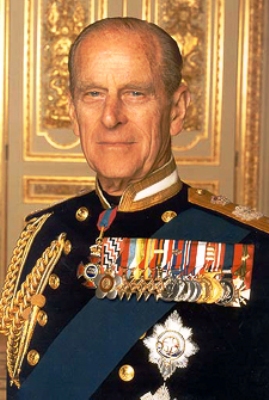 Prince Philip |
The Guardian newspaper reported on gifts of medical aid by devotees to villages surrounding the Puttaparthi ashram of Sathya Sai Baba (Paul Lewis, “The Indian living god, the paedophilia claims and the Duke of Edinburgh awards,” The Guardian, Nov. 4th, 2006, p. 3). Such commendable dispensations were indeed made under the auspices of Sathya Sai. However, ex-devotees emphasised that devotees were the means of providing and dispensing the funds. The guru himself lived for many years a rather relaxed lifestyle of daily darshans or audiences. His ashram was the scene of elaborate fundraising and donation procedures that became repellant to disaffected admirers like Dr. Marianne Warren (section 6 above). From 2005, Sathya Sai was confined to a wheelchair.
The Guardian report accurately stated that Sathya Sai Baba had never been charged following the allegations of sexual misconduct (a dire situation caused by uncritical support for the guru in India, where socially prominent devotees staunchly supported his claims to divine status). The British newspaper article further informed:
The US State Department issued a travel warning after reports of 'inappropriate sexual behaviour by a prominent local religious leader' which, officials later confirmed was a reference to [Sathya] Sai Baba. (The Guardian, art. cit., p. 3 col. 1)
The British journalist did not cite further from the State Department warning. Paul Lewis did not include the word "unconfirmed," which appeared in a subsequent sentence of the warning. The British version was cited in the 2007 original of this webpage, being a source of references for the relevant section. A sectarian apologist in America (Gerald Joe Moreno) berated my webpage for the omission of "unconfirmed." His polemical tactic was dubious, and there is doubt that he had duly bothered to inspect the British version in the press. See section 8 above. The journalist Paul Lewis referred explicitly to allegations, as did my webpage. This recourse is sufficient to distinguish between officially confirmed and unconfirmed details.
The Wikipedia article on Sathya Sai Baba stated that the American Embassy in Delhi warned Americans visiting Andhra Pradesh of the "local religious leader" who reportedly engaged in "inappropriate sexual behaviour." The Embassy informed: "Most of the reports indicate that the subjects of these approaches have been young male devotees, including a number of U.S. citizens." The official source cited here was the Consular Information Sheet for India, released by the Bureau of Consular Affairs for the US Department of State (Wikipedia article accessed 03/04/2009).
The same U.S. State Department Travel Advisory for India had repeatedly warned in this manner against Sathya Sai Baba from the year 2000, amplifying the message in 2005, when the contents read:
U.S. citizens should be aware that there have been reports of inappropriate sexual behaviour by a prominent local religious leader at an ashram or religious retreat located in Andhra Pradesh. Most of the reports indicate that the subjects of these approaches have been young male devotees, including a number of U.S. citizens. Although these reports are unconfirmed, U.S. citizens should be aware of this information and contact the U.S. Consulate General in Chennai for further information. (Glen Meloy, Sathya Sai Baba's 'inappropriate sexual behaviour' confirmed by U.S. Officialdom, at ex-baba.com, filed under New articles in May 2004).
The Californian commentator Glen Meloy (1930-2005) was a distinctive ex-devotee active in various liaisons. At the time of his death, "a very qualified sexual abuse therapist and former Sathya Sai Organisation leader, Shirley Pike, speaks for many in saying, 'Glen spent many hours counselling and supporting former devotees when they found out the truth and were reeling with the shock of it all" (Barry Pittard, In Memoriam - Glen Meloy, at exbaba.com, filed under New articles in January 2005).
The purpose of The Guardian article by Paul Lewis, in 2006, was to investigate a controversial addition to the Duke of Edinburgh Award Scheme. The Sathya Sai Organisation had recently infiltrated the Award Scheme, to the perplexity of some British observers. An abridged version of The Guardian report appeared in the journal of the British cult-monitoring and victim support organisation then known as FAIR (now The Family Survival Trust, associated with the counterparts of ICSA in Florida and FECRIS in Europe).
The Guardian informed that Sathya Sai Baba had issued an invitation for about 200 youths (of Sai Youth UK) to visit him in India on his eightieth birthday in November 2006. This was interpreted by devotees as a “divine commandment.” The youths were scheduled to fly to India that month. The event was invested with humanitarian significance, a precedent having occurred two years before when group interviews were gained with the guru after the distribution of medical aid in nearby villages. This was the basis for involvement in the Award Scheme, which somehow ignored known hazards associated with Puttaparthi.
  l to r: Tom Sackville, Michael Gove |
The November expedition to India met with due responses of alarm in more informed quarters than the Award Scheme. The chairman of FAIR, Tom Sackville (a former Home Office minister), commented to the press in November: “It is appallingly naïve for the Award Scheme to involve young people and the royal family with an organisation whose leader is accused of paedophilia. Parents who plan to send their children on this month’s pilgrimage should be aware of the danger their children are being exposed to” (FAIR News, Dec. 2006, p. 9).
A representative of the Award Scheme stated that award credit had been given to Sai Youth UK (a division of the Sathya Sai Organisation) for the distributions to the poor. He evaded requests to terminate the arrangement, expressing a misconception about what was at issue. The Award Scheme representative stated that “we make no judgment about their religion” (ibid). However, the issue concerned had no relation to judging a religion. Paedophilia and related molestation is not an index to Hinduism, whose celibate code shuns aberrations. Sathya Sai Baba was nominally a Swami ("Reverend") representing that code. The Award Scheme now became viewed as a hazard.
Conservative MP Michael Gove told The Guardian that he would write to the Award Scheme requesting a stricter monitoring of the organisations they work with. Gove further stated: “As a society, we need a more determined effort to identify and expose those religious cults and extremists that pose a direct threat to people, so that they (the extremists) do not enjoy patronage that should be directed elsewhere” (ibid).
The Guardian also reported on the response from the private secretary to Prince Philip, namely Brigadier Sir Miles Hunt-Davis. His letter expressed the desire to get the matter sorted out, stating that trustees of the Award Scheme would be seeking legal advice before deciding how to proceed. The element of anticipated delay was not encouraging for public interests. The newspaper coverage informed that Prince Philip had given a private audience to an official of Sai Youth UK in 2005, leading to a certificate for a “valuable contribution” to the awards. That certificate was conferred upon the same official at a Buckingham Palace garden party in July 2006. This reckless development was viewed by critics as a glaring flaw in royal liaisons and recreation events, given the extent of the strong allegations against the guru that were visible on the internet and mediated by the press and the BBC.
The same Sai Youth UK coordinator who had attended the Buckingham Palace garden party (and who had met Prince Philip at St. James’s Palace), was asked by The Guardian to give clarification. This official of the Sathya Sai Organisation said that the sex abuse claims were “totally unfounded.” This was a standard devotional response. The same official posted a glorifying report of his role at the Buckingham Palace garden party on a Sathya Sai website, to the extent that the Award Scheme representative abovequoted had to intervene by requesting removal of the misleading item. The Guardian reproduced the devotional account of the garden party as follows:
I was the last speaker called up, and suddenly a confidence, a joy, engulfed my being. I attributed everything to our founder Bhagavan Shri Sathya Sai Baba. As I spoke I watched the sea of faces, they were hanging from my every word and there was a look of excitement on their faces as if to say ‘why have we not heard of this organisation before?’ (The Guardian, art. cit., p. 3 col. 2)
Such accounts raise a strong doubt about devotional objectivity. Observers have concluded that more realistic details were being overlooked. One cannot avoid the ex-devotee testifiers to abuse who inform that Sathya Sai Baba was in the habit of inducing oral sex in private interviews. Even if the confinement to a wheelchair in 2005 is interpreted as a limitation of activity, the opponents had made a strong point that tendencies to sexual abuse were shared by some devotees associated with the Sathya Sai Baba College staff in India.
There is a pronounced dichotomy between the “allegation” reports and partisan sources dismissing these. Due evaluation is called for. The dissident versus partisan issue is perhaps rarely so strongly defined as in this field of controversial guru movements. There have been other instances of ex-devotees in strong complaint about the leader. These foci of discontent have varied over the years from Indian gurus like Bhagwan Shree Rajneesh, Swami Muktananda, and Sri Chinmoy, to American "guru" celebrities such as Andrew Cohen and Adi Da Samraj. All these phenomena, and many more, come under the broad official classification of "new religious movements." This standard description is considered hopelessly inadequate by some analysts.
Critical observers compared the lax attitude of the Award Scheme with an indulgent policy of the Labour government towards "new religious movement" manifestations. Is there any connection?
Labour Prime Minister Tony Blair (and colleagues) became strongly associated with INFORM, a body noted for information and pronouncements on “new religious movements.” Labour renewed the financial support at Westminster for INFORM, a British organisation opposed by members of the Conservative government in the 1990s. Blair was said to hold the director of INFORM in high regard, that director being a Professor of Sociology, namely Eileen Barker.
Tony Blair is on record as having prudently stated, in a letter to another MP, that he would not meet Sathya Sai Baba (Shepherd, Investigating the Sai Baba Movement, 2005, p. 286). However, this detail does not cover ideological influences upon the overall Labour position with respect to “new religious movements.” The Duke of Edinburgh Award Scheme is thought to have been similarly reflecting the "soft" attitude to incongruities encouraged by INFORM in bureaucratic circles.
Gerald Joe Moreno was reported to have died in July 2010, at the age of thirty-nine. Much of his online output subsequently disappeared. This blog output has been compared to a giant smokescreen obscuring the landscape. However, Moreno was unable to prevent the details of sexual abuse, on the part of Sathya Sai Baba, from circulating worldwide. Sectarian denial was not convincing to close inspection of the data. The bad publicity created a substantial reduction in the number of Western visitors to Puttaparthi ashram.
Sathya Sai Baba died in 2011. Soon after, his sealed private quarters were opened. An inventory was made of the treasure hoard found by the Sathya Sai Baba Central Trust. Gold and silver ornaments, plus substantial cash, did not exhaust the assets discovered. There were also precious stones, including diamonds. The guru had even stockpiled over seven hundred ochre robes of the type he liked to wear. The total value of this private hoard was estimated to exceed 7.8 million US dollars. Afterwards, another hoard was discovered at the Whitefield colony of the guru, including 8 million rupees. However, his total assets were far greater. These are differently assessed, the value varying from nine billion US dollars (£5.5 billion sterling) to over 30 billion US dollars.
The opulent lifestyle of this Puttaparthi guru was far removed from that of the faqir he usurped with a reincarnation claim. Shirdi Sai Baba died a renunciate without possessions, living in a simplicity foreign to Puttaparthi. Influential high caste followers of Sathya Sai denied abuses and other drawbacks on record. However, critics presented a more realistic picture.
A notable assessment came from Sanal Edamaruku, president of the Indian Rationalist Association:
At a time when scientific progress led to great social and economic leaps, and scientific awakening started spreading all over India, Sathya Sai Baba launched a “counter revolution” of superstition, supported by irresponsible politicians and other public figures who should have known better…. Dur to his political protectors he was never held responsible for his crimes against public reason. Nor was he ever booked for any other crime he was accused of. Numerous cases of alleged sexual abuse and murder are yet to be investigated, not to mention the financial secrets of his empire….
As son of a village tantric he was familiar with the hand sleights and tricks of the [tantric] trade. However, he did not only fascinate poor and uneducated villagers with his fraudulent performances. Over the years, he managed to attract a galaxy of India’s rich and powerful, among them [government] ministers, prime ministers, presidents, chief justices, top industrialists and superstars…. Many of his high society devotees came to serve their own vested interests…. Many joined the [Sathya Sai] club because it was working as a powerful syndicate spreading tentacles all over the political system….
On his eightieth birthday, [Sathya] Sai Baba’s supporters announced that he would turn from [being] a miracle man to a philanthropist. That was after I had demonstrated his miracles so often on TV shows that many kids in the streets could imitate them. That he then spent a part of the great fortunes, swindled out of the gullible, for social development around his ancestral village, is highlighted now to present him as a saint…. This kind of alibi-philanthropy is well known even to mafia bosses.
The social context for Sathya Sai miracles and abuses was blinkered high caste support deceived by "miracle" trinkets and pretentious claims. Magistrates refused to validate complaints against their guru. Law courts were here reduced to a penchant for devotional belief. The aborted legal process did not work for Basava Premanand and Hari Sampath. In America, the apologist Sathya Sai Organisation evaded responsibility for sexual abuse at another law court, adopting a superficial strategy designed to negate the complainant Alaya Rahm.
In 2014, a shocking murder occurred at Puttaparthi ashram. The victim was a 75 year old Australian grandmother, Toni Anne Ludgate. While doing charity work, this devotee gave a security guard about 600 dollars to pay her rent. The guard only passed 200 dollars to the landlord. When she asked for the remaining money back a few days later, the guard and two accomplices murdered her. The killers travelled sixteen kilometres into the fields to bury the corpse. They burned all the victim’s belongings, including her passport.
This well attested event was the successor of many other drawbacks generally suppressed. Security forces had for many years been installed at the ashram. The underlying mood of violence was not quelled by meditation. Basava Premanand and others referred to obscure murders, and other mishaps, in the ashram environment of intrigue ruled by Sathya Sai Baba.
The ashram indoctrination created by Sathya Sai acted as camouflage for his indulgence in “massive bribery, hoarding of money, abusing followers in all possible manners and building an empire for himself the likes of which has rarely been seen” (Murdered Australian Grandmother, 2014).
Many devotees of Sathya Sai are reported to have disappeared, suffered murder, or committed suicide. Puttaparthi was not a safe place. Basava Premanand filed several lawsuits against the guru, being blocked by influential devotees. Premanand stated that he possessed records of more than a hundred victims destroyed by the “Sathya Sai Baba gang.” This ashram mafia resorted to five deadly expedients, described by the Indian Rationalist in terms of death by car accident, by heart failure, by poisoning, by drowning, and by hanging. The Sathya Sai Baba Central Trust became notorious amongst Indian critics for a pervasive influence amongst government ministers, the police, and the judiciary.
Kevin R. D. Shepherd
August 2009 (last modified December 2020)
Abusive Wikipedia Biographical Editorial Process
Analysis of a Cultist Defamation
Anonymous Reports on Sathya Sai Baba
Hate Campaign Blogs of Gerald Joe Moreno
Internet Terrorist Gerald Joe Moreno
saibaba-invigilator.blogspot.com
Tulasi Srinivas and the Politics of Religion
Tulasi Srinivas and Winged Faith
Wikipedia and Kevin R. D. Shepherd
Wikipedia article: Basava Premanand
Wikipedia article: Sathya Sai Baba
Wikipedia, Gerald Joe Moreno, and Google
Copyright © 2020 Kevin R. D. Shepherd. All Rights Reserved. Page uploaded August 2007, last modified December 2020.
CONTENTS KEY
1. Jibe rhetoric of pro-Sai activism
2. Ignored link to primary website
3. Annotated books versus vehement postings
4. Diminished reference to Routledge publishers
5. Ex-devotees not a uniform phenomenon
6. California lawsuit of Alaya Rahm
8. Joe Moreno libels Robert Priddy
9. Ex-journalist V. K. Narasimhan
10. Jibe of whining and snivelling
12. Seriously inaccurate aspersion of comical citations
13. Three errors in one sentence
14. The misleading Findhorn Foundation internet stigma
15. Misunderstanding a Wikipedia talk page
18. Joe Moreno as internet hit man
19. The BBC documentary "Secret Swami"
20. Joe Moreno image under threat
22. Placing opponents in the worst possible light
23. Sectarian polemical tactics
24. Out of context
25. Alleged negative Search Engine Optimisation
26. Militant sectarian web harassment
27. Characteristics of cultist attack
30. A case against Wikipedia in intellectual terms
31. Blogger judgments and wordpress.com
32. Further complaint at a Wikipedia User page and Wikimedia Foundation Inc.
This entry dates to November 2007. It was composed in answer to the repudiation by Gerald Joe Moreno, in September 2007, of the original version of the Wikipedia Issues and Sathya Sai Baba article showing above. That article is also known as Sathya Sai Baba and Wikipedia.
1. Jibe rhetoric of pro-Sai activism
The reaction of Joe [or Gerald Joe] Moreno to the above webpage Sathya Sai Baba and Wikipedia has appeared on his primary website www.saisathyasai.com, under the heading of Citizen Initiative and Kevin R.D. Shepherd. Moreno’s counter does not stop at emphasising what he interprets as my errors according to the canons of pro-Sai activism. His verbalism in this attack has been described in terms of “jibe rhetoric,” the accusations and ridicule frequently being couched in a noticeably insulting manner.
The jibing pro-Sai activist describes me as “a garrulous writer adept in writing loose, tabloid-like diatribes.” I only have one website, which is considered by more impartial parties to be outspoken but definitely not in the category of a blog. Joe is an industrious composer of blogs; it is difficult to believe that he is reticent in all things. He is noted as a persistent user of web bulletin boards in the zealous cause of Sathya Sai Baba. His primary website is increasingly notorious for pillorying critics of the guru, who are depicted as perverts at worst and rank deceivers at best.
Joe’s most acute defamations and insinuations have aroused comment as extremist fantasies of a destructive kind. His basic interest appears to be attacking critics of Sathya Sai Baba. He has devoted numerous attack blogs to “exposing” salient opponents. These are said to frequently read like offensive gossip columns. See also the secondary Moreno websites www.vishvarupa.com and www.sai-fi.net. His web output is said to attack over fifty ex-devotees; his overall activities have been construed in terms of harassment. Outsiders to the movement have also come under fire. Joe became one of the commentators on Sathya Sai Baba in Wikipedia, an episode which ended in his being banned indefinitely.
The Citizen Initiative (CI) webpage above [originally assisted by friends, and at that time written in the third person] was an answer to the Wikipedia slur on my publishing effort contrived by Joe Moreno. His counter is to interpret the above webpage in terms of “browbeating” and “conspiracy theories” and “frenzied Anti-Sai speculations.” I am called “just another foaming-at-the-mouth Anti-Sai ruffian.” Moreno is thus avoiding the context of my defence against his stigmatising Wikipedia User page, and also his blog tactics which similarly demote my publishing effort.
He prefaces his attack by accusing me of quoting an article in The Guardian newspaper. He adopts a pedantic emphasis about the former warning of the US State Department, whose withdrawal [of warning about Sathya Sai Baba] is now implied in the process of international political obscurantism. Joe does eventually get around to mentioning the Wikipedia issue, in a very dismissive manner employing derogatory phraseology in my direction. Such phraseology is probably of less distinction than that found in most tabloids.
Yet further, the pro-Sai activist adds (in his conclusion) that Anti-Sai ruffians “come a dime a dozen in the Anti-Sai Movement.” So we learn of his contempt reserved for the “Movement,” which others define in terms of widely varying trends of exegesis. The BBC are evidently included in the aspersion of dime values, on account of their 2004 documentary The Secret Swami. The high values claimed by pro-Sai activism are open to critical scrutiny.
2. Ignored link to primary website
Joe Moreno also accuses me of not citing his contributions. He fails to mention that the Citizen Initiative (CI) webpage Sathya Sai Baba and Wikipedia does link to his primary website saisathyasai.com, thus making his views easily accessible [that website is no longer online]. He formerly complained at the lack of such links on the part of ex-devotees. The presence of such a link on the CI webpage evidently does not make any difference [the link was deactivated in September 2008]. He also fails to mention that the same CI webpage quotes at length from the FAQ on his primary website. The quotes include his complaint about the lack of links on opposing websites, and so I made a tangible gesture in this respect on the list of Links at the bottom of the CI webpage. Of course, I am not an ex-devotee, but an independent critic.
3. Annotated books versus vehement postings
Joe’s response also accuses me of not contacting him to ascertain details. That accusation is easily met. It is very unlikely that someone who had been proscribed on his Wikipedia User page (abovecited), as I was, would have been prepared to consult more directly his rather overbearing sense of jurisdiction.
The website compositions by Joe include items such as My Ban on Wikipedia, Anti-Sai Activists, Pervasive Anti-Sai Websites, and Lunatic Fringe in the Anti-Sai Movement. Ex-devotees warn that his contributions are not reliable in view of the known extent of his commitment to deny any validity to rivals. He routinely denies allegations of sexual abuse [in relation to Sathya Sai Baba], and instead urges explanations which are acceptable to the Sathya Sai movement. The berated category of “Anti-Sai Activist” is totally reprehensible in his worldview.
Rather excessively, Moreno now accuses me of vanity publishing under four different imprints. Two of those imprints are not mine at all. I now have the distribution rights to those imprints, but that is a very different matter. He also renders one of those imprints inaccurately as New Media Books Ltd. There is no Ltd in the real imprint being discussed. Moreno does not actually know my details, and classifies me as an “Anti-Sai ruffian,” an allegation which does not prove vanity publishing. If annotated books are a vanity, then vehement postings could be considered culpable in other ways.
[By book trade definition I am not a vanity publisher; my two imprints of Anthropographia and Citizen Initiative have been granted very different classification to the Moreno slur by academic libraries and related expertise].
4. Diminished reference to Routledge publishers
Joe says that the publishing firm of Routledge "turned away Shepherd's manuscript." He gives no further details and writes as if this is conclusive proof of the "conspiratorial" nature of my books. He was here lifting and diminishing his reference from the more complete CI website statement (in the publications file) that Routledge "turned down the prospect without any inspection of the manuscript." This was in the early 1980s. The reason for lack of interest was the manuscript being too lengthy and complex for commercial profits. [The manuscript was never sent to Routledge; see publishing statement] The eventual publication of Minds and Sociocultures Vol. One involved 1,000 pages content. Joe Moreno is careful not to let his uncritical devotee audience know anything about the extending details.
Joe is said to rely heavily upon devotees not reading or seeing the sources he misrepresents. The sect in general regards criticisms as unreadable. The guru [Sathya Sai Baba] is said to have enjoined the avoidance of critical sources; such factors contribute to a situation in which relevant data goes missing. It is surely well known that cults interpret criticisms as dire conspiracies.
5. Ex-devotees not a uniform phenomenon
I have nowhere claimed to be an expert on Sathya Sai Baba, nor even the exposé controversy, despite Joe Moreno’s insinuation to that effect. Ex-devotees know far more about those matters than I do. Joe habitually accuses his opponents of bias; he is apparently beyond any bias in his jibes and libels.
The CI webpage Sathya Sai Baba and Wikipedia arose in complaint about his censorship of myself in a Wikipedia User page. Joe is again dismissive of a “self-published” book which is treated by him as being completely irrelevant. He prefers diversions such as his rather obsessive preoccupation with his opponent Sanjay Dadlani. The latter is not mentioned on the [original] CI webpage above, and I have never contacted him. Amongst the ex-devotees, I have only contacted Robert Priddy and Barry Pittard (and once, Brian Steel). I have nothing whatever to do with Dadlani’s form of exegesis, which includes some extreme idioms. The same considerations apply to certain other ex-devotees and kindred categories who tend to rather indiscreet statements.
I am not a supporter of the entire corpus of “Anti-Sai” writings or statements. There are some flaws and excesses discernible, along with a very large quantity of far more relevant and pressing material such as is available on various websites.
Moreno also objects to Martin Alan Kazlev, who is indeed cited on the CI webpage above. Moreno says that my inclusion of Kazlev is not applicable because the latter has “new age” beliefs and I am an opponent of these. That reasoning is faulty, and disproves itself. Belief in Sathya Sai Baba does not guarantee unassailable logic. It is true that Kazlev does entertain various “new age” ideas. These did not prevent him from posting a webpage that highlighted his transition from being a believer in the Moreno website to a critic of that website. The reasons are significant, involving a reappraisal of ex-devotees misrepresented by Moreno. As such, the Kazlev webpage is a legitimate source of reference, which certainly does not mean that every statement made there is necessarily true or relevant (Joe has objected to the psychological portrayal of himself by Kazlev, a consideration that I will respect here).
Investigators of these subjects will inevitably refer to the Kazlev webpage. I did not ignore or select that webpage because the author was a believer in UFOs, Aliens, Integral Transformation, Theta Magic etc. The list of such crimes alleged by Moreno includes the more traditional subject of reincarnation. Kazlev does seem to take that subject to an extreme in discussing his past lives, as Moreno complains. Yet very many devotees of Sathya Sai Baba are believers in reincarnation. Sathya Sai himself evidently believes in reincarnation. His controversial claim to be a reincarnation of Shirdi Sai Baba (died 1918) has been rebutted by other Hindu believers in reincarnation. That claim undoubtedly facilitated the rise to fame of Sathya Sai. See Brian Steel, Claim to be the Reincarnation of Shirdi Sai Baba.
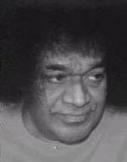
l to r: Shirdi Sai Baba, Sathya Sai Baba
I am also berated by Moreno for including the testimony of Ullrich Zimmermann. That testimony is relevant, and more so in the commentary of Robert Priddy, cited on the CI webpage. Priddy makes clear that there are some bizarre features in the Zimmermann interviews arising from the latter’s conditioning to a devotee aptitude [see section nine to Sathya Sai Baba and Wikipedia above].
The effect of devotee conditioning is not generally understood. I would personally be quite dismissive of the embellishments caused by conditioning, but do not wish to appear insulting. I neither believe nor endorse the peculiar beliefs of some devotees and ex-devotees. Nowhere is any such belief endorsed on the CI webpage above, e.g., genital switch miracles. It is obvious that the atmosphere cultivated by Sathya Sai Baba, of instilling belief in miracles, was quite unconducive to clarity in the minds of devotees. They were led to believe in fantastic things more or less as routine. The confusion was such that some of the victims of sexual abuse at first believed that this form of attention was for their spiritual benefit. When they subsequently grasped that this was not so, they were very upset and disillusioned. They needed to adapt to a different set of priorities serving to dispel all the confusions. That did not always happen.
Zimmermann is associated with Ramtha channelling, relating to sectors that have also harboured the “channelling” of Sathya Sai Baba. Resistance to such “new age” confusions does not entail dismissing relevant evidence in testimonies which underline discrepancies. Such dismissal would be irresponsible. Such an attitude of dismissal is altogether too convenient for Sathya Sai Baba apologetics.
Further, the Moreno argument implies an arbitrary distinction between the Sathya Sai cult of the Western “new age” and other new age manifestations. Organisations like the Findhorn Foundation have been host to various types of channelling, including the Sathya Sai variety, which has been promoted by admirers of the guru for many years.
The putative lack of bias on the part of Joe Moreno is extremely insensitive to the sufferers and the disillusioned. He treats the testimonies to abuse as lies or delusion, and attacks anyone who concedes validity to the victims and testifiers. He is obscuring the situation in which Indian politicians and other social elite have turned a blind eye to strongly alleged abuse at Puttaparthi, the very wealthy ashram of Sathya Sai Baba. Because of the bureaucratic deficiency, nothing has been done to investigate the alleged problems. It is said that Moreno is an apologist for evasionism, his attitude reflecting in many respects the views held by prominent American devotees.
One testifier to sexual abuse is Conny Larsson, who was a devotee for 21 years until 1999; he has described the guru’s ashram situation as "choreography for paedophile activity" (www.saibabaexpose.com/GD.htm).
6. California lawsuit of Alaya Rahm
The accusing Joe says that I failed to mention one word about his version of the lawsuit of Alaya Rahm in America. This is entitled Alaya Rahm’s Self Dismissed Lawsuit, being visible on the Moreno website to which I linked on the CI webpage. The Moreno website has been queried for stating that, e.g., Alaya Rahm’s “self-dismissal proves that the numerous claims to witnesses and corroborated information were untrue all along.” The Moreno version is supportive of the American devotee orientation which effectively foiled the lawsuit. This is confirmed by such refrains on the primary Moreno website as “a scathing response to critics that exposes their fraud, lies and deceit about Alaya Rahm’s failed lawsuit against the Sathya Sai Baba Society of America.” Moreno believes in being very scathing. The iniquity of critics is left in no doubt according to strident partisan terminology.
The Sathya Sai Organisation was not represented in America, strangely enough. Some lines were given to that subject in the CI webpage above. A lawsuit had no chance in America. Yet a basic problem was the bleak prospect for any possible lawsuit in India. These are very serious matters. Moreno wants to believe that Alaya Rahm’s testimony to sexual abuse is invalid, urging that he was a drug user and alcoholic. The status of testimony would be up to legal authorities to decide if the due legal procedures had not been obstructed in 2006.
Ex-devotees affirm Moreno’s agenda in this direction to be one of blackening the name of Alaya Rahm. They remind that the BBC and Mark Roche (also abused by Sathya Sai Baba) both found Alaya to be a decent young man. For years Alaya was highly regarded by many American devotees. When he courageously spoke to his parents about the sexual abuse he had experienced, he was soon after reviled and ostracised, with fanatical devotees accusing him of dishonesty.
The sexual abuse of Alaya Rahm started in 1995, when he was 16 years old. For the important testimony of his ex-devotee father, see Al Rahm's Explanatory Letter (2004). Al Rahm was a devotee of Sathya Sai Baba since the early 1970s. His son Alaya Rahm was reared from birth to believe in the guru. The defection of the offspring is therefore quite significant, an event which also involved his devotee parents becoming aware of the guru's flaws and likewise seceding.
The blocked [or hindered] lawsuit of Alaya Rahm merits some attention here. This American, still in his twenties, filed a civil lawsuit in 2006 against wealthy Californian leaders of the national Sathya Sai Society, who notably included Dr. Michael Goldstein, a major international player in the sect as a whole. Those devotees created a formidable legal problem, as a consequence of which Alaya Rahm was advised by his attorney to self-dismiss the case, because the Sathya Sai Society were defining their operation as being nothing more than a bookstore. That manoeuvre is regarded as an evasion by other parties. The lawsuit could not continue because of this improvised technicality. The allegations of Alaya Rahm remain valid; they were not legally disproven, only blocked [or hindered] from being presented for legal scrutiny. See Alaya Rahm’s Lawsuit vs Sathya Sai Society of America (2006).
The parents of Alaya Rahm stated that:
Sai Baba also threatened Alaya repeatedly that if he ever told anyone what Swami (Sathya Sai) was doing (i.e., sexual abuse), Sai Baba would use his powers to cause an accident to Alaya and would also never talk to his parents again.
Such tactics were obviously calculated to cause reticence, and can also explain what many other young men may have experienced.
Other important testimonies were also not able to be heard in court, due to the legal set-up of the Goldstein faction. Mrs Diane Payne had long ago written to the evasive Dr. Hislop about the sexual abuse of her teenage son at a Sathya Sai College in the 1970s. Such details had been suppressed for nearly three decades. Another abused ex-devotee, Mark Roche, was also unable to testify about the oral sex forced upon him by the guru in the 1970s. The only way that Roche and Alaya Rahm could gain a due hearing for their complaints was an appearance on the BBC documentary The Secret Swami in 2004. Viewers were amazed to see the accompanying denial by Dr. Goldstein, whose threatening response to a BBC interviewer is now well known. The partisan sector was well entrenched for a resistance to the Rahm lawsuit in 2006.
Prominent devotees in various countries had been instructed to ensure that the Sathya Sai Organisation was not registered in a way that would render it legally or financially liable. Within India itself, the obstacles to justice have been phenomenal [according to ex-devotee reports]. Sathya Sai devotees in that country include Supreme Court and High Court judges, government ministers, and other socially influential elite. In America, further suppression occurred.
One of the witnesses available in the aborted Rahm lawsuit was Dr. Timothy Conway, a former leader in the American devotee movement. He intended to verify the Hislop letters, discarded by the Goldstein faction. Dr. John Hislop, over twenty years before, had conferred with Goldstein and other prominent devotees about the allegations causing headaches. Mrs Payne and her abused teenage son were accused of lying. The Rahm family have stated that the leading American devotees were covering up in 1980, and are still being evasive. See also “Conny Larsson’s Letter about Dr. Hislop’s Awareness of the Sexual Abuse of Sathya Sai Baba” at saiguru.net.
Moreno has posted on the subject of the John Hislop letters, in a manner tending very much to converge with the Goldstein camp. See The John Hislop Letters on the primary Moreno website (which conveniently lists contents at a glance, thus justifying the use of a link on the CI webpage which Moreno does not mention). That website www.saisathyasai.com includes postings on the BBC documentary of 2004, David Bailey’s The Findings, the “hidden bias” of journalist Paul Lewis in The Guardian newspaper, the US State Department, and the lawsuit of Alaya Rahm. The tone throughout is strongly partisan [to Sathya Sai Baba], and censorious of testifiers to abuse and their supporters, who are depicted as villains. The primary audience involved is evidently that of devotees in various countries.
Some say that Moreno is outnumbered and outflanked by the critics of Sathya Sai. His vehement denials can be seen as a symptom of desperation experienced by the cult mentality of extremist Western devotees.
8. Joe Moreno Libels Robert Priddy
The Moreno dismissals are very questionable in relation to Robert Priddy, a retired academic of Oslo University who is indicted by the “unbiased” party for having taken drugs in the 1960s. Moreno’s objective has been to imply that Priddy is thus an unreliable source for the despised Anti-Sai websites. During the decades since the 60s, many bureaucrats, politicians, and academics have also taken drugs. I do not at all agree with their laxity. However, it would be very unwise to dismiss their professional abilities as being totally unreliable. Even some lawyers took drugs during their university years, as did many medical doctors. Should we jettison all their talents as mere stupor? If they were still taking drugs, then yes. Otherwise we should be more discreet.
My opposition to drugs is not of the puritanical kind. Robert Priddy long ago relinquished drugs, and has since extricated himself from his devotee orientation, which cost him so much time , money, and distraction in extolling the claims of a guru he later discovered to be false. See Priddy, After the End of the Dream: My current credo and views on Sathya Sai Baba (formerly online).
The comments of Joe Moreno on Priddy’s long past cannabis use are misleading; he is clearly too eager to indict on the basis of inadequate grounds. In his recent posting on CI, Joe misuses the CI webpage reference to “a single joint of cannabis raises the risk of schizophrenia by more than forty per cent.” That quote comes via the [original] CI webpage above (Update July 2007), citing an official analysis recently conducted in Britain. Moreno’s version would not qualify for medical status. The big risk group is the adolescent sector, and even younger users (also adult heavy users of this drug). There are medical and academic arguments about statistics of drug users in Britain, and the changes in rate of schizophrenia (a complex subject). This matter is aggravated by the increasing strength of cannabis in the form known as “skunk.” There have been drug gangs [using skunk] tending to violence, and skunk can be dangerous. In fact, skunk is dangerous. [See further Opposing the dangers of drug use]
Priddy never indulged in skunk, which was not available in his day. However, I do not agree with anyone who praises drug experiences. Priddy was remiss on that point in his pre-devotee phase, a failing which he repeated in a devotional book he wrote under the influence of Sathya Sai Baba (Source of the Dream, 1994). The miracle glamour was not conducive to clarity. Many other Western devotees were also confused in their contact with Eastern religion, which became popular in superficial guises from the 60s onwards. Sathya Sai’s declared “miracles” have been discerned as sleight of hand by first hand observers over many years, starting with the exposure by Basava Premanand, the insights since becoming more common amongst Westerners. The frequent “materializations” of holy ash and jewellery are very unconvincing, as are other devices. See, e.g., Brian Steel, Omnipotence?
9. Ex-journalist V. K. Narasimhan
The Moreno depreciation of Priddy’s informative articles on V. K. Narasimhan is quite acute. The latter was a devotee of Sathya Sai Baba who lived at Puttaparthi ashram. Priddy knew this man personally, which was one of the reasons for placing the photograph of these two figures on the CI webpage above. Yet due inspection of what Priddy wrote about Narasimhan is classified as a “fanatic” viewpoint by the pro-Sai activism of Moreno. These articles of Priddy are described by the purportedly unbiased Joe as “hearsay and speculations.” Canonical writings are evidently in favour here, the rest being in the category of fanaticism about hearsay. Critics here have the status of biased midgets compared with the unbiased giant Joe Moreno.
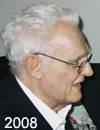 Robert Priddy |
Narasimhan was a well known Indian journalist, his former career bequeathing him with a healthy sense of scepticism at times. In 1996, Narasimhan privately divulged “many utterly damaging details” which Priddy recorded in his diary. Those details related to the “bedroom murders” occurring in 1993 , an event which had been officially covered up by the lack of due investigation. Narasimhan stated that he had repeatedly asked the guru about this notorious event. The answers of Sathya Sai “were not convincing.” See Priddy, The Unresolved, Covered-Up 1993 Murders in Sathya Sai Baba’s Bedroom Revisited (formerly online). [See also The Case of V. K. Narasimhan]
10. Jibe of whining and snivelling
The tone of Moreno jibe is notably offensive. My complaint, at Joe’s Wikipedia User page against myself, is described by him in terms of “repeatedly whined and sniveled about my objection on Wikipedia to the inclusion of a quote from his (Shepherd’s) self-published book.” That is how the jiber views serious complaints. The quote did not actually come from my book. The jiber should know where his quotes originate. The Wikipedia quote was used as the trigger for a defamation of my books and publishing project. So forget Citizen Initiative, was the basic message. This project merely whines and snivels like a dog needing to be put to sleep by the unbiased canonists. “Whined and snivelled” is the 21st century cult diction for a citizen protest against the Wikipedia inquisition (now banned in contradiction to canonical supremacy).
The so-called citizen encyclopaedia is a farce under such influences as those discernible in Moreno’s Wikipedia User page, showing on Google and bearing his identity as SSS108. This is a confirmation of the proscribing gesture which utilised Wikipedia files in the pursuit of cult objectives. Wikipedia should officially withdraw that User page, or else Google should do so. As it is, the channels of American democracy are not efficient media in such respects. [The SSS108 User page was eventually deleted by Jimmy Wales in 2012]
An example of Moreno misreading is afforded by his inverse statement: “Kevin Shepherd would like to make it appear that I was alone in my grievance.” The text of the above CI webpage Sathya Sai Baba and Wikipedia clearly states that “all except one of these (four) contributors expressed biases in favour of the guru” [now in section four of that page]. That refers to Joe’s Wikipedia User page on myself. To pro-Sai activist polemic, three becomes one. Even without such numerical considerations, jibe rhetoric is insulting to a memorable degree. Joe is fond of stating that opponents do not get their facts right, a matter which can look different when sectarian apologetics are seen to repeatedly distort and dismiss facts and strong allegations of abuse.
The exception to convergence with guru favouritism was Andries Krugers Dagneaux (the fourth contributor). Even this liberal capitulated to the censorious argument of Moreno at the end of the reported dialogue in the Wikipedia User page at issue. The stigma applied to an annotated “self-published” book is very questionable on the basis of a single misattributed quote, especially when subsequent protest is described in terms of “whined and sniveled” by the apologist for cult.
Dagneaux was banned from Wikipedia along with Moreno. An earlier episode of friction involved what Joe claims as “my thorough documentation about Andries Anti-Sai agenda.” That documentation influenced the Wikipedia arbitration committee, who ruled:
Negative information in an article or on a talk page regarding Sathya Sai Baba or organisations affiliated with him which is poorly sourced may be removed without discussion. The three revert rule shall not apply to such removal. This includes links to critical websites which contain original research or which consist of personal accounts of negative experiences with Sathya Sai Baba or organisations affiliated with him....
The influence of Joe Moreno thus curtailed relevant information unwelcome to sectarian horizons. The fact that this could happen on Wikipedia is a cause of due alarm to close analysts. Yet Joe is proud of the cordon created [in 2006]. His account (in his recent website attack on myself) states that this development was a huge blow to Anti-Sai Activists, who “whined and hissed about it on their own Anti-Sai websites.”
One hopes that Citizendium will recognise the limitations of sectarian agendas and phrases, as Wikipedia needs to do more often. This event of cordon was what the CI webpage Sathya Sai Baba and Wikipedia was basically complaining about, a factor proven by the [original] sub-title of The Sathya Sai Baba Cordon in Wikipedia. Yet Joe prefers to think that I was ignorant of pertinent facts despite my “alleged in-depth research into this topic.” There was no claim of such research, as this had already been done by ex-devotees, meaning those who “whined and hissed” on their websites according to the bias of sectarian language.
12. Seriously inaccurate aspersion of comical citations
The condemnation is likewise exaggerated when Joe stresses my “comical citations to anonymous scholars.” Other readers can see no comedy in my references to two Wikipedia contributors, namely Jedermann and The Communicator. Joe denies Ph.D. status to an academic [Dr. M. Dean] known in Britain for the doctoral credential, which has been communicated to me in a notification from university precincts. An erudite article of that official academic has appeared in a learned journal devoted to the history of science. The academic doctor concerned is one of those exasperated by sectarian intrusions in Wikipedia, which changed the format of one of his own Wikipedia contributions; such factors cause him to look with favour upon the rival project Citizendium.
Joe also denies Australian University affiliation to an academic in Australia [Simon Kidd], who is on record in Wikipedia for reporting his master’s degree in philosophy (see Wikipedia Article on HB). The opposing Grof team [on a Wikipedia talk page] surpassed Joe Moreno in their assimilation of basic factors, after first mistaking his adverse remarks about myself as academic pronouncements of authority. Yes, Wikipedia pseudonymous identity tags can be misleading, and should be jettisoned for real names. Meanwhile, cultists could be doing the talking. Beware the Wikipedia grapevine.
Ex-Wikipedia Moreno now insinuates that Jedermann and The Communicator are merely two anonymous persons claiming to be scholars. His effort to deny due identity may be viewed as an extension of the cordoning Wikipedia User page that pressed for the removal of reference to a rival interpretation. [see further Serious Citations are not Comical]
13. Three errors in one sentence
The Moreno purge goes on to state: “Kevin Shepherd publishes the writings of Stephen J. Castro and Kate Thomas through Citizen Initiative Publishing.” There are at least three errors in that canonical sentence. There is no such imprint of mine as Citizen Initiative Publishing. The excesses have here applied an extra word to the CI logo. I have never published the writings of Castro or Thomas, though I do now have distribution rights to some of the books involved. Kate Thomas has been published under three imprints, none of which are mine.
14. The misleading Findhorn Foundation internet stigma
The zealous Joe then lifts an inadvisable statement from the Findhorn Foundation internet stigma of 2002, which misleadingly describes Thomas as the “ex-housemate” of Castro in Forres, where they were in conflict with that rather calculating organisation spreading from the Findhorn Bay caravan park. The stigma as a whole has caused many confusions about the nature of events. Joe fails to mention my rebuttal of the Findhorn Foundation strategy in Metcalf and the Internet Stigma, where I duly complain that the stigmatisers made no reference to myself and misinterpreted the relationship between Thomas and Castro. Joe does not cite the internet stigma and instead seems to have been confused by a Wikipedia talk page which he does mention.
15. Misunderstanding a Wikipedia talk page
Joe insinuates that I was involved in “collaborated scheming on Wikipedia against Stanislav Grof, Holotropic Breathwork, and the Findhorn Foundation.” This misunderstanding was engendered by the Wikipedia talk page extending from the Holotropic Breathwork (HB) entry. That talk page mentions the three subjects extensively, but not in any manner serving to support the Moreno misconception. What actually happened was that The Communicator [Simon Kidd] insisted upon a section being added to the Holotropic Breathwork entry in order to supply critical sources, both academic and non-academic. Even a member of the Grof team involved [on the talk page] now admitted that the original entry amounted to a commercial ad for the Breathwork.
The lengthy argument [in the talk page to the Holotropic Breathwork article] mentioned the Findhorn Foundation with some confusions from the Grof team, who had not duly investigated published details. The “edit war” involved continual changes to format. Eventually the Wikipedia arbitration procedures were invoked. By that time I was keeping closely informed of what was occurring, and incorporated some details in my Grof Therapy and MAPS. The Grof team have since decided to be more reasonable in acknowledging critical sources without ridicule. [The HB article was subsequently modified by pro-Grof biases, and subsequently terminated by opposing editors]
Another example of how Joe Moreno diverges is afforded by his attempt to link me with Reinier Van Der Sandt. I have never been in contact with the latter, and certainly do not approve of any statement that can be interpreted to favour child pornography. There is no mention of Der Sandt on the [original] CI webpage under attack. Moreno arrives at this intrusive and unjustified treatment by referring to the article of Kazlev, which I did cite in the primary context of Kazlev being a former believer in the Moreno website that transmitted so many misconceptions about ex-devotees. Kazlev subsequently discovered that Joe had misrepresented those people. He did add his own personal interpretation of Joe, which the latter has repudiated.
The [original] CI webpage above (assisted by some friends of mine) cites a letter from Robert Priddy which affirms that Joe plays “dirty tricks.” Joe has denied that charge, though ex-devotees are very sceptical. Other critics are disconcerted by the reported detail that two ex-devotees have had their identity inserted on porno sites. Joe does emphasise that Priddy’s website was listed on pornography webpages, and adds rather caustically: “These facts suggest that Robert Priddy attempted to obtain more exposure for his Anti-Sai website on a worldwide sex directory.” Many onlookers find that suggestion very difficult to believe. The rather retiring Priddy is not the most feasible candidate for such methods of publicity.
Joe posted on his pro-Sai website a screen capture of the porno webpage bearing Priddy’s website name. Joe claimed that Priddy paid for this dubious service of the porno site. Ex-devotees urge that this was a form of libel, and that Joe has used a similar technique against Sanjay Dadlani as part of a dirt-digging agenda. All this is very disconcerting. See also Moreno slander against Robert Priddy (formerly online). This feature states that Moreno created a new blog to defame Priddy, and also posted a photo of the latter’s non-involved son against his wishes. “For Moreno, a liar is virtually anyone who questions Sathya Sai Baba.” There is also the information online: “Moreno’s allegation about Priddy having subscribed to two porn sites is the grossest defamation.”
Joe states that he himself (via his email) has been assigned to porno sites by a psychologically disturbed testifier to abuse by the guru. It seems evident to me that a larger number of serious investigators must get to grips with these offputting phenomena. Accordingly, I am placing these matters on file here for future reference.
18. Joe Moreno as internet hit man
The view of leading ex-devotees is that Joe Moreno is an internet “hit man.” This was reported in Part Two [of the original Sathya Sai and Wikipedia webpage] above where opposing views of the subject are described. Joe has berated me for such an inclusion, but unfortunately, such views are held. His very edged polemical tactic has aroused deep suspicions of an unmerited form of harassment. In fact, ex-devotees have described this in terms of “webstalking and harassment.” The same Part Two [now section seven] of the CI webpage above very briefly mentions the Moreno accusations against Barry Pittard (one of the most articulate ex-devotees).
Some readers have found the Pittard drama quite staggering. This is on internet record. In 2006, Moreno slandered Pittard by claiming that he was a paedophile, also alleging that Pittard fathered a child with a 15 year old girl. Go to Serious Defamation Attempt. Joe is here reported to have contacted Pittard’s former partner with the aim of exposing both her and Pittard. Joe posted his ugly defamation on his pro-Sai website and still “distorts and avoids central facts of the matter.” Pittard was obliged to post a decisive rebuttal. Joe very grudgingly retracted his false allegation, this concession consisting of “a single line buried among a mass of self-justification.” Joe has since continued other slanders against Barry Pittard. The full details of all this have deeply shocked careful readers.
Moreno and two of his colleagues are notorious for the vituperative nature of many Yahoo postings, which evidence the tactic of “defame a person then imply that nothing that person states can be honest or true.” The intended victims include numerous ex-devotees, also journalists and BBC representatives. See “Three Documented Internet Defamers of Barry Pittard” at saibabaexpose.com. The BBC documentary The Secret Swami (2004) aroused strong vituperation from the sectarian trio. That trio have since been banned from Wikipedia in 2007.
19. The BBC documentary "Secret Swami"
The BBC devoted many hours of footage to the controversial guru (associated with BBC producer Eamon Hardy, considered an Anti-Sai demonstrator by obsessive postings). The resulting documentary of 2004 included the figure of Dr. Michael Goldstein, the international chairman of the Sathya Sai Organisation. He stated that his role as a physician automatically qualified him to know who has been sexually abused on the basis of judging their appearance alone. This meant that no sexual abuses had occurred in relation to his guru. Goldstein had never undertaken a thorough questioning of Sathya Sai. There is thus scope for improvement in checking strongly alleged anomalies. See The BBC Documentary Secret Swami, concise overview (www.ex.baba.com).
One review of the BBC documentary emphasises that this milestone programme understated, not reflecting the full extent of the abuse allegations, nor conducting any examination of the multiple billions that pour into the coffers of the Sathya Sai Baba Central Trust from all over the world. Likewise omitted were financial scams by the guru’s administration [including the sale of apartments at the ashram, afterwards reclaiming these from the rightful owners]. Likewise escaping exposure was the suppression by both Tony Blair and the Conservative Party Whips of over fifty British parliamentarians who wished to raise Sai Baba-related issues in the House of Commons. This significant event occurred at a time “when Blair wanted to placate the then Indian Prime Minister Atal Bihari Vajpayee so as to win a contract for 66 jet fighters for India.”
Barry Pittard goes on to inform: “The BBC had evidence from a former British diplomat that Vajpayee demanded of Blair that he cool down the activity concerning Sathya Sai Baba, whose long-time devotee Vajpayee was, and is” (The Secret Swami, Condensed). The political evasions and cover-ups are perhaps the most disconcerting feature of the entire Sathya Sai Baba scenario. Compared to this, perhaps even the evasion of Dr. Michael Goldstein was a minor feature in provoking the BBC to film him with a hidden camera. Goldstein was nevertheless rather extreme in his reactions on that occasion, when he was being interviewed by the inoffensive BBC reporter Tanya Datta. The relevant images are well known on the internet.
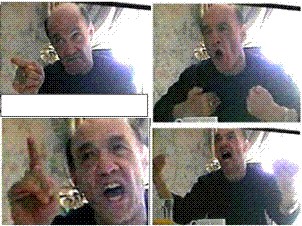
Dr. Michael Goldstein on BBC camera
The persuasive political evasionism, created by eminent Indian devotees, spread to UNESCO and the US State Department. The burgeoning coffers of the guru are said to be tokens of status in the avoidance of abuse testimonies. Further, the sectarian fulminations of Joe Moreno against The Guardian article (November 2006), cited above, are totally unconvincing to persons who can assess relevant information about royal oversights in Britain accompanying the general political malaise.
20. Joe Moreno image under threat
The Citizen Initiative (CI) website was uploaded on August 31st, 2007. Shortly after, Joe sent me an email demanding that his photo be removed from the webpage above. He threatened to report me to my web host if I did not comply. I was not under any legal obligation to do so. Instead, I wished to identify the frequently anonymous composer of the Wikipedia User page against me. Joe Moreno has several pseudonyms, but only one known photograph which he removed from his website some time ago. My web host (one of the best in the UK) tended very much to subscribe to the prevalent UK attitude that controversialists on the internet should be willing to have their image visible in the public domain. Absence of such an image can lead to strong suspicions about motivation. The photo of Joe was actually retrieved from the website of a sympathiser with ex-devotees, after Joe had discarded that image. Robert Priddy passed the photo to me when I asked to see what Joe looked like. The image is not unflattering to the subject, so there seemed no harm in making it known.
However, Joe has since expressed the dire warning, in his website critique of CI, that I will be sued for copyright infringement and sustain “hefty damages” if I dare to publish his image in any book. I had (and have) no intention of publishing his image in a book, though his adamance in this direction seems extreme. He has incorporated an image of myself on his own website. No more than one image of myself is permitted, as those images are all recently copyrighted. My image must not be distorted in any way. If distortion occurs, then many people will notice. [Moreno subsequently resorted to three images of myself in a row, proving his extremist tendency]
I have to state this [proviso against distorted image], because although Joe indicates that he does not engage in practices of distortion, a contradiction is evident at “On the Misleading Pages of Gerald ‘Joe’ Moreno of Las Cruces, New Mexico” at saibabaexpose.com/libeller. This ex-devotee website displays a distorted image of Reinier Van Der Sandt formerly appearing on a Moreno webpage. Van Der Sandt is here described as “webmaster of ExBaba.com, who was attacked relentlessly and viciously by Gerald Joe Moreno on (web) bulletin boards and his own disreputable websites.” The nose of the victim appears much bigger in the distortion than in the original photo. Moreno’s distorted image of Der Sandt is here displayed alongside the original, and the comparison is telling.
The same webpage states that Moreno has used the distorted image technique “against numerous critics of Sathya Sai Baba.” Another complaint here is that “Moreno loves to quote out of context and twist meanings.”
22. Placing opponents in the worst possible light
This disconcerting scenario was unknown to me in 2006. I had heard about partisan reactions to internet exposures of the guru occurring since 2000. When I discovered the Wikipedia User page bearing the tag of SSS108, I knew nothing about the real identity of the composer. He dismissed all my books, and evidently had not read them. He was solely concerned with censoring a Wikipedia quote briefly referring to the content of an appendice in one of my books. Wikipedia was not democratic after all, I reflected. The level of dogmatic perspective in that User page was puzzling.
I had to find out from academic friends what this was all about. Gerald (Joe) Moreno was said to be in his thirties. His background was obscure. There were no details about his education or study background, and no books to his credit; he had become a devotee of Sathya Sai in his late teens. He used pseudonyms like vishwarupa108 and JM108. There were complaints about him on the internet, his methods being described as extremist. Yet he had become an editor on Wikipedia. Some friends were concerned to assist me in gathering information, especially as I was not a computer user at that time. I was advised to give a critical response to Moreno, who was contemptuously dismissing me as being off the map.
Though I linked to his website and quoted his FAQ, Joe Moreno describes me as “a fanatic and intellectual imposter.” He is notorious for placing his opponents in the worst possible light in his extravagantly "unbiased" manner.
23. Sectarian polemical tactics
Joe ends his entry on CI with emphatic statements that, e.g., Sathya Sai Baba has never been proven to be a charlatan, and has never been charged or convicted of any crime. This stance is deceptive, because no due official enquiry was ever mounted in India as a consequence of partisan influence in high places. Contraindications have been squashed.
Joe is averse to any mention of the terrorism associated with the guru of Puttaparthi, most notably via the Indian Rationalists, whose leader [Basava Premanand] has reported savage beatings administered by a mafia mentality supporting Sathya Sai.
In distant New Mexico, Joe is eager to latch onto the phrase "reports of inappropriate sexual behaviour" formulated by the US State Department, who previously issued a travel warning prior to July 2007, when they removed all references to the guru. The Guardian newspaper of Britain deleted [or rather did not employ] the word “unconfirmed” [found in a subsequent sentence of the State Department warning] from a November 2006 coverage. The CI webpage above [originally Part Four, now section ten] followed suit in quoting the media article. Joe has expressed wrath at this occurrence. Quotes are not supposed to add words, according to academics. It was not me, but The Guardian who made the deletion, which some analysts say makes absolutely no difference to the ongoing political blanketing involved in different countries.
In his jibing polemic, Joe takes noticeable liberties with the phrase “serious amateur,” used at Cambridge and Oxford for some decades. This is a British semi-academic phrase. That phrase has appeared even in learned journals, denoting someone who attempts serious written work without being (or presuming to be) a professional. Such written work is always accompanied by annotations. All my published works have annotations. The phrase “serious amateur” does not refer to the internet, predating that form of media. Joe mocks this phrase from the angle of American sectarian polemic existing in Las Cruces, New Mexico.
Witnessing my interdisciplinary research effort during the 1980s and 90s, some (academic) friends kindly commented that my books cited sources to a greater extent than many academic philosophers (not scholars, be it noted), who frequently follow very prescribed routes of discourse and argument. That consideration was included in the [original] CI Publishing Statement on this website, but taken out of context by Joe, who does not distinguish between philosophers and scholars, or between published works and the internet. As a consequence of American sectarian tendencies to misunderstand context, the relevant sentence has been altered.
I cannot now be described as a “serious amateur,” as I am no longer existent in the Cambridge study purlieus from which that phrase derived. The tag chiefly attaches to my two volume work Minds and Sociocultures, associated with the 90s, the second volume of which remains unpublished due to economic factors [though more recently, considerations of improvement are the primary cause of delay]. The new Preface to Volume Two refers to aspects of my intellectual transition to the “citizen philosopher” mode associated with Pointed Observations (2005). Meanwhile, the emphatic American polemicist, who caricatures the misunderstood British phrase “serious amateur,” is solely concerned with maintaining as unassailable the dogmas of a controversial sect (or cult) exhibiting discrepancies.
25. Alleged negative Search Engine Optimisation
Such considerations are almost trifling by comparison with an emerging technological theme. Certain documents in private circulation (October 2007) refer to Joe Moreno’s “massive targeted misuse of the Google Search Engine” to harass many ex-devotees and other critics of Sathya Sai Baba. Joe is now closely associated with the suspect procedure known as negative SEO (Search Engine Optimisation). The basic purport of an ex-devotee contention is that via this suspect method, Moreno websites and blogs often achieve higher Google rankings than the original postings which are being attacked and subverted. Moreno webpages are ubiquitous in Google Search name listings of the critics of Sathya Sai. Yet many of those webpages are anonymous on the listings, conveying the impression of a more widespread authorship than is actually the case.
Joe is described as “getting a massive number of top rankings on Google for his many attack URLs (three websites and numerous blogs and bulletin boards in the hundreds).” Joe Moreno allegedly copies hundreds of keywords from very numerous rival webpages in a manipulative strategy that spams the index of Google and dominates the keywords.
A charge against Joe Moreno urges that the names of opponents are used as keywords. Joe Moreno carefully inserts the names of opponents in sub-headings which appear on the Google Search name listings. Those captions or metatags frequently convey a strong vein of disapproval or stigma. For instance, he uses the phrase “Kevin R. D. Shepherd Reveals his Bias, Shabby Research, and Penchant for...” Of course, Joe is not biased or in any way shabby. He merely wishes to disfigure the name listing of someone else in the cause of “Love All Serve All” associated with Bhagavan Shri Sathya Sai Baba.
My name listing (Kevin R.D. Shepherd) on Google Search has to date shown four compositions of Moreno above my own entries. Only one of those Moreno entries bears his real name (found on his primary website). The other three are anonymous. Two of these are blog items, while a third is the controversial Wikipedia User page showing the cover identity SSS108. The mocking metatags emphasising my name are a noticeable feature. Moreno’s objective is clearly to drive me off page one of my Google Search name listing, or to sandwich my own contribution. The nature of his strategy is quite evident to close observers. Proliferating tag entries attest to the sectarian zeal for subversion. Other critics of Sathya Sai Baba have the same Moreno problem on Google Search; however, most of these are ex-devotees. I am a complete outsider to the cult.
Does the factor of Google Search stigma on different name listings represent coincidence, genuine ratings, or negative SEO? I am told that coincidence may be ruled out due to a consistent hostile element on Google Search name listings for, e.g., Conny Larsson, Barry Pittard, and Robert Priddy (all of these being major ex-devotees). Anonymous Moreno is rampant in these listings. Joe Moreno is not a famous name. Most of his entries on Google listings carry no identifying name of his on the metatags. He moves very high on Google name listings of competitors by inserting their names. Is this ascendancy just due to backlinks or whatever? Are his blogs that much in repute?
Negative SEO is an allegation with some power of persuasion. Joe has only been on the web for about four years [since 2003]. He has not written any books. His industry with blog invective has aroused strong suspicions that he is being paid by some wealthy American devotee like Michael Goldstein. Ex-devotees complain that Joe has been allowed to get away with a dozen or more “attack blogs” on the Google blogspot.com (including attacks on Pittard, Priddy, and the critic Kazlev). Such blogs are “dedicated solely to slander and harassment,” to quote from one analysis. Whereas Joe claims that the victims are being exposed.
26. Militant sectarian web harassment
There are also more ramifying social implications involved in the basic issue under discussion. Ex-devotees have said that the majority of Sathya Sai devotees in Western countries do not exhibit the militant characteristics of Moreno and others. The militants are said to be a small minority. However, the ex-devotee complaint is that the movement at large does not say anything against a known defamer like Joe Moreno. The well known “Love All Serve All” slogan, associated with this movement, has effectively become “Ridicule and Slander all Critics.” An extreme case is that of an Indian ex-devotee said to have been pilloried by having his identity placed on numerous porno sites, apparently in retaliation for his contemporary idioms and resistance to Gerald Joe Moreno.
However, whatever the complexities of these “deserter from the fold” trends, when the pointed ridicule extends outside the ranks of ex-devotees, a larger audience may feel trepidation. The vehement and punitive voices could get even more unrestrained.
Harassment is a factor of such unpredictable consequences that there are now specialist legal consultants who deal with this fraught issue. Harassment is a noted feature of cults and related enclaves, and can take very diverse forms, occurring in a varying scale of consequences. Harassment can begin as ridicule and develop into more severe symptoms. Victim support efforts in anti-cult organisations are well aware of the dangers existent in channels of ridicule and attendant harassment. The believers in forms of cult vehemence are effectively solipsist, assigning to themselves a sense of legitimacy that can easily override all other concerns.
27. Characteristics of cultist attack
Attention has been drawn to similarities emerging in the experiences of different persons daring to speak out against various dubious gurus, thus incurring cultist responses. The convergences include death threats, cyber and other forms of stalking, libels, invasion of privacy, attempted intimidation of media investigating the allegations, the castigation of dissenters as liars, the classification of all critics as speaking with one voice at all times, and the blanket stigmatisation of dissenters as perverts, anti-Semitists, fascists, Christian fundamentalists, drunkards, hallucinators, drug addicts, etc.
There is the factor of ad hominem arguments used by cultists, spotlighting a defective logic resorted to, whereby they ascribe guilt by a form of faulty association, a “misinterpretation of facts that have another explanation altogether.” The harassment exerted can be extreme, “attempting to blacken the character of critics in their workplaces, families, friendships, universities, and so on.” A serious social problem is under discussion here.
In his recent jibing comments about the Citizen Initiative (CI) webpage, Moreno has attempted a distorting interpretation of my reference to the Kazlev webpage (critical of Moreno) cited above. Moreno interposes a reflection apparently designed to implicate me in pornographic subscription. The actual phrase he employs on his primary website is: “Mr. Shepherd, do you or do you not agree that viewing child pornography is wrong regardless of whether or not you are a ‘customer’?” This comment occurs in between Moreno’s preoccupations with Reinier Van Der Sandt and Sanjay Dadlani, neither of whom were mentioned on the CI webpage above.
For the record here, I have very strong views about child pornography. I believe that internet versions should have been totally eliminated long ago by governments showing lax tendencies instead. I am definitely not a “customer,” and also have very strong views about insinuations that could be interpreted as harassment given the overall context of pro-Sai activism in America. My basic view, about the defective media and child pornography, appeared in Pointed Observations (2005), p. 113:
America became notorious as one of the leading sources of child pornography, and the internet was a means for pornographers to evade British laws. Moral issues now apply very much to computers, and some issues bite, at last. Recently, a very sick and totally appalling pay-per-view internet website promoting child pornography was flourishing in Texas. This crime was eventually smashed.
The disillusioned ex-devotee Kazlev pointed out Moreno’s tendency to a blanket stigma of critics in terms of fundamentalism, racism, paedophilism, and pornographic interests. See section seven to Sathya Sai Baba and Wikipedia above. The preoccupation with stigma is misleading. For instance, Moreno says adamantly: “Ex-devotees attempt to take a moral and ethical stance against Sai Baba, yet have no morals or ethics themselves” (from his abovecited recent website comments about the CI webpage). That is an extremist statement. Accordingly, the attempt to indict Pittard, Priddy, and others is not convincing. A dogma that rivals have no morals or ethics is a counterpart to medieval tactics of inquisition.
Further, Moreno asserts: “Anti-Sai Activists fully promote, endorse and associate themselves with the proven defamers, liars and perverts Sanjay Dadlani and Tony O’Clery.” It is not clear whether I am included in that accusation. For the record here, I have never associated myself with either of these stigmatised entities, never having mentioned them previously, let alone fully promoted them or endorsed them.
It is easy to see, via Moreno’s own words, that he subscribes to a worldview in which opponents are the rightful recipients of stigma. This castigating worldview seeks to persuade that there can be no validity in the argument of ex-devotees because they are immoral or utterly biased. Any outside investigator who appears on the scene is likely to be classified under the dire label of “Anti-Sai Activist,” which might mean being guilty of any form of agreement with the ex-devotees.
30. A case against Wikipedia in intellectual terms
The disadvantages of such a blanket tendency perspective should be obvious. Yet that worldview surfaced in Wikipedia, the citizen encyclopaedia.
This event involved strong attempts, on the part of Moreno, to cordon from view two critics as mentioned in the above CI webpage Sathya Sai Baba and Wikipedia. He at first succeeded [to some extent] in the case of Robert Priddy, while his Wikipedia User page against myself has not been remedied by the citizen encyclopaedia. I have been told that I have a case against Wikipedia which I may press strongly in intellectual terms.
The blind Wikipedia process allowed Moreno editorial scope, in 2006, despite his extremist defamation of Barry Pittard early that year. He then tried to eliminate Robert Priddy from Wikipedia files. He derided my books and publishing imprint because I cited Priddy approvingly in an appendice. Now, despite being banned from Wikipedia, Moreno gets his User page (stigmatising myself) higher than my own entries on Google Search. There is effective complicity of Wikipedia in post-ban strategies of stigma. Wikipedia regulations and precautions leave much to be desired.
The Wikipedia transmission, permitting such an exercise of [User page] cultist stigma, surely merits comment. Some observers wonder what other problems could be engendered by that transmission. An irony is that several of my books are represented in Wikipedia articles, including one which exercised a strong influence upon the official entry. Yet according to SSS108, alias Joe Moreno, there can be no Wikipedia role for such books, which he deems to be mere vanities. Is this sheer bias, or just the measured judgment of a sectarian who has not written any books?
31. Blogger judgments and wordpress.com
Joe has exceeded his earlier zeal by declaring in his recent website critique that “Kevin Shepherd’s books are biased.” There we have the ex-Wikipedia aspersive tactic in full force. Joe’s many scathing postings could not, of course, come under such a negative description as bias, even though some consider him to be one of the most acerbic commentators on the internet. Indeed, he has pronounced definitively, from the rostrum of pro-Sai activism, that I am “a thoroughly biased conspiracy theorist incapable of formulating a sober argument” (this judgment evidently arose from Joe’s strong reaction to the Sathya Sai Baba and Wikipedia webpage).
A related attempt to sabotage my Google Search name listing (Kevin R. D. Shepherd) appears via the Moreno blog entry showing on wordpress under his favoured virtual pseudonym of sathyasaibaba. My name listing shows a hostile phrase deriving from the Wikipedia User page [of SSS108, alias Moreno]:
There are absolutely no online references about Kevin R. D. Shepherd’s qualifications, notability, personal information, credentials or schooling.
This blog offensive was clearly intended as a continuing stigma, designed to prove my inferior role in the sectarian worldview devolving from Wikipedia. This stigma has been maintained on Google Search despite the appearance of the Citizen Initiative website. That imposition doubtless meets with the insular caste approval of wealthy Californian devotees rumoured to support Moreno.
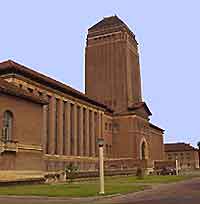 Cambridge University Library |
For the record here, I attended the third best school in Cambridge prior to associations with Downing College Library, Corpus Christi College, and Cambridge University Library. While at CUL, I declined a Ph.D. prospect because of my commitment to a “serious amateur” role that is not assimilable to American sectarian horizons.
One could only expect from the field of Wikipedia-related cultism a tag like that found on Moreno’s primary website: “Kevin Shepherd: The ‘Serious Amateur’ Non-Academic Writer Who Conducts Seriously Amateurish and Biased Research.” Joe overlooked the initials R. D. in that frivolous sentence, but then he did not in this instance need those initials for any purposes of the alleged negative SEO [via his blog network].
32. Further complaint at a Wikipedia User page and Wikimedia Foundation Inc.
My link with Cambridge University Library has been clearly stated in my annotated books since 1983. Joe Moreno failed to mention this factor in his Wikipedia User page of 2006, instead adopting a preference for web media. It is apparent that he had not even read Investigating the Sai Baba Movement. He dismissed all my books on the basis of a Wikipedia quote that included reference to Robert Priddy, whom he regards as an arch-enemy. He has since attributed that quote to my own book. This form of sectarian illiteracy is what can pass muster as expertise in pseudonymous Wikipedia User pages.
I am now in the mood to complain strongly at the situation in which a stigmatising and derisive Wikipedia User page has been transmitted to Google Search on my name listing (Kevin R. D. Shepherd), in a process strongly associated with alleged negative SEO, even though SSS108 (alias Gerald Joe Moreno) has been banned from Wikipedia indefinitely. Where is the follow-up attention to disparities on the part of Wikimedia Foundation Inc.? The latter is a US-registered charity. The protocol of their registered trademark Wikipedia is inadequate according to some observer assessments.
I do here plead that Citizen Initiative has the right to a fair hearing outside (or even within) the Wikipedia circuit currently permitting on Google Search a contested Wikipedia User page emanating from sectarian religious ranks. Furthermore, the varied and dubious sectarian components infiltrating Wikipedia leave me feeling that alternatives to the citizen encyclopaedia are valid, especially in countries outside America.
[Five years later, Jimmy Wales deleted the Moreno User page from Wikipedia files in 2012, following a strong objection to the cult complexion of Wikipedia]
Kevin R. D. Shepherd
November 6th, 2007
Postscript
During the past several days, a further number of questionable postings have appeared on my Google Search name listing. My own entries have been relegated to page two. The questionable postings are strongly associated with Joe Moreno. Submitted several weeks ago, an item posted by Joe108 (Joe Moreno) comprises only five short lines stating:
Kevin R. D. Shepherd is a self-publisher of various controversial topics through Citizen Initiative Publishing. Attempting to portray himself as a serious researcher into the Sai Controversy, Kevin Shepherd wrote a rambling diatribe against Joe Moreno. Moreno responded to Shepherd and exposed him as a shabby and biased researcher.
Observers have noticed the inaccuracies in this digg.com ephemera, including the incorrect version of my publishing logo. Observers do not consider Moreno to have "exposed" me but to have reacted acutely from a sectarian perspective. His more recent attempt to undermine my Google Search name listing includes tagged entries of no effective content, using my name and publishing imprints as tags calculated to draw hostile attention.
One entry that has aroused strong comment is the item on my Google Search name listing which tags my name with "Kevin Shepherd murder." This refers to an actual murder which has nothing to do with me:
Kevin Shepherd murder 8/11/07 Copperton, UT... Kevin Shepherd and Robert Priddy... Find other items tagged with 'kevin-shepherd' at wordpress.com/tag/kevin-shepherd.
[This wordpress.com conflation is analysed more fully in The Joe Moreno Blog and Tag Harassment. The adverse Moreno item Kevin Shepherd and Robert Priddy has constantly surfaced on my Google listing at Kevin R. D. Shepherd since July 2007, being a known sectarian attack blog featuring at sathyasaibaba, a Moreno creation employing the pseudonym of Equalizer. Wordpress.com are in strong contention as a mediator of unmonitored sectarian hostilities, which include the strategy of unidentified tag presence on Google. There have been other Moreno harassments in my direction via wordpress.com. See, e.g., no. 31 above, entitled Blogger judgments and wordpress.com]
Observers have deduced that the multiple blog and tag tactic, under discussion here, amounts to a form of internet harassment. Joe Moreno is clearly attempting to influence uncritical devotees via his websites and blogs and affiliated tagging system. The strong conclusion follows that he is an obsessive internet "hit man" as ex-devotees have been urging.
Kevin R. D. Shepherd
November 10th, 2007 (slightly modified 2020)
The original composition of November 2007 has here been preserved in the Response to Moreno. The sub-headings in red were subsequently added to assist ease of reading and assimilation. Some of the images were also added.